

19 Kryptoracemates
401
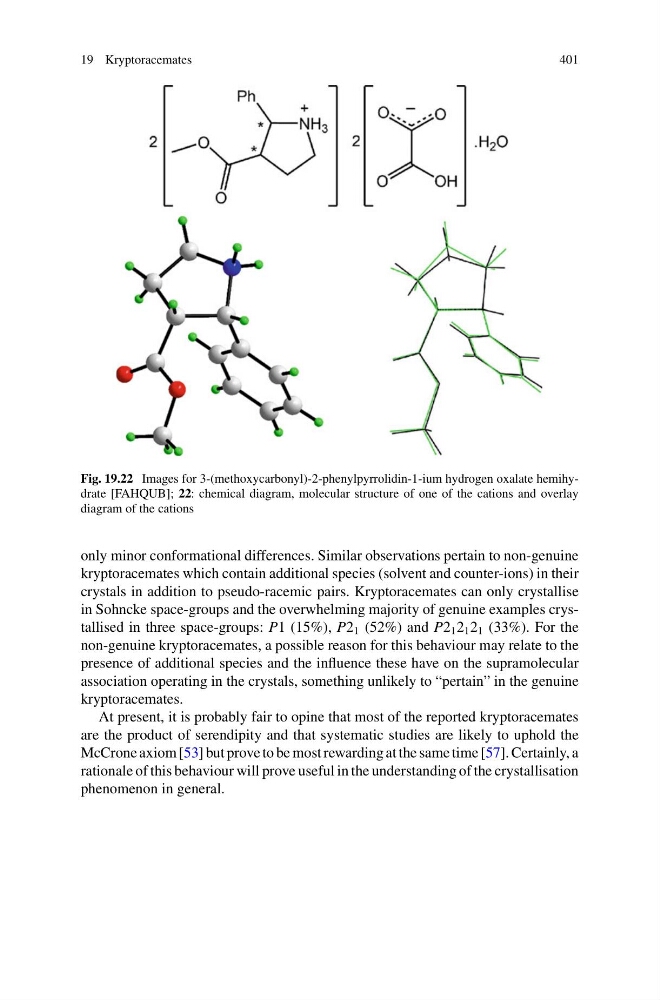
Fig. 19.22 Images for 3-(methoxycarbonyl)-2-phenylpyrrolidin-1-ium hydrogen oxalate hemihydrate [FAHQUB]; 22: chemical diagram, molecular structure of one of the cations and overlay
diagram of the cations
only minor conformational differences. Similar observations pertain to non-genuine
kryptoracemates which contain additional species (solvent and counter-ions) in their
crystals in addition to pseudo-racemic pairs. Kryptoracemates can only crystallise
in Sohncke space-groups and the overwhelming majority of genuine examples crystallised in three space-groups: P1 (15%), P2 1 (52%) and P2 1 2 1 2 1 (33%). For the
non-genuine kryptoracemates, a possible reason for this behaviour may relate to the
presence of additional species and the influence these have on the supramolecular
association operating in the crystals, something unlikely to “pertain” in the genuine
kryptoracemates.
At present, it is probably fair to opine that most of the reported kryptoracemates
are the product of serendipity and that systematic studies are likely to uphold the
McCrone axiom [53] but prove to be most rewarding at the same time [57]. Certainly, a
rationale of this behaviour will prove useful in the understanding of the crystallisation
phenomenon in general.
401
Fig. 19.22 Images for 3-(methoxycarbonyl)-2-phenylpyrrolidin-1-ium hydrogen oxalate hemihydrate [FAHQUB]; 22: chemical diagram, molecular structure of one of the cations and overlay
diagram of the cations
only minor conformational differences. Similar observations pertain to non-genuine
kryptoracemates which contain additional species (solvent and counter-ions) in their
crystals in addition to pseudo-racemic pairs. Kryptoracemates can only crystallise
in Sohncke space-groups and the overwhelming majority of genuine examples crystallised in three space-groups: P1 (15%), P2 1 (52%) and P2 1 2 1 2 1 (33%). For the
non-genuine kryptoracemates, a possible reason for this behaviour may relate to the
presence of additional species and the influence these have on the supramolecular
association operating in the crystals, something unlikely to “pertain” in the genuine
kryptoracemates.
At present, it is probably fair to opine that most of the reported kryptoracemates
are the product of serendipity and that systematic studies are likely to uphold the
McCrone axiom [53] but prove to be most rewarding at the same time [57]. Certainly, a
rationale of this behaviour will prove useful in the understanding of the crystallisation
phenomenon in general.