

19 Kryptoracemates
395
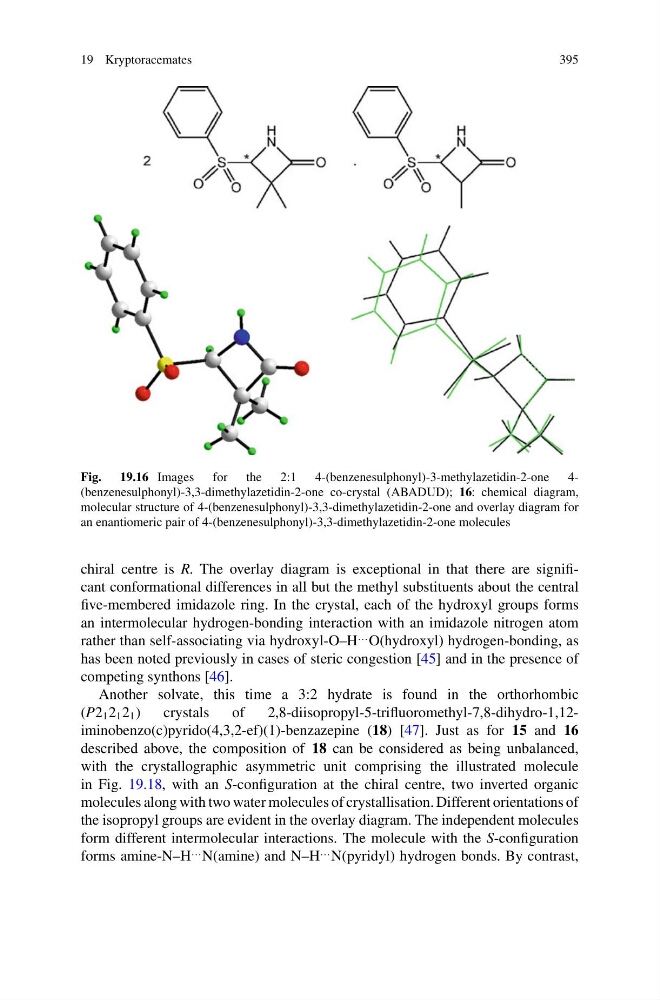
Fig. 19.16 Images for the 2:1 4-(benzenesulphonyl)-3-methylazetidin-2-one 4(benzenesulphonyl)-3,3-dimethylazetidin-2-one co-crystal (ABADUD); 16: chemical diagram,
molecular structure of 4-(benzenesulphonyl)-3,3-dimethylazetidin-2-one and overlay diagram for
an enantiomeric pair of 4-(benzenesulphonyl)-3,3-dimethylazetidin-2-one molecules
chiral centre is R. The overlay diagram is exceptional in that there are significant conformational differences in all but the methyl substituents about the central
five-membered imidazole ring. In the crystal, each of the hydroxyl groups forms
an intermolecular hydrogen-bonding interaction with an imidazole nitrogen atom
rather than self-associating via hydroxyl-O–H
… O(hydroxyl) hydrogen-bonding, as
has been noted previously in cases of steric congestion [45] and in the presence of
competing synthons [46].
Another solvate, this time a 3:2 hydrate is found in the orthorhombic
(P2 1 2 1 2 1 )
crystals
of
2,8-diisopropyl-5-trifluoromethyl-7,8-dihydro-1,12iminobenzo(c)pyrido(4,3,2-ef)(1)-benzazepine (18) [47]. Just as for 15 and 16
described above, the composition of 18 can be considered as being unbalanced,
with the crystallographic asymmetric unit comprising the illustrated molecule
in Fig. 19.18, with an S-configuration at the chiral centre, two inverted organic
molecules along with two water molecules of crystallisation. Different orientations of
the isopropyl groups are evident in the overlay diagram. The independent molecules
form different intermolecular interactions. The molecule with the S-configuration
forms amine-N–H
… N(amine) and N–H
… N(pyridyl) hydrogen bonds. By contrast,
395
Fig. 19.16 Images for the 2:1 4-(benzenesulphonyl)-3-methylazetidin-2-one 4(benzenesulphonyl)-3,3-dimethylazetidin-2-one co-crystal (ABADUD); 16: chemical diagram,
molecular structure of 4-(benzenesulphonyl)-3,3-dimethylazetidin-2-one and overlay diagram for
an enantiomeric pair of 4-(benzenesulphonyl)-3,3-dimethylazetidin-2-one molecules
chiral centre is R. The overlay diagram is exceptional in that there are significant conformational differences in all but the methyl substituents about the central
five-membered imidazole ring. In the crystal, each of the hydroxyl groups forms
an intermolecular hydrogen-bonding interaction with an imidazole nitrogen atom
rather than self-associating via hydroxyl-O–H
… O(hydroxyl) hydrogen-bonding, as
has been noted previously in cases of steric congestion [45] and in the presence of
competing synthons [46].
Another solvate, this time a 3:2 hydrate is found in the orthorhombic
(P2 1 2 1 2 1 )
crystals
of
2,8-diisopropyl-5-trifluoromethyl-7,8-dihydro-1,12iminobenzo(c)pyrido(4,3,2-ef)(1)-benzazepine (18) [47]. Just as for 15 and 16
described above, the composition of 18 can be considered as being unbalanced,
with the crystallographic asymmetric unit comprising the illustrated molecule
in Fig. 19.18, with an S-configuration at the chiral centre, two inverted organic
molecules along with two water molecules of crystallisation. Different orientations of
the isopropyl groups are evident in the overlay diagram. The independent molecules
form different intermolecular interactions. The molecule with the S-configuration
forms amine-N–H
… N(amine) and N–H
… N(pyridyl) hydrogen bonds. By contrast,