

394
E. R. T. Tiekink
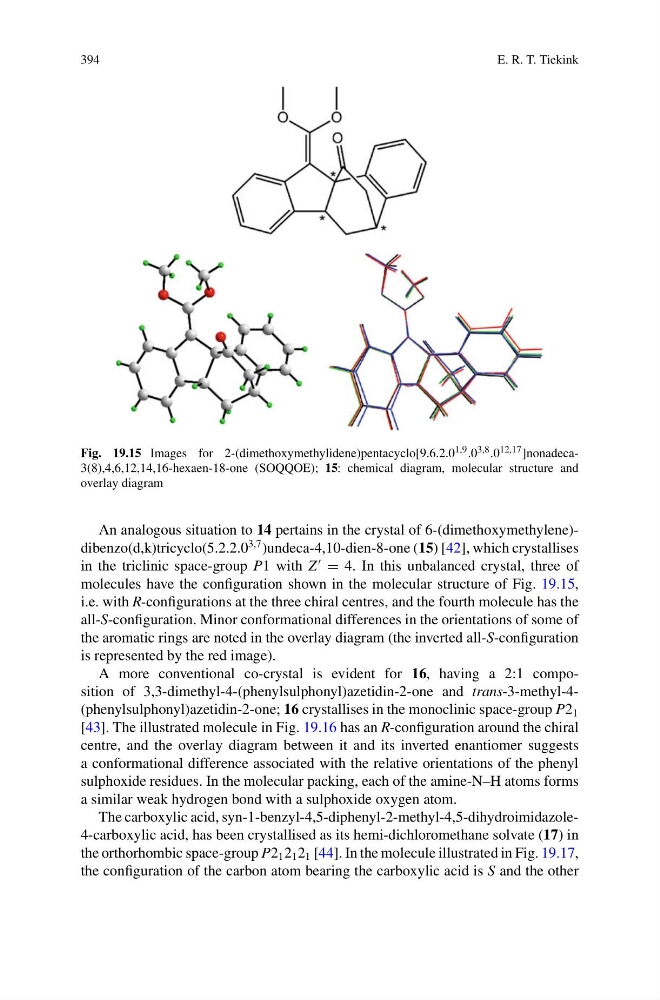
Fig. 19.15 Images for 2-(dimethoxymethylidene)pentacyclo[9.6.2.0 1,9 .0 3,8 .0 12,17 ]nonadeca3(8),4,6,12,14,16-hexaen-18-one (SOQQOE); 15: chemical diagram, molecular structure and
overlay diagram
An analogous situation to 14 pertains in the crystal of 6-(dimethoxymethylene)dibenzo(d,k)tricyclo(5.2.2.0
3,7 )undeca-4,10-dien-8-one (15) [42], which crystallises
in the triclinic space-group P1 with Z
= 4. In this unbalanced crystal, three of
molecules have the configuration shown in the molecular structure of Fig. 19.15,
i.e. with R-configurations at the three chiral centres, and the fourth molecule has the
all-S-configuration. Minor conformational differences in the orientations of some of
the aromatic rings are noted in the overlay diagram (the inverted all-S-configuration
is represented by the red image).
A more conventional co-crystal is evident for 16, having a 2:1 composition of 3,3-dimethyl-4-(phenylsulphonyl)azetidin-2-one and trans-3-methyl-4(phenylsulphonyl)azetidin-2-one; 16 crystallises in the monoclinic space-group P2 1
[43]. The illustrated molecule in Fig. 19.16 has an R-configuration around the chiral
centre, and the overlay diagram between it and its inverted enantiomer suggests
a conformational difference associated with the relative orientations of the phenyl
sulphoxide residues. In the molecular packing, each of the amine-N–H atoms forms
a similar weak hydrogen bond with a sulphoxide oxygen atom.
The carboxylic acid, syn-1-benzyl-4,5-diphenyl-2-methyl-4,5-dihydroimidazole4-carboxylic acid, has been crystallised as its hemi-dichloromethane solvate (17) in
the orthorhombic space-group P2 1 2 1 2 1 [44]. In the molecule illustrated in Fig. 19.17,
the configuration of the carbon atom bearing the carboxylic acid is S and the other
E. R. T. Tiekink
Fig. 19.15 Images for 2-(dimethoxymethylidene)pentacyclo[9.6.2.0 1,9 .0 3,8 .0 12,17 ]nonadeca3(8),4,6,12,14,16-hexaen-18-one (SOQQOE); 15: chemical diagram, molecular structure and
overlay diagram
An analogous situation to 14 pertains in the crystal of 6-(dimethoxymethylene)dibenzo(d,k)tricyclo(5.2.2.0
3,7 )undeca-4,10-dien-8-one (15) [42], which crystallises
in the triclinic space-group P1 with Z
= 4. In this unbalanced crystal, three of
molecules have the configuration shown in the molecular structure of Fig. 19.15,
i.e. with R-configurations at the three chiral centres, and the fourth molecule has the
all-S-configuration. Minor conformational differences in the orientations of some of
the aromatic rings are noted in the overlay diagram (the inverted all-S-configuration
is represented by the red image).
A more conventional co-crystal is evident for 16, having a 2:1 composition of 3,3-dimethyl-4-(phenylsulphonyl)azetidin-2-one and trans-3-methyl-4(phenylsulphonyl)azetidin-2-one; 16 crystallises in the monoclinic space-group P2 1
[43]. The illustrated molecule in Fig. 19.16 has an R-configuration around the chiral
centre, and the overlay diagram between it and its inverted enantiomer suggests
a conformational difference associated with the relative orientations of the phenyl
sulphoxide residues. In the molecular packing, each of the amine-N–H atoms forms
a similar weak hydrogen bond with a sulphoxide oxygen atom.
The carboxylic acid, syn-1-benzyl-4,5-diphenyl-2-methyl-4,5-dihydroimidazole4-carboxylic acid, has been crystallised as its hemi-dichloromethane solvate (17) in
the orthorhombic space-group P2 1 2 1 2 1 [44]. In the molecule illustrated in Fig. 19.17,
the configuration of the carbon atom bearing the carboxylic acid is S and the other