

368
M. Funahashi
revealed a dichroic ratio of 5. This uniaxiality was retained during the acid-vaporinitialized polymerization, decreasing the dichroic ratio in the polarized absorption
spectra to 3.
18.4 Nanosegregated Liquid Crystals with Electrochemical
Functions
18.4.1 Liquid Crystalline Perylene Bisimide Hybridized
with Lithium Salt
For electrochemical applications of nanosegregated liquid crystals, ion-conductive
channels should be constructed in the liquid crystalline on the nanometer scale. In
general, electrochemically active π-conjugated units and ionic moieties decrease the
solubilities in organic solvents and raise up the phase transition temperatures, due
to strong π –π and electrostatic interactions. Oligosiloxane moieties are effective to
increase solubilities in organic solvents and suppress crystallization.
Oligoethylene oxide derivatives have been used for solid electrolytes because
of lone pairs of oxygen atoms coordinating to metal cations. Perylene bisimide
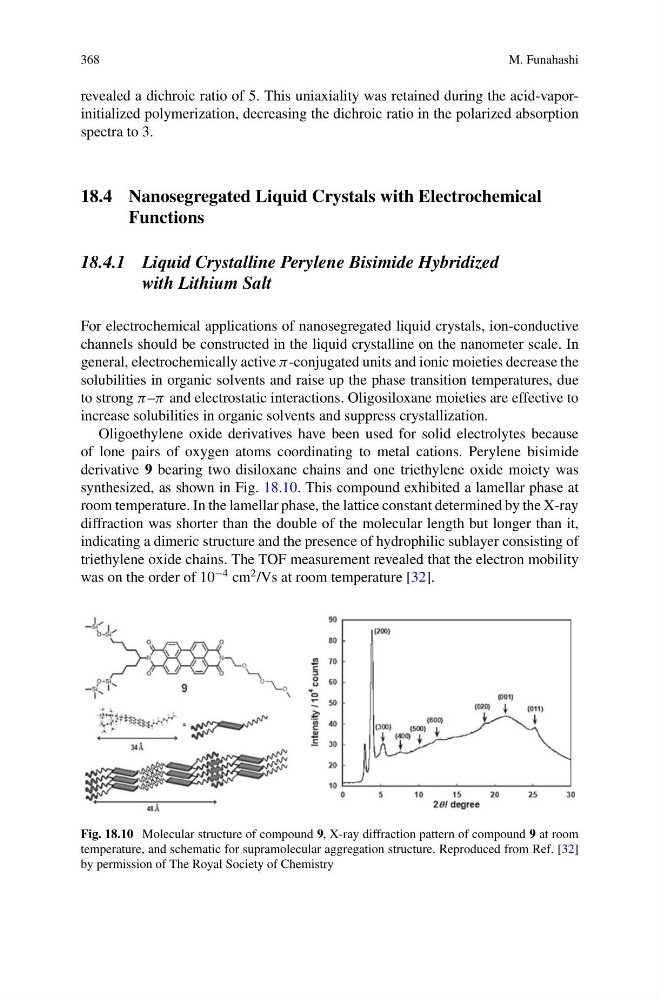
derivative 9 bearing two disiloxane chains and one triethylene oxide moiety was
synthesized, as shown in Fig. 18.10. This compound exhibited a lamellar phase at
room temperature. In the lamellar phase, the lattice constant determined by the X-ray
diffraction was shorter than the double of the molecular length but longer than it,
indicating a dimeric structure and the presence of hydrophilic sublayer consisting of
triethylene oxide chains. The TOF measurement revealed that the electron mobility
was on the order of 10
−4 cm
2 /Vs at room temperature [32].
Fig. 18.10 Molecular structure of compound 9, X-ray diffraction pattern of compound 9 at room
temperature, and schematic for supramolecular aggregation structure. Reproduced from Ref. [32]
by permission of The Royal Society of Chemistry
M. Funahashi
revealed a dichroic ratio of 5. This uniaxiality was retained during the acid-vaporinitialized polymerization, decreasing the dichroic ratio in the polarized absorption
spectra to 3.
18.4 Nanosegregated Liquid Crystals with Electrochemical
Functions
18.4.1 Liquid Crystalline Perylene Bisimide Hybridized
with Lithium Salt
For electrochemical applications of nanosegregated liquid crystals, ion-conductive
channels should be constructed in the liquid crystalline on the nanometer scale. In
general, electrochemically active π-conjugated units and ionic moieties decrease the
solubilities in organic solvents and raise up the phase transition temperatures, due
to strong π –π and electrostatic interactions. Oligosiloxane moieties are effective to
increase solubilities in organic solvents and suppress crystallization.
Oligoethylene oxide derivatives have been used for solid electrolytes because
of lone pairs of oxygen atoms coordinating to metal cations. Perylene bisimide
derivative 9 bearing two disiloxane chains and one triethylene oxide moiety was
synthesized, as shown in Fig. 18.10. This compound exhibited a lamellar phase at
room temperature. In the lamellar phase, the lattice constant determined by the X-ray
diffraction was shorter than the double of the molecular length but longer than it,
indicating a dimeric structure and the presence of hydrophilic sublayer consisting of
triethylene oxide chains. The TOF measurement revealed that the electron mobility
was on the order of 10
−4 cm
2 /Vs at room temperature [32].
Fig. 18.10 Molecular structure of compound 9, X-ray diffraction pattern of compound 9 at room
temperature, and schematic for supramolecular aggregation structure. Reproduced from Ref. [32]
by permission of The Royal Society of Chemistry