

18 Electrochemical Functions of Nanostructured Liquid Crystals …
369
This compound retained the LC phase when 3 mol% of lithium triflate was doped.
Lithium triflate should be absorbed in the hydrophilic sublayers consisting of triethylene oxide chains. The electron mobility did not change in the doped samples. This
result indicated that the doped lithium and triflate ions should be adsorbed in the
hydrophilic sublayers and separated from the electron transport layers consisting of
electroactive perylene bisimide units.
18.4.2 Polymerizable Liquid Crystalline Mixed Conductor
In the usage of electrochemical application such as supercapacitors, butteries, and
electrochromic devices, electrochemically active materials are operated in electrolyte
solutions. Therefore, it is indispensable to insolubilize the thin films, retaining
the nanosegregated structures formed in the as-deposited thin films. The cyclotetrasiloxane moiety is not only polymerizable but also promotes nanosegregation.
Perylene bisimide derivatives have been known as n-type semiconductors and
redox-active materials. However, electrochromism of the monomeric and polymeric
derivatives have unexpectedly been limited, perhaps because of difficulties in fabrication of homogeneous thin films which are durable in organic solvents. Polymers
containing perylene bisimide units in their backbones indicated electrochromism in
electrolyte solution [33].
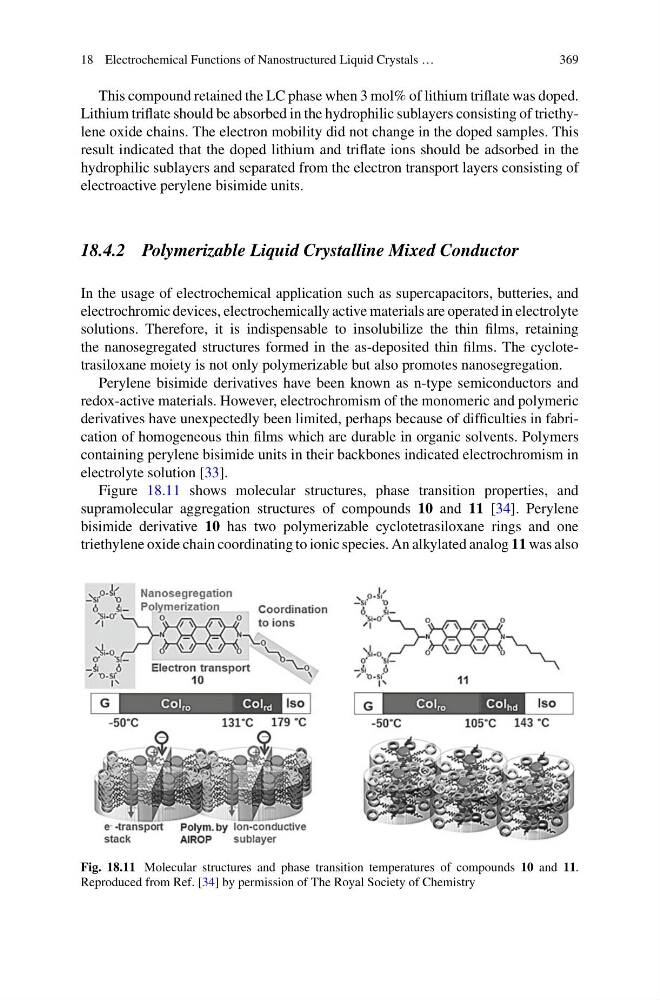
Figure 18.11 shows molecular structures, phase transition properties, and
supramolecular aggregation structures of compounds 10 and 11 [34]. Perylene
bisimide derivative 10 has two polymerizable cyclotetrasiloxane rings and one
triethylene oxide chain coordinating to ionic species. An alkylated analog 11 was also
Fig. 18.11 Molecular structures and phase transition temperatures of compounds 10 and 11.
Reproduced from Ref. [34] by permission of The Royal Society of Chemistry
369
This compound retained the LC phase when 3 mol% of lithium triflate was doped.
Lithium triflate should be absorbed in the hydrophilic sublayers consisting of triethylene oxide chains. The electron mobility did not change in the doped samples. This
result indicated that the doped lithium and triflate ions should be adsorbed in the
hydrophilic sublayers and separated from the electron transport layers consisting of
electroactive perylene bisimide units.
18.4.2 Polymerizable Liquid Crystalline Mixed Conductor
In the usage of electrochemical application such as supercapacitors, butteries, and
electrochromic devices, electrochemically active materials are operated in electrolyte
solutions. Therefore, it is indispensable to insolubilize the thin films, retaining
the nanosegregated structures formed in the as-deposited thin films. The cyclotetrasiloxane moiety is not only polymerizable but also promotes nanosegregation.
Perylene bisimide derivatives have been known as n-type semiconductors and
redox-active materials. However, electrochromism of the monomeric and polymeric
derivatives have unexpectedly been limited, perhaps because of difficulties in fabrication of homogeneous thin films which are durable in organic solvents. Polymers
containing perylene bisimide units in their backbones indicated electrochromism in
electrolyte solution [33].
Figure 18.11 shows molecular structures, phase transition properties, and
supramolecular aggregation structures of compounds 10 and 11 [34]. Perylene
bisimide derivative 10 has two polymerizable cyclotetrasiloxane rings and one
triethylene oxide chain coordinating to ionic species. An alkylated analog 11 was also
Fig. 18.11 Molecular structures and phase transition temperatures of compounds 10 and 11.
Reproduced from Ref. [34] by permission of The Royal Society of Chemistry