

18 Electrochemical Functions of Nanostructured Liquid Crystals …
367
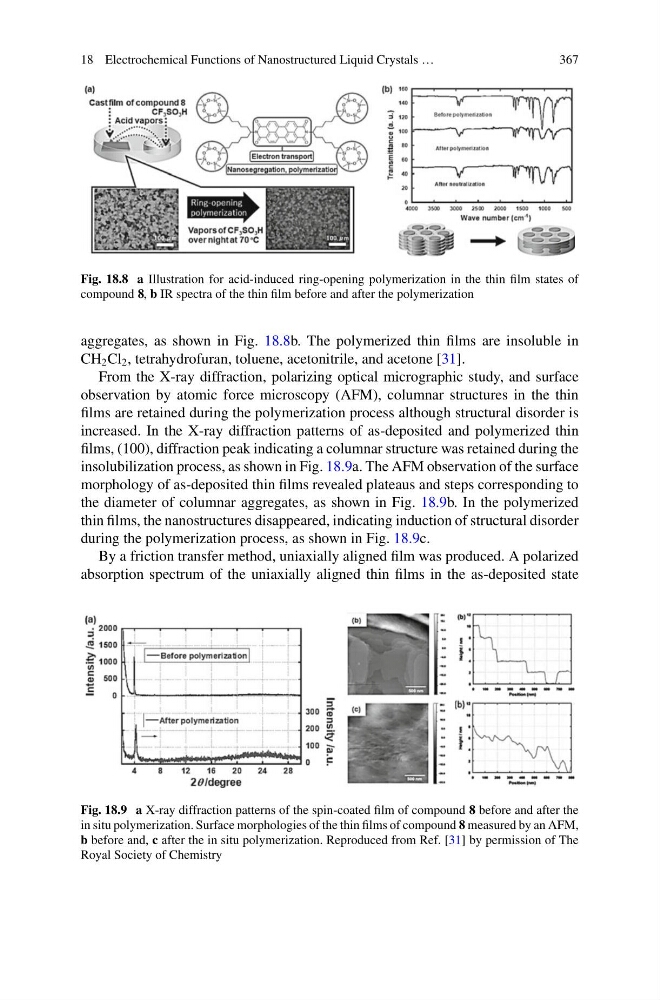
Fig. 18.8 a Illustration for acid-induced ring-opening polymerization in the thin film states of
compound 8, b IR spectra of the thin film before and after the polymerization
aggregates, as shown in Fig. 18.8b. The polymerized thin films are insoluble in
CH 2 Cl 2 , tetrahydrofuran, toluene, acetonitrile, and acetone [31].
From the X-ray diffraction, polarizing optical micrographic study, and surface
observation by atomic force microscopy (AFM), columnar structures in the thin
films are retained during the polymerization process although structural disorder is
increased. In the X-ray diffraction patterns of as-deposited and polymerized thin
films, (100), diffraction peak indicating a columnar structure was retained during the
insolubilization process, as shown in Fig. 18.9a. The AFM observation of the surface
morphology of as-deposited thin films revealed plateaus and steps corresponding to
the diameter of columnar aggregates, as shown in Fig. 18.9b. In the polymerized
thin films, the nanostructures disappeared, indicating induction of structural disorder
during the polymerization process, as shown in Fig. 18.9c.
By a friction transfer method, uniaxially aligned film was produced. A polarized
absorption spectrum of the uniaxially aligned thin films in the as-deposited state
Fig. 18.9 a X-ray diffraction patterns of the spin-coated film of compound 8 before and after the
in situ polymerization. Surface morphologies of the thin films of compound 8 measured by an AFM,
b before and, c after the in situ polymerization. Reproduced from Ref. [31] by permission of The
Royal Society of Chemistry
367
Fig. 18.8 a Illustration for acid-induced ring-opening polymerization in the thin film states of
compound 8, b IR spectra of the thin film before and after the polymerization
aggregates, as shown in Fig. 18.8b. The polymerized thin films are insoluble in
CH 2 Cl 2 , tetrahydrofuran, toluene, acetonitrile, and acetone [31].
From the X-ray diffraction, polarizing optical micrographic study, and surface
observation by atomic force microscopy (AFM), columnar structures in the thin
films are retained during the polymerization process although structural disorder is
increased. In the X-ray diffraction patterns of as-deposited and polymerized thin
films, (100), diffraction peak indicating a columnar structure was retained during the
insolubilization process, as shown in Fig. 18.9a. The AFM observation of the surface
morphology of as-deposited thin films revealed plateaus and steps corresponding to
the diameter of columnar aggregates, as shown in Fig. 18.9b. In the polymerized
thin films, the nanostructures disappeared, indicating induction of structural disorder
during the polymerization process, as shown in Fig. 18.9c.
By a friction transfer method, uniaxially aligned film was produced. A polarized
absorption spectrum of the uniaxially aligned thin films in the as-deposited state
Fig. 18.9 a X-ray diffraction patterns of the spin-coated film of compound 8 before and after the
in situ polymerization. Surface morphologies of the thin films of compound 8 measured by an AFM,
b before and, c after the in situ polymerization. Reproduced from Ref. [31] by permission of The
Royal Society of Chemistry