

354
H. Katagiri
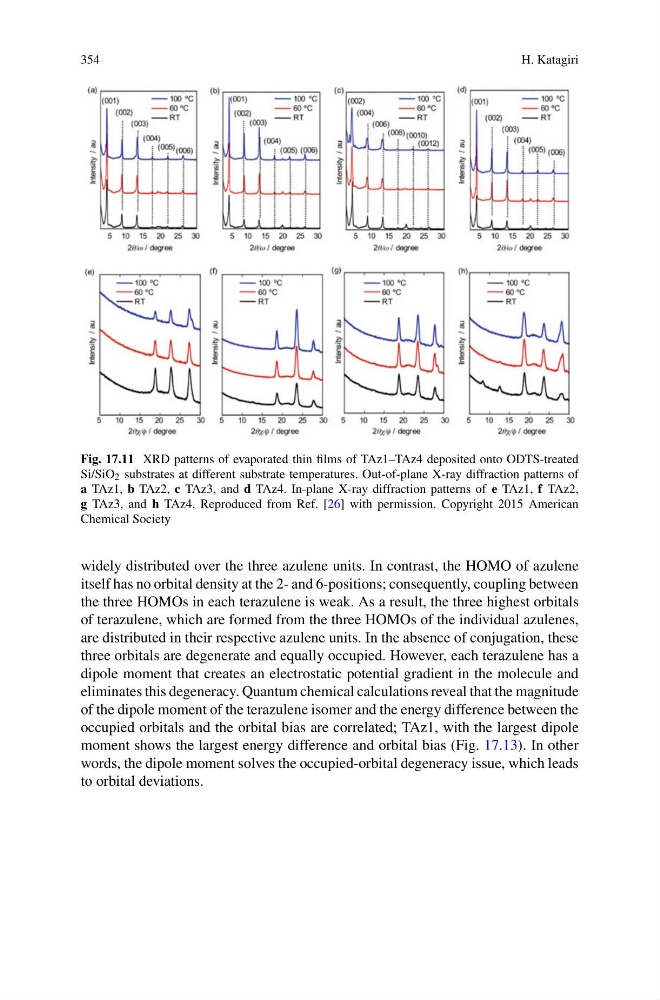
Fig. 17.11 XRD patterns of evaporated thin films of TAz1–TAz4 deposited onto ODTS-treated
Si/SiO 2 substrates at different substrate temperatures. Out-of-plane X-ray diffraction patterns of
a TAz1, b TAz2, c TAz3, and d TAz4. In-plane X-ray diffraction patterns of e TAz1, f TAz2,
g TAz3, and h TAz4. Reproduced from Ref. [26] with permission. Copyright 2015 American
Chemical Society
widely distributed over the three azulene units. In contrast, the HOMO of azulene
itself has no orbital density at the 2- and 6-positions; consequently, coupling between
the three HOMOs in each terazulene is weak. As a result, the three highest orbitals
of terazulene, which are formed from the three HOMOs of the individual azulenes,
are distributed in their respective azulene units. In the absence of conjugation, these
three orbitals are degenerate and equally occupied. However, each terazulene has a
dipole moment that creates an electrostatic potential gradient in the molecule and
eliminates this degeneracy. Quantum chemical calculations reveal that the magnitude
of the dipole moment of the terazulene isomer and the energy difference between the
occupied orbitals and the orbital bias are correlated; TAz1, with the largest dipole
moment shows the largest energy difference and orbital bias (Fig. 17.13). In other
words, the dipole moment solves the occupied-orbital degeneracy issue, which leads
to orbital deviations.
H. Katagiri
Fig. 17.11 XRD patterns of evaporated thin films of TAz1–TAz4 deposited onto ODTS-treated
Si/SiO 2 substrates at different substrate temperatures. Out-of-plane X-ray diffraction patterns of
a TAz1, b TAz2, c TAz3, and d TAz4. In-plane X-ray diffraction patterns of e TAz1, f TAz2,
g TAz3, and h TAz4. Reproduced from Ref. [26] with permission. Copyright 2015 American
Chemical Society
widely distributed over the three azulene units. In contrast, the HOMO of azulene
itself has no orbital density at the 2- and 6-positions; consequently, coupling between
the three HOMOs in each terazulene is weak. As a result, the three highest orbitals
of terazulene, which are formed from the three HOMOs of the individual azulenes,
are distributed in their respective azulene units. In the absence of conjugation, these
three orbitals are degenerate and equally occupied. However, each terazulene has a
dipole moment that creates an electrostatic potential gradient in the molecule and
eliminates this degeneracy. Quantum chemical calculations reveal that the magnitude
of the dipole moment of the terazulene isomer and the energy difference between the
occupied orbitals and the orbital bias are correlated; TAz1, with the largest dipole
moment shows the largest energy difference and orbital bias (Fig. 17.13). In other
words, the dipole moment solves the occupied-orbital degeneracy issue, which leads
to orbital deviations.