

17 Azulene-Based Materials for Organic Field-Effect Transistors
353
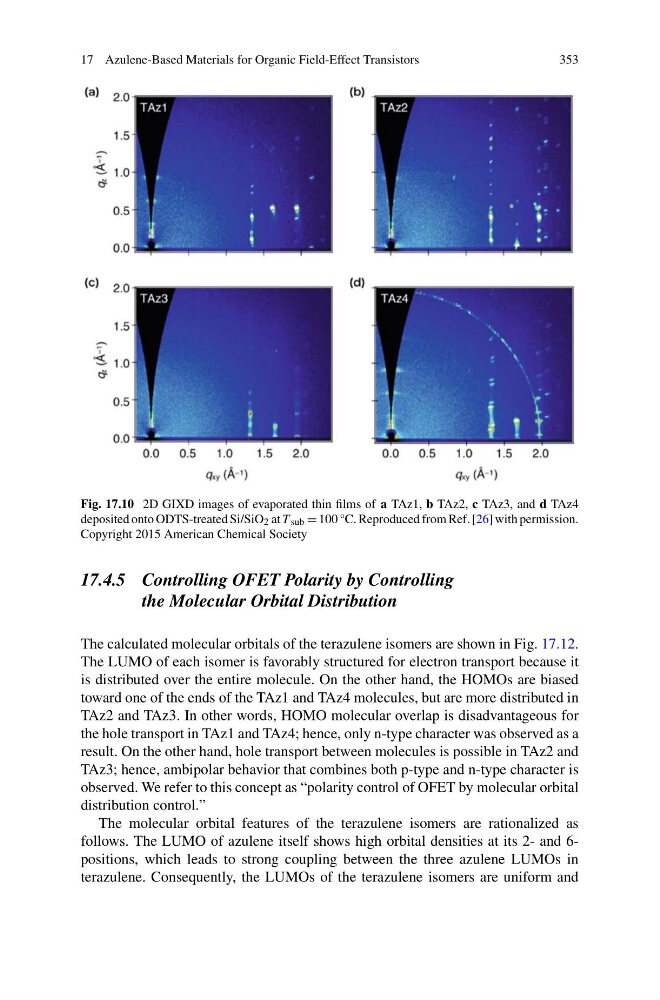
Fig. 17.10 2D GIXD images of evaporated thin films of a TAz1, b TAz2, c TAz3, and d TAz4
deposited onto ODTS-treated Si/SiO 2 at T sub = 100 °C. Reproduced from Ref. [26] with permission.
Copyright 2015 American Chemical Society
17.4.5 Controlling OFET Polarity by Controlling
the Molecular Orbital Distribution
The calculated molecular orbitals of the terazulene isomers are shown in Fig. 17.12.
The LUMO of each isomer is favorably structured for electron transport because it
is distributed over the entire molecule. On the other hand, the HOMOs are biased
toward one of the ends of the TAz1 and TAz4 molecules, but are more distributed in
TAz2 and TAz3. In other words, HOMO molecular overlap is disadvantageous for
the hole transport in TAz1 and TAz4; hence, only n-type character was observed as a
result. On the other hand, hole transport between molecules is possible in TAz2 and
TAz3; hence, ambipolar behavior that combines both p-type and n-type character is
observed. We refer to this concept as “polarity control of OFET by molecular orbital
distribution control.”
The molecular orbital features of the terazulene isomers are rationalized as
follows. The LUMO of azulene itself shows high orbital densities at its 2- and 6positions, which leads to strong coupling between the three azulene LUMOs in
terazulene. Consequently, the LUMOs of the terazulene isomers are uniform and
353
Fig. 17.10 2D GIXD images of evaporated thin films of a TAz1, b TAz2, c TAz3, and d TAz4
deposited onto ODTS-treated Si/SiO 2 at T sub = 100 °C. Reproduced from Ref. [26] with permission.
Copyright 2015 American Chemical Society
17.4.5 Controlling OFET Polarity by Controlling
the Molecular Orbital Distribution
The calculated molecular orbitals of the terazulene isomers are shown in Fig. 17.12.
The LUMO of each isomer is favorably structured for electron transport because it
is distributed over the entire molecule. On the other hand, the HOMOs are biased
toward one of the ends of the TAz1 and TAz4 molecules, but are more distributed in
TAz2 and TAz3. In other words, HOMO molecular overlap is disadvantageous for
the hole transport in TAz1 and TAz4; hence, only n-type character was observed as a
result. On the other hand, hole transport between molecules is possible in TAz2 and
TAz3; hence, ambipolar behavior that combines both p-type and n-type character is
observed. We refer to this concept as “polarity control of OFET by molecular orbital
distribution control.”
The molecular orbital features of the terazulene isomers are rationalized as
follows. The LUMO of azulene itself shows high orbital densities at its 2- and 6positions, which leads to strong coupling between the three azulene LUMOs in
terazulene. Consequently, the LUMOs of the terazulene isomers are uniform and