

17 Azulene-Based Materials for Organic Field-Effect Transistors
355
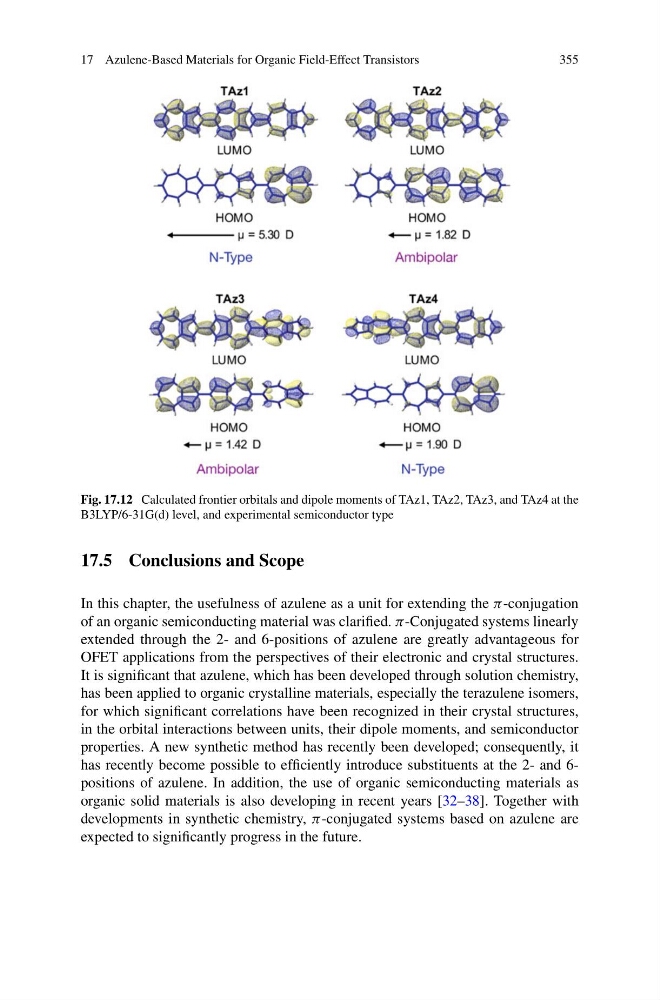
Fig. 17.12 Calculated frontier orbitals and dipole moments of TAz1, TAz2, TAz3, and TAz4 at the
B3LYP/6-31G(d) level, and experimental semiconductor type
17.5 Conclusions and Scope
In this chapter, the usefulness of azulene as a unit for extending the π-conjugation
of an organic semiconducting material was clarified. π-Conjugated systems linearly
extended through the 2- and 6-positions of azulene are greatly advantageous for
OFET applications from the perspectives of their electronic and crystal structures.
It is significant that azulene, which has been developed through solution chemistry,
has been applied to organic crystalline materials, especially the terazulene isomers,
for which significant correlations have been recognized in their crystal structures,
in the orbital interactions between units, their dipole moments, and semiconductor
properties. A new synthetic method has recently been developed; consequently, it
has recently become possible to efficiently introduce substituents at the 2- and 6positions of azulene. In addition, the use of organic semiconducting materials as
organic solid materials is also developing in recent years [32–38]. Together with
developments in synthetic chemistry, π-conjugated systems based on azulene are
expected to significantly progress in the future.
355
Fig. 17.12 Calculated frontier orbitals and dipole moments of TAz1, TAz2, TAz3, and TAz4 at the
B3LYP/6-31G(d) level, and experimental semiconductor type
17.5 Conclusions and Scope
In this chapter, the usefulness of azulene as a unit for extending the π-conjugation
of an organic semiconducting material was clarified. π-Conjugated systems linearly
extended through the 2- and 6-positions of azulene are greatly advantageous for
OFET applications from the perspectives of their electronic and crystal structures.
It is significant that azulene, which has been developed through solution chemistry,
has been applied to organic crystalline materials, especially the terazulene isomers,
for which significant correlations have been recognized in their crystal structures,
in the orbital interactions between units, their dipole moments, and semiconductor
properties. A new synthetic method has recently been developed; consequently, it
has recently become possible to efficiently introduce substituents at the 2- and 6positions of azulene. In addition, the use of organic semiconducting materials as
organic solid materials is also developing in recent years [32–38]. Together with
developments in synthetic chemistry, π-conjugated systems based on azulene are
expected to significantly progress in the future.