

16 Circularly Polarized Luminescence …
335
(a)
(b)
-10
-5
0
5
10
300
400
500
600
700
800
CD / mdeg
Wavelength / nm
(R,R)-1-BNP/PMMA
(R,R)-2-BNP/PMMA
300
400
500
600
700
800
-10
-5
0
5
10
CPL / mdeg
Wavelength / nm
(R,R)-2-BNP/PMMA
(R,R)-1-BNP/PMMA
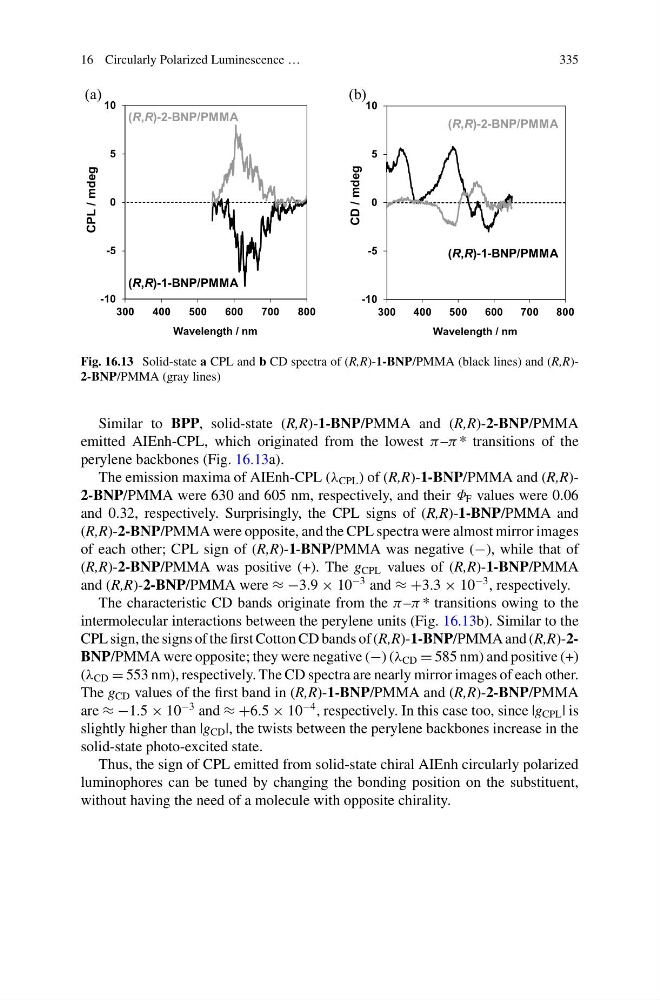
Fig. 16.13 Solid-state a CPL and b CD spectra of (R,R)-1-BNP/PMMA (black lines) and (R,R)2-BNP/PMMA (gray lines)
Similar to BPP, solid-state (R,R)-1-BNP/PMMA and (R,R)-2-BNP/PMMA
emitted AIEnh-CPL, which originated from the lowest π –π * transitions of the
perylene backbones (Fig. 16.13a).
The emission maxima of AIEnh-CPL (λ CPL ) of (R,R)-1-BNP/PMMA and (R,R)2-BNP/PMMA were 630 and 605 nm, respectively, and their F F values were 0.06
and 0.32, respectively. Surprisingly, the CPL signs of (R,R)-1-BNP/PMMA and
(R,R)-2-BNP/PMMA were opposite, and the CPL spectra were almost mirror images
of each other; CPL sign of (R,R)-1-BNP/PMMA was negative (−), while that of
(R,R)-2-BNP/PMMA was positive (+). The g CPL values of (R,R)-1-BNP/PMMA
and (R,R)-2-BNP/PMMA were ≈ −3.9 × 10
−3 and ≈ +3.3 × 10
−3 , respectively.
The characteristic CD bands originate from the π –π * transitions owing to the
intermolecular interactions between the perylene units (Fig. 16.13b). Similar to the
CPL sign, the signs of the first Cotton CD bands of (R,R)-1-BNP/PMMA and (R,R)-2BNP/PMMA were opposite; they were negative (−) (λ CD = 585 nm) and positive (+)
(λ CD = 553 nm), respectively. The CD spectra are nearly mirror images of each other.
The g CD values of the first band in (R,R)-1-BNP/PMMA and (R,R)-2-BNP/PMMA
are ≈ −1.5 × 10
−3 and ≈ +6.5 × 10
−4 , respectively. In this case too, since |g CPL | is
slightly higher than |g CD |, the twists between the perylene backbones increase in the
solid-state photo-excited state.
Thus, the sign of CPL emitted from solid-state chiral AIEnh circularly polarized
luminophores can be tuned by changing the bonding position on the substituent,
without having the need of a molecule with opposite chirality.
335
(a)
(b)
-10
-5
0
5
10
300
400
500
600
700
800
CD / mdeg
Wavelength / nm
(R,R)-1-BNP/PMMA
(R,R)-2-BNP/PMMA
300
400
500
600
700
800
-10
-5
0
5
10
CPL / mdeg
Wavelength / nm
(R,R)-2-BNP/PMMA
(R,R)-1-BNP/PMMA
Fig. 16.13 Solid-state a CPL and b CD spectra of (R,R)-1-BNP/PMMA (black lines) and (R,R)2-BNP/PMMA (gray lines)
Similar to BPP, solid-state (R,R)-1-BNP/PMMA and (R,R)-2-BNP/PMMA
emitted AIEnh-CPL, which originated from the lowest π –π * transitions of the
perylene backbones (Fig. 16.13a).
The emission maxima of AIEnh-CPL (λ CPL ) of (R,R)-1-BNP/PMMA and (R,R)2-BNP/PMMA were 630 and 605 nm, respectively, and their F F values were 0.06
and 0.32, respectively. Surprisingly, the CPL signs of (R,R)-1-BNP/PMMA and
(R,R)-2-BNP/PMMA were opposite, and the CPL spectra were almost mirror images
of each other; CPL sign of (R,R)-1-BNP/PMMA was negative (−), while that of
(R,R)-2-BNP/PMMA was positive (+). The g CPL values of (R,R)-1-BNP/PMMA
and (R,R)-2-BNP/PMMA were ≈ −3.9 × 10
−3 and ≈ +3.3 × 10
−3 , respectively.
The characteristic CD bands originate from the π –π * transitions owing to the
intermolecular interactions between the perylene units (Fig. 16.13b). Similar to the
CPL sign, the signs of the first Cotton CD bands of (R,R)-1-BNP/PMMA and (R,R)-2BNP/PMMA were opposite; they were negative (−) (λ CD = 585 nm) and positive (+)
(λ CD = 553 nm), respectively. The CD spectra are nearly mirror images of each other.
The g CD values of the first band in (R,R)-1-BNP/PMMA and (R,R)-2-BNP/PMMA
are ≈ −1.5 × 10
−3 and ≈ +6.5 × 10
−4 , respectively. In this case too, since |g CPL | is
slightly higher than |g CD |, the twists between the perylene backbones increase in the
solid-state photo-excited state.
Thus, the sign of CPL emitted from solid-state chiral AIEnh circularly polarized
luminophores can be tuned by changing the bonding position on the substituent,
without having the need of a molecule with opposite chirality.