

336
Y. Imai
16.8 Non-classical Control of CPL in Solid-State
Supramolecular Organic Luminophore Composed
of 4-(2-Arylethynyl)-Benzoic Acid [17]
Most chiral organic luminophores exhibiting solid-state fluorescence are composed
of a single component. Chiral supramolecular organic luminophores containing
two organic molecules have different functionalities compared with luminophores
containing a single molecule. A key property of chiral supramolecular luminophores
is that their solid-state chiroptical properties can be easily altered by varying the
component molecules. Effective functionalities due to the synergistic effects of
packing and the properties of the component molecules can be obtained.
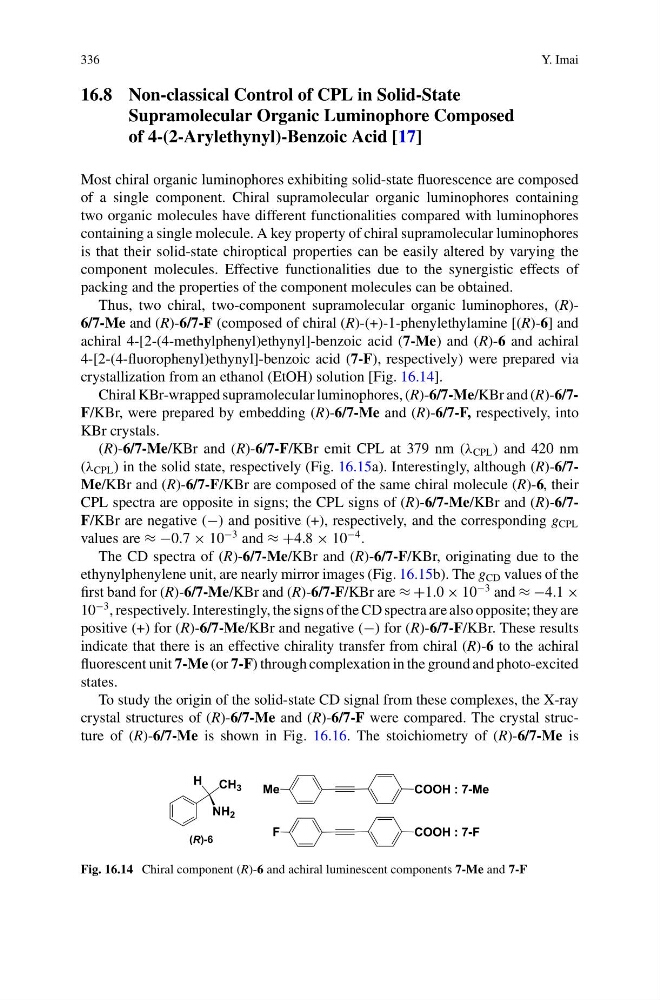
Thus, two chiral, two-component supramolecular organic luminophores, (R)6/7-Me and (R)-6/7-F (composed of chiral (R)-(+)-1-phenylethylamine [(R)-6] and
achiral 4-[2-(4-methylphenyl)ethynyl]-benzoic acid (7-Me) and (R)-6 and achiral
4-[2-(4-fluorophenyl)ethynyl]-benzoic acid (7-F), respectively) were prepared via
crystallization from an ethanol (EtOH) solution [Fig. 16.14].
Chiral KBr-wrapped supramolecular luminophores, (R)-6/7-Me/KBr and (R)-6/7F/KBr, were prepared by embedding (R)-6/7-Me and (R)-6/7-F, respectively, into
KBr crystals.
(R)-6/7-Me/KBr and (R)-6/7-F/KBr emit CPL at 379 nm (λ CPL ) and 420 nm
(λ CPL ) in the solid state, respectively (Fig. 16.15a). Interestingly, although (R)-6/7Me/KBr and (R)-6/7-F/KBr are composed of the same chiral molecule (R)-6, their
CPL spectra are opposite in signs; the CPL signs of (R)-6/7-Me/KBr and (R)-6/7F/KBr are negative (−) and positive (+), respectively, and the corresponding g CPL
values are ≈ −0.7 × 10
−3 and ≈ +4.8 × 10
−4 .
The CD spectra of (R)-6/7-Me/KBr and (R)-6/7-F/KBr, originating due to the
ethynylphenylene unit, are nearly mirror images (Fig. 16.15b). The g CD values of the
first band for (R)-6/7-Me/KBr and (R)-6/7-F/KBr are ≈ +1.0 × 10
−3 and ≈ −4.1 ×
10
−3 , respectively. Interestingly, the signs of the CD spectra are also opposite; they are
positive (+) for (R)-6/7-Me/KBr and negative (−) for (R)-6/7-F/KBr. These results
indicate that there is an effective chirality transfer from chiral (R)-6 to the achiral
fluorescent unit 7-Me (or 7-F) through complexation in the ground and photo-excited
states.
To study the origin of the solid-state CD signal from these complexes, the X-ray
crystal structures of (R)-6/7-Me and (R)-6/7-F were compared. The crystal structure of (R)-6/7-Me is shown in Fig. 16.16. The stoichiometry of (R)-6/7-Me is
Me
COOH : 7-Me
H CH 3
NH 2
(R)-6
F
COOH : 7-F
Fig. 16.14 Chiral component (R)-6 and achiral luminescent components 7-Me and 7-F
Y. Imai
16.8 Non-classical Control of CPL in Solid-State
Supramolecular Organic Luminophore Composed
of 4-(2-Arylethynyl)-Benzoic Acid [17]
Most chiral organic luminophores exhibiting solid-state fluorescence are composed
of a single component. Chiral supramolecular organic luminophores containing
two organic molecules have different functionalities compared with luminophores
containing a single molecule. A key property of chiral supramolecular luminophores
is that their solid-state chiroptical properties can be easily altered by varying the
component molecules. Effective functionalities due to the synergistic effects of
packing and the properties of the component molecules can be obtained.
Thus, two chiral, two-component supramolecular organic luminophores, (R)6/7-Me and (R)-6/7-F (composed of chiral (R)-(+)-1-phenylethylamine [(R)-6] and
achiral 4-[2-(4-methylphenyl)ethynyl]-benzoic acid (7-Me) and (R)-6 and achiral
4-[2-(4-fluorophenyl)ethynyl]-benzoic acid (7-F), respectively) were prepared via
crystallization from an ethanol (EtOH) solution [Fig. 16.14].
Chiral KBr-wrapped supramolecular luminophores, (R)-6/7-Me/KBr and (R)-6/7F/KBr, were prepared by embedding (R)-6/7-Me and (R)-6/7-F, respectively, into
KBr crystals.
(R)-6/7-Me/KBr and (R)-6/7-F/KBr emit CPL at 379 nm (λ CPL ) and 420 nm
(λ CPL ) in the solid state, respectively (Fig. 16.15a). Interestingly, although (R)-6/7Me/KBr and (R)-6/7-F/KBr are composed of the same chiral molecule (R)-6, their
CPL spectra are opposite in signs; the CPL signs of (R)-6/7-Me/KBr and (R)-6/7F/KBr are negative (−) and positive (+), respectively, and the corresponding g CPL
values are ≈ −0.7 × 10
−3 and ≈ +4.8 × 10
−4 .
The CD spectra of (R)-6/7-Me/KBr and (R)-6/7-F/KBr, originating due to the
ethynylphenylene unit, are nearly mirror images (Fig. 16.15b). The g CD values of the
first band for (R)-6/7-Me/KBr and (R)-6/7-F/KBr are ≈ +1.0 × 10
−3 and ≈ −4.1 ×
10
−3 , respectively. Interestingly, the signs of the CD spectra are also opposite; they are
positive (+) for (R)-6/7-Me/KBr and negative (−) for (R)-6/7-F/KBr. These results
indicate that there is an effective chirality transfer from chiral (R)-6 to the achiral
fluorescent unit 7-Me (or 7-F) through complexation in the ground and photo-excited
states.
To study the origin of the solid-state CD signal from these complexes, the X-ray
crystal structures of (R)-6/7-Me and (R)-6/7-F were compared. The crystal structure of (R)-6/7-Me is shown in Fig. 16.16. The stoichiometry of (R)-6/7-Me is
Me
COOH : 7-Me
H CH 3
NH 2
(R)-6
F
COOH : 7-F
Fig. 16.14 Chiral component (R)-6 and achiral luminescent components 7-Me and 7-F