

334
Y. Imai
(a)
(b)
0
0.5
1
-10
-5
0
5
10
300 400 500 600 700 800
Absorbance
CD / mdeg
Wavelength / nm
(R,R)-BPP/PMMA
(S,S)-BPP/PMMA
.0
0
0.1
0.2
300 400 500 600 700 800
-4
-2
0
2
4
DC / V
CPL / mdeg
Wavelength / nm
(S,S)-BPP/PMMA
(R,R)-BPP/PMMA
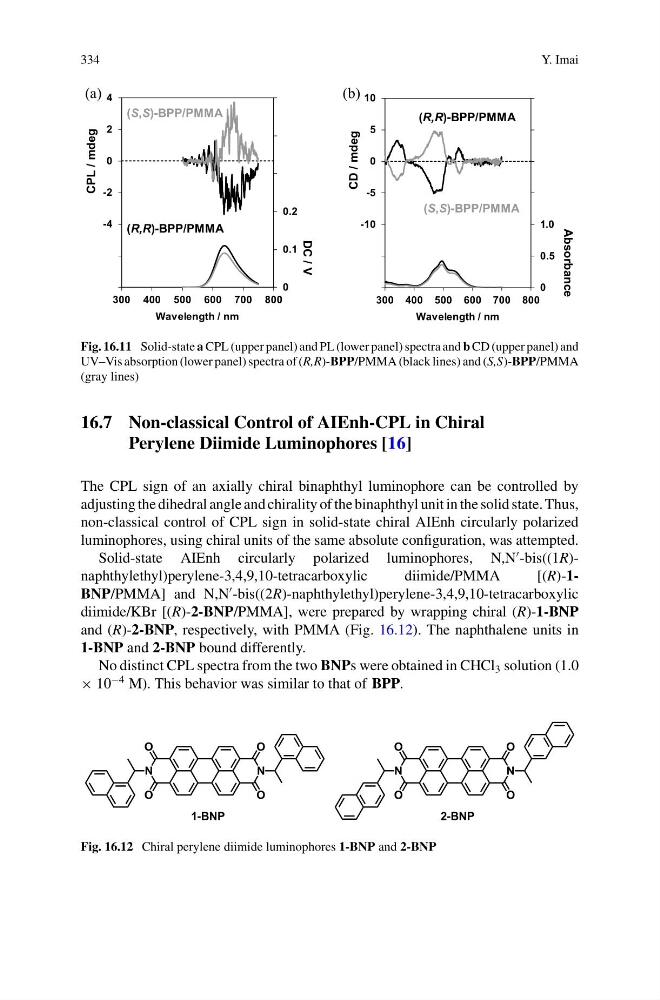
Fig. 16.11 Solid-state a CPL (upper panel) and PL (lower panel) spectra and b CD (upper panel) and
UV–Vis absorption (lower panel) spectra of (R,R)-BPP/PMMA (black lines) and (S,S)-BPP/PMMA
(gray lines)
16.7 Non-classical Control of AIEnh-CPL in Chiral
Perylene Diimide Luminophores [16]
The CPL sign of an axially chiral binaphthyl luminophore can be controlled by
adjusting the dihedral angle and chirality of the binaphthyl unit in the solid state. Thus,
non-classical control of CPL sign in solid-state chiral AIEnh circularly polarized
luminophores, using chiral units of the same absolute configuration, was attempted.
Solid-state AIEnh circularly polarized luminophores, N,N
-bis((1R)naphthylethyl)perylene-3,4,9,10-tetracarboxylic
diimide/PMMA
[(R)-1BNP/PMMA] and N,N
-bis((2R)-naphthylethyl)perylene-3,4,9,10-tetracarboxylic
diimide/KBr [(R)-2-BNP/PMMA], were prepared by wrapping chiral (R)-1-BNP
and (R)-2-BNP, respectively, with PMMA (Fig. 16.12). The naphthalene units in
1-BNP and 2-BNP bound differently.
No distinct CPL spectra from the two BNPs were obtained in CHCl 3 solution (1.0
× 10
−4 M). This behavior was similar to that of BPP.
N
N
O
O
O
O
N
N
O
O
O
O
1-BNP
2-BNP
Fig. 16.12 Chiral perylene diimide luminophores 1-BNP and 2-BNP
Y. Imai
(a)
(b)
0
0.5
1
-10
-5
0
5
10
300 400 500 600 700 800
Absorbance
CD / mdeg
Wavelength / nm
(R,R)-BPP/PMMA
(S,S)-BPP/PMMA
.0
0
0.1
0.2
300 400 500 600 700 800
-4
-2
0
2
4
DC / V
CPL / mdeg
Wavelength / nm
(S,S)-BPP/PMMA
(R,R)-BPP/PMMA
Fig. 16.11 Solid-state a CPL (upper panel) and PL (lower panel) spectra and b CD (upper panel) and
UV–Vis absorption (lower panel) spectra of (R,R)-BPP/PMMA (black lines) and (S,S)-BPP/PMMA
(gray lines)
16.7 Non-classical Control of AIEnh-CPL in Chiral
Perylene Diimide Luminophores [16]
The CPL sign of an axially chiral binaphthyl luminophore can be controlled by
adjusting the dihedral angle and chirality of the binaphthyl unit in the solid state. Thus,
non-classical control of CPL sign in solid-state chiral AIEnh circularly polarized
luminophores, using chiral units of the same absolute configuration, was attempted.
Solid-state AIEnh circularly polarized luminophores, N,N
-bis((1R)naphthylethyl)perylene-3,4,9,10-tetracarboxylic
diimide/PMMA
[(R)-1BNP/PMMA] and N,N
-bis((2R)-naphthylethyl)perylene-3,4,9,10-tetracarboxylic
diimide/KBr [(R)-2-BNP/PMMA], were prepared by wrapping chiral (R)-1-BNP
and (R)-2-BNP, respectively, with PMMA (Fig. 16.12). The naphthalene units in
1-BNP and 2-BNP bound differently.
No distinct CPL spectra from the two BNPs were obtained in CHCl 3 solution (1.0
× 10
−4 M). This behavior was similar to that of BPP.
N
N
O
O
O
O
N
N
O
O
O
O
1-BNP
2-BNP
Fig. 16.12 Chiral perylene diimide luminophores 1-BNP and 2-BNP