

16 Circularly Polarized Luminescence …
333
(a)
(b)
0
0.5
1
-20
-15
-10
-5
0
5
10
250 350 450 550 650 750
Absorbance
CD / mdeg
Wavelength / nm
(R,R)-BPP/KBr
(S,S)-BPP/KBr
.0
0
0.1
0.2
250 350 450 550 650 750
-4
-2
0
2
4
DC / V
CPL / mdeg
Wavelength / nm
(S,S)-BPP/KBr
(R,R)-BPP/KBr
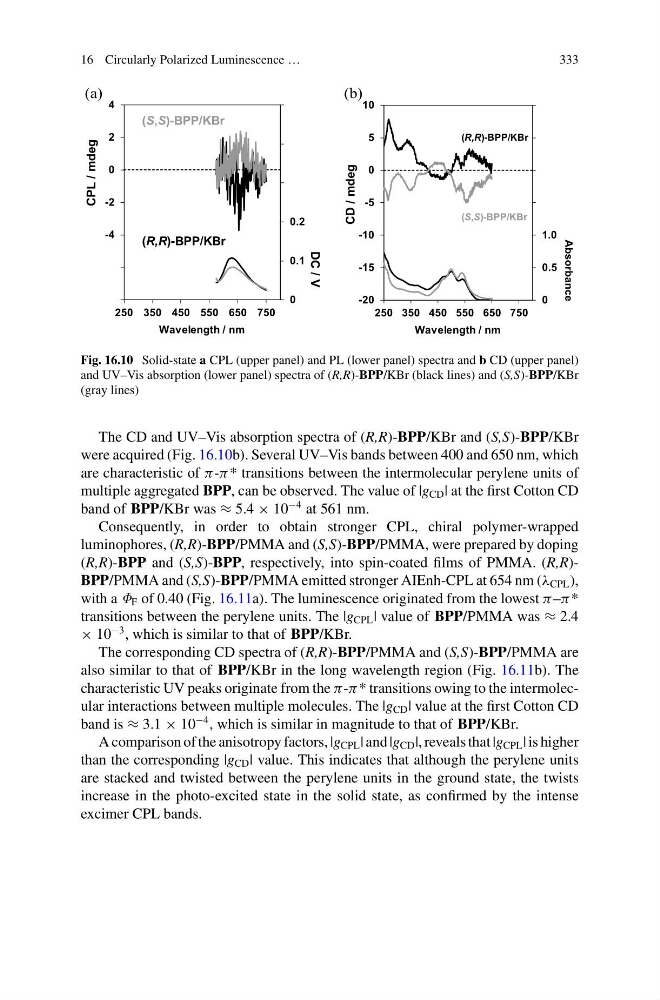
Fig. 16.10 Solid-state a CPL (upper panel) and PL (lower panel) spectra and b CD (upper panel)
and UV–Vis absorption (lower panel) spectra of (R,R)-BPP/KBr (black lines) and (S,S)-BPP/KBr
(gray lines)
The CD and UV–Vis absorption spectra of (R,R)-BPP/KBr and (S,S)-BPP/KBr
were acquired (Fig. 16.10b). Several UV–Vis bands between 400 and 650 nm, which
are characteristic of π-π * transitions between the intermolecular perylene units of
multiple aggregated BPP, can be observed. The value of |g CD | at the first Cotton CD
band of BPP/KBr was ≈ 5.4 × 10
−4 at 561 nm.
Consequently, in order to obtain stronger CPL, chiral polymer-wrapped
luminophores, (R,R)-BPP/PMMA and (S,S)-BPP/PMMA, were prepared by doping
(R,R)-BPP and (S,S)-BPP, respectively, into spin-coated films of PMMA. (R,R)BPP/PMMA and (S,S)-BPP/PMMA emitted stronger AIEnh-CPL at 654 nm (λ CPL ),
with a F F of 0.40 (Fig. 16.11a). The luminescence originated from the lowest π –π *
transitions between the perylene units. The |g CPL | value of BPP/PMMA was ≈ 2.4
× 10
−3 , which is similar to that of BPP/KBr.
The corresponding CD spectra of (R,R)-BPP/PMMA and (S,S)-BPP/PMMA are
also similar to that of BPP/KBr in the long wavelength region (Fig. 16.11b). The
characteristic UV peaks originate from the π-π * transitions owing to the intermolecular interactions between multiple molecules. The |g CD | value at the first Cotton CD
band is ≈ 3.1 × 10
−4 , which is similar in magnitude to that of BPP/KBr.
A comparison of the anisotropy factors, |g CPL | and |g CD |, reveals that |g CPL | is higher
than the corresponding |g CD | value. This indicates that although the perylene units
are stacked and twisted between the perylene units in the ground state, the twists
increase in the photo-excited state in the solid state, as confirmed by the intense
excimer CPL bands.
333
(a)
(b)
0
0.5
1
-20
-15
-10
-5
0
5
10
250 350 450 550 650 750
Absorbance
CD / mdeg
Wavelength / nm
(R,R)-BPP/KBr
(S,S)-BPP/KBr
.0
0
0.1
0.2
250 350 450 550 650 750
-4
-2
0
2
4
DC / V
CPL / mdeg
Wavelength / nm
(S,S)-BPP/KBr
(R,R)-BPP/KBr
Fig. 16.10 Solid-state a CPL (upper panel) and PL (lower panel) spectra and b CD (upper panel)
and UV–Vis absorption (lower panel) spectra of (R,R)-BPP/KBr (black lines) and (S,S)-BPP/KBr
(gray lines)
The CD and UV–Vis absorption spectra of (R,R)-BPP/KBr and (S,S)-BPP/KBr
were acquired (Fig. 16.10b). Several UV–Vis bands between 400 and 650 nm, which
are characteristic of π-π * transitions between the intermolecular perylene units of
multiple aggregated BPP, can be observed. The value of |g CD | at the first Cotton CD
band of BPP/KBr was ≈ 5.4 × 10
−4 at 561 nm.
Consequently, in order to obtain stronger CPL, chiral polymer-wrapped
luminophores, (R,R)-BPP/PMMA and (S,S)-BPP/PMMA, were prepared by doping
(R,R)-BPP and (S,S)-BPP, respectively, into spin-coated films of PMMA. (R,R)BPP/PMMA and (S,S)-BPP/PMMA emitted stronger AIEnh-CPL at 654 nm (λ CPL ),
with a F F of 0.40 (Fig. 16.11a). The luminescence originated from the lowest π –π *
transitions between the perylene units. The |g CPL | value of BPP/PMMA was ≈ 2.4
× 10
−3 , which is similar to that of BPP/KBr.
The corresponding CD spectra of (R,R)-BPP/PMMA and (S,S)-BPP/PMMA are
also similar to that of BPP/KBr in the long wavelength region (Fig. 16.11b). The
characteristic UV peaks originate from the π-π * transitions owing to the intermolecular interactions between multiple molecules. The |g CD | value at the first Cotton CD
band is ≈ 3.1 × 10
−4 , which is similar in magnitude to that of BPP/KBr.
A comparison of the anisotropy factors, |g CPL | and |g CD |, reveals that |g CPL | is higher
than the corresponding |g CD | value. This indicates that although the perylene units
are stacked and twisted between the perylene units in the ground state, the twists
increase in the photo-excited state in the solid state, as confirmed by the intense
excimer CPL bands.