

332
Y. Imai
(a)
(b)
0
0.5
1.0
-9
-6
-3
0
3
6
9
280
330
380
430
Absorbance
CD / mdeg
Wavelength / nm
(R)-BINAP/PMMA
(S)-BINAP/PMMA
0
0.5
1.0
-9
-6
-3
0
3
6
9
280
330
380
430
DC / V
CPL / mdeg
Wavelength / nm
(R)-BINAP/PMMA
(S)-BINAP/PMMA
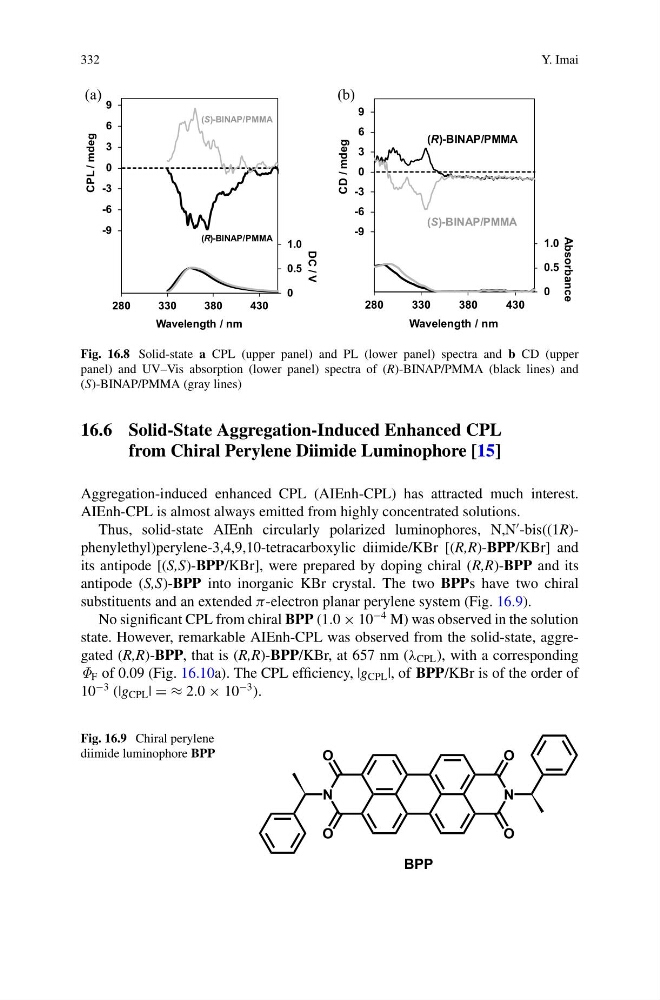
Fig. 16.8 Solid-state a CPL (upper panel) and PL (lower panel) spectra and b CD (upper
panel) and UV–Vis absorption (lower panel) spectra of (R)-BINAP/PMMA (black lines) and
(S)-BINAP/PMMA (gray lines)
16.6 Solid-State Aggregation-Induced Enhanced CPL
from Chiral Perylene Diimide Luminophore [15]
Aggregation-induced enhanced CPL (AIEnh-CPL) has attracted much interest.
AIEnh-CPL is almost always emitted from highly concentrated solutions.
Thus, solid-state AIEnh circularly polarized luminophores, N,N
-bis((1R)phenylethyl)perylene-3,4,9,10-tetracarboxylic diimide/KBr [(R,R)-BPP/KBr] and
its antipode [(S,S)-BPP/KBr], were prepared by doping chiral (R,R)-BPP and its
antipode (S,S)-BPP into inorganic KBr crystal. The two BPPs have two chiral
substituents and an extended π-electron planar perylene system (Fig. 16.9).
No significant CPL from chiral BPP (1.0 × 10
−4 M) was observed in the solution
state. However, remarkable AIEnh-CPL was observed from the solid-state, aggregated (R,R)-BPP, that is (R,R)-BPP/KBr, at 657 nm (λ CPL ), with a corresponding
F F of 0.09 (Fig. 16.10a). The CPL efficiency, |g CPL |, of BPP/KBr is of the order of
10
−3 (|g CPL | = ≈ 2.0 × 10
−3 ).
Fig. 16.9 Chiral perylene
diimide luminophore BPP
N
N
O
O
O
O
BPP
Y. Imai
(a)
(b)
0
0.5
1.0
-9
-6
-3
0
3
6
9
280
330
380
430
Absorbance
CD / mdeg
Wavelength / nm
(R)-BINAP/PMMA
(S)-BINAP/PMMA
0
0.5
1.0
-9
-6
-3
0
3
6
9
280
330
380
430
DC / V
CPL / mdeg
Wavelength / nm
(R)-BINAP/PMMA
(S)-BINAP/PMMA
Fig. 16.8 Solid-state a CPL (upper panel) and PL (lower panel) spectra and b CD (upper
panel) and UV–Vis absorption (lower panel) spectra of (R)-BINAP/PMMA (black lines) and
(S)-BINAP/PMMA (gray lines)
16.6 Solid-State Aggregation-Induced Enhanced CPL
from Chiral Perylene Diimide Luminophore [15]
Aggregation-induced enhanced CPL (AIEnh-CPL) has attracted much interest.
AIEnh-CPL is almost always emitted from highly concentrated solutions.
Thus, solid-state AIEnh circularly polarized luminophores, N,N
-bis((1R)phenylethyl)perylene-3,4,9,10-tetracarboxylic diimide/KBr [(R,R)-BPP/KBr] and
its antipode [(S,S)-BPP/KBr], were prepared by doping chiral (R,R)-BPP and its
antipode (S,S)-BPP into inorganic KBr crystal. The two BPPs have two chiral
substituents and an extended π-electron planar perylene system (Fig. 16.9).
No significant CPL from chiral BPP (1.0 × 10
−4 M) was observed in the solution
state. However, remarkable AIEnh-CPL was observed from the solid-state, aggregated (R,R)-BPP, that is (R,R)-BPP/KBr, at 657 nm (λ CPL ), with a corresponding
F F of 0.09 (Fig. 16.10a). The CPL efficiency, |g CPL |, of BPP/KBr is of the order of
10
−3 (|g CPL | = ≈ 2.0 × 10
−3 ).
Fig. 16.9 Chiral perylene
diimide luminophore BPP
N
N
O
O
O
O
BPP