

16 Circularly Polarized Luminescence …
331
16.5 Non-classical Emission of CPL from Axially Chiral
Binaphthyl Luminophore Wrapped with Organic
PMMA Polymer [14]
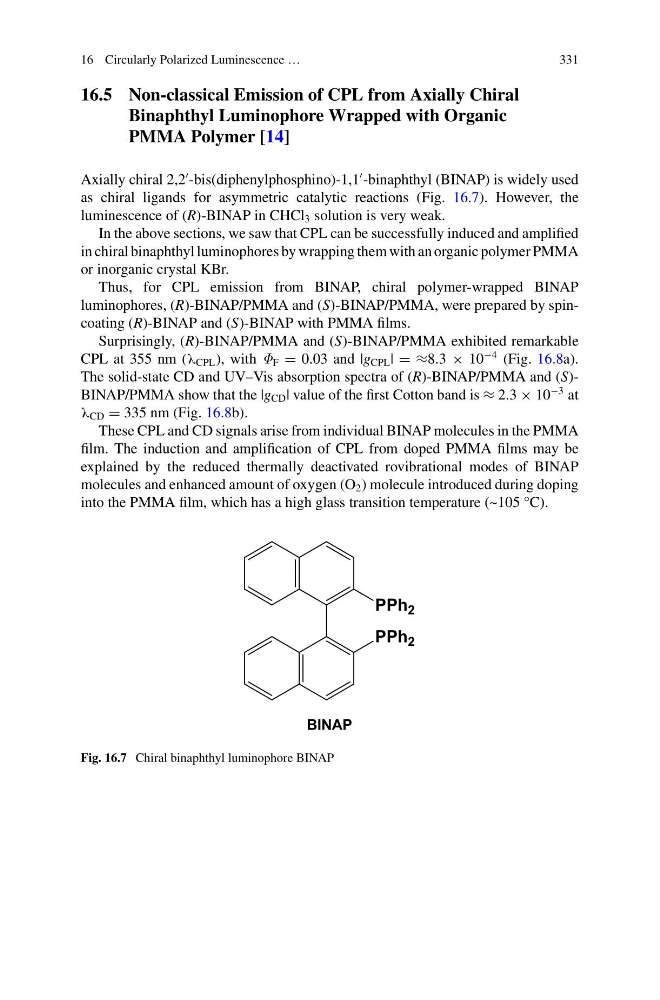
Axially chiral 2,2
-bis(diphenylphosphino)-1,1
-binaphthyl (BINAP) is widely used
as chiral ligands for asymmetric catalytic reactions (Fig. 16.7). However, the
luminescence of (R)-BINAP in CHCl 3 solution is very weak.
In the above sections, we saw that CPL can be successfully induced and amplified
in chiral binaphthyl luminophores by wrapping them with an organic polymer PMMA
or inorganic crystal KBr.
Thus, for CPL emission from BINAP, chiral polymer-wrapped BINAP
luminophores, (R)-BINAP/PMMA and (S)-BINAP/PMMA, were prepared by spincoating (R)-BINAP and (S)-BINAP with PMMA films.
Surprisingly, (R)-BINAP/PMMA and (S)-BINAP/PMMA exhibited remarkable
CPL at 355 nm (λ CPL ), with F F = 0.03 and |g CPL | = ≈8.3 × 10
−4 (Fig. 16.8a).
The solid-state CD and UV–Vis absorption spectra of (R)-BINAP/PMMA and (S)BINAP/PMMA show that the |g CD | value of the first Cotton band is ≈ 2.3 × 10
−3 at
λ CD = 335 nm (Fig. 16.8b).
These CPL and CD signals arise from individual BINAP molecules in the PMMA
film. The induction and amplification of CPL from doped PMMA films may be
explained by the reduced thermally deactivated rovibrational modes of BINAP
molecules and enhanced amount of oxygen (O 2 ) molecule introduced during doping
into the PMMA film, which has a high glass transition temperature (~105 °C).
PPh 2
PPh 2
BINAP
Fig. 16.7 Chiral binaphthyl luminophore BINAP
331
16.5 Non-classical Emission of CPL from Axially Chiral
Binaphthyl Luminophore Wrapped with Organic
PMMA Polymer [14]
Axially chiral 2,2
-bis(diphenylphosphino)-1,1
-binaphthyl (BINAP) is widely used
as chiral ligands for asymmetric catalytic reactions (Fig. 16.7). However, the
luminescence of (R)-BINAP in CHCl 3 solution is very weak.
In the above sections, we saw that CPL can be successfully induced and amplified
in chiral binaphthyl luminophores by wrapping them with an organic polymer PMMA
or inorganic crystal KBr.
Thus, for CPL emission from BINAP, chiral polymer-wrapped BINAP
luminophores, (R)-BINAP/PMMA and (S)-BINAP/PMMA, were prepared by spincoating (R)-BINAP and (S)-BINAP with PMMA films.
Surprisingly, (R)-BINAP/PMMA and (S)-BINAP/PMMA exhibited remarkable
CPL at 355 nm (λ CPL ), with F F = 0.03 and |g CPL | = ≈8.3 × 10
−4 (Fig. 16.8a).
The solid-state CD and UV–Vis absorption spectra of (R)-BINAP/PMMA and (S)BINAP/PMMA show that the |g CD | value of the first Cotton band is ≈ 2.3 × 10
−3 at
λ CD = 335 nm (Fig. 16.8b).
These CPL and CD signals arise from individual BINAP molecules in the PMMA
film. The induction and amplification of CPL from doped PMMA films may be
explained by the reduced thermally deactivated rovibrational modes of BINAP
molecules and enhanced amount of oxygen (O 2 ) molecule introduced during doping
into the PMMA film, which has a high glass transition temperature (~105 °C).
PPh 2
PPh 2
BINAP
Fig. 16.7 Chiral binaphthyl luminophore BINAP