

330
Y. Imai
5
O
O
S
S
S
S
S
S
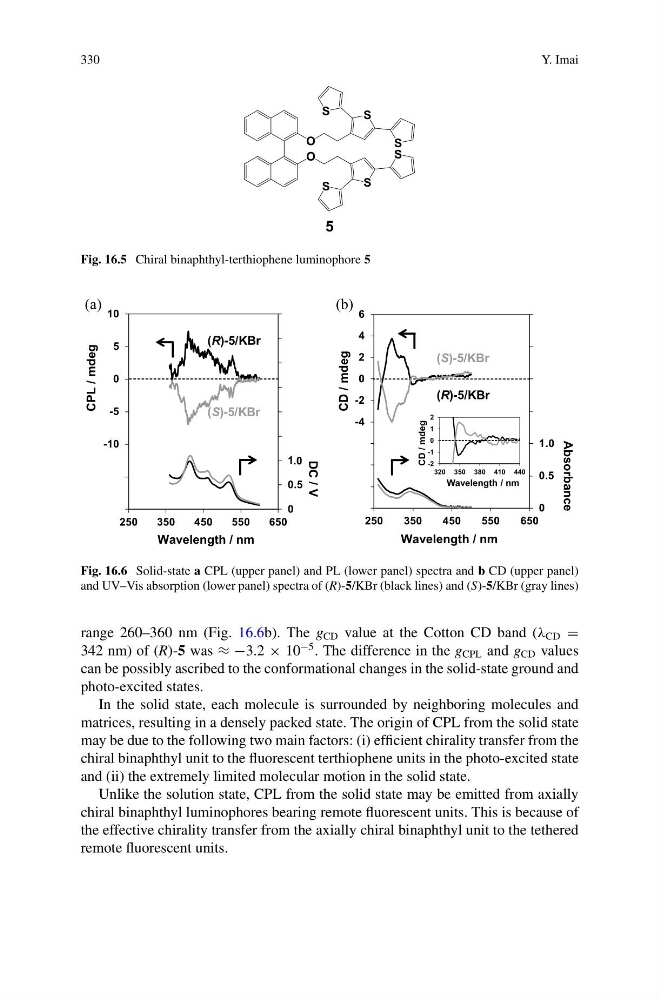
Fig. 16.5 Chiral binaphthyl-terthiophene luminophore 5
(a)
(b)
0
0.5
1
250
350
450
550
650
-10
-5
0
5
10
DC / V
CPL / mdeg
Wavelength / nm
(S)-5/KBr
(R)-5/KBr
.0
0
0.5
1
-4
-2
0
2
4
6
250
350
450
550
650
Absorbance
CD / mdeg
Wavelength / nm
-2
-1
0
1
2
320 350 380 410 440
CD / mdeg
Wavelength / nm
(R)-5/KBr
(S)-5/KBr
.0
Fig. 16.6 Solid-state a CPL (upper panel) and PL (lower panel) spectra and b CD (upper panel)
and UV–Vis absorption (lower panel) spectra of (R)-5/KBr (black lines) and (S)-5/KBr (gray lines)
range 260–360 nm (Fig. 16.6b). The g CD value at the Cotton CD band (λ CD =
342 nm) of (R)-5 was ≈ −3.2 × 10
−5 . The difference in the g CPL and g CD values
can be possibly ascribed to the conformational changes in the solid-state ground and
photo-excited states.
In the solid state, each molecule is surrounded by neighboring molecules and
matrices, resulting in a densely packed state. The origin of CPL from the solid state
may be due to the following two main factors: (i) efficient chirality transfer from the
chiral binaphthyl unit to the fluorescent terthiophene units in the photo-excited state
and (ii) the extremely limited molecular motion in the solid state.
Unlike the solution state, CPL from the solid state may be emitted from axially
chiral binaphthyl luminophores bearing remote fluorescent units. This is because of
the effective chirality transfer from the axially chiral binaphthyl unit to the tethered
remote fluorescent units.
Y. Imai
5
O
O
S
S
S
S
S
S
Fig. 16.5 Chiral binaphthyl-terthiophene luminophore 5
(a)
(b)
0
0.5
1
250
350
450
550
650
-10
-5
0
5
10
DC / V
CPL / mdeg
Wavelength / nm
(S)-5/KBr
(R)-5/KBr
.0
0
0.5
1
-4
-2
0
2
4
6
250
350
450
550
650
Absorbance
CD / mdeg
Wavelength / nm
-2
-1
0
1
2
320 350 380 410 440
CD / mdeg
Wavelength / nm
(R)-5/KBr
(S)-5/KBr
.0
Fig. 16.6 Solid-state a CPL (upper panel) and PL (lower panel) spectra and b CD (upper panel)
and UV–Vis absorption (lower panel) spectra of (R)-5/KBr (black lines) and (S)-5/KBr (gray lines)
range 260–360 nm (Fig. 16.6b). The g CD value at the Cotton CD band (λ CD =
342 nm) of (R)-5 was ≈ −3.2 × 10
−5 . The difference in the g CPL and g CD values
can be possibly ascribed to the conformational changes in the solid-state ground and
photo-excited states.
In the solid state, each molecule is surrounded by neighboring molecules and
matrices, resulting in a densely packed state. The origin of CPL from the solid state
may be due to the following two main factors: (i) efficient chirality transfer from the
chiral binaphthyl unit to the fluorescent terthiophene units in the photo-excited state
and (ii) the extremely limited molecular motion in the solid state.
Unlike the solution state, CPL from the solid state may be emitted from axially
chiral binaphthyl luminophores bearing remote fluorescent units. This is because of
the effective chirality transfer from the axially chiral binaphthyl unit to the tethered
remote fluorescent units.