

16 Circularly Polarized Luminescence …
329
(a)
(b)
250
300
350
400
450
500
-20
-10
0
10
20
CPL / mdeg
Wavelength / nm
(R)-4/KBr
(R)-3/KBr
-50
-25
0
25
50
250
300
350
400
450
500
CD / mdeg
Wavelength / nm
(R)-3/KBr
(R)-4/KBr
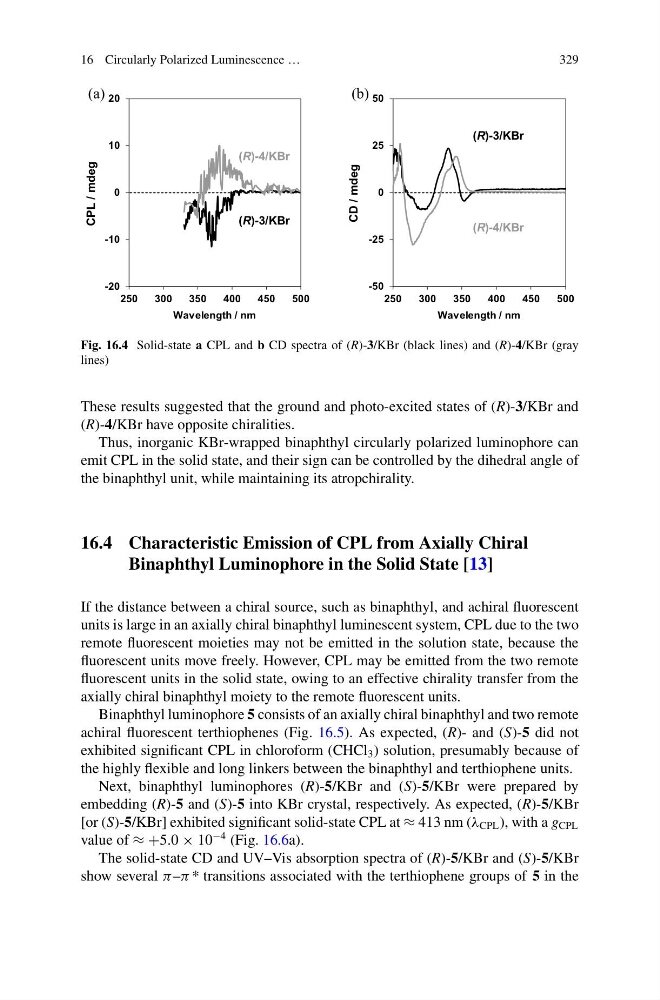
Fig. 16.4 Solid-state a CPL and b CD spectra of (R)-3/KBr (black lines) and (R)-4/KBr (gray
lines)
These results suggested that the ground and photo-excited states of (R)-3/KBr and
(R)-4/KBr have opposite chiralities.
Thus, inorganic KBr-wrapped binaphthyl circularly polarized luminophore can
emit CPL in the solid state, and their sign can be controlled by the dihedral angle of
the binaphthyl unit, while maintaining its atropchirality.
16.4 Characteristic Emission of CPL from Axially Chiral
Binaphthyl Luminophore in the Solid State [13]
If the distance between a chiral source, such as binaphthyl, and achiral fluorescent
units is large in an axially chiral binaphthyl luminescent system, CPL due to the two
remote fluorescent moieties may not be emitted in the solution state, because the
fluorescent units move freely. However, CPL may be emitted from the two remote
fluorescent units in the solid state, owing to an effective chirality transfer from the
axially chiral binaphthyl moiety to the remote fluorescent units.
Binaphthyl luminophore 5 consists of an axially chiral binaphthyl and two remote
achiral fluorescent terthiophenes (Fig. 16.5). As expected, (R)- and (S)-5 did not
exhibited significant CPL in chloroform (CHCl 3 ) solution, presumably because of
the highly flexible and long linkers between the binaphthyl and terthiophene units.
Next, binaphthyl luminophores (R)-5/KBr and (S)-5/KBr were prepared by
embedding (R)-5 and (S)-5 into KBr crystal, respectively. As expected, (R)-5/KBr
[or (S)-5/KBr] exhibited significant solid-state CPL at ≈ 413 nm (λ CPL ), with a g CPL
value of ≈ +5.0 × 10
−4 (Fig. 16.6a).
The solid-state CD and UV–Vis absorption spectra of (R)-5/KBr and (S)-5/KBr
show several π –π * transitions associated with the terthiophene groups of 5 in the
329
(a)
(b)
250
300
350
400
450
500
-20
-10
0
10
20
CPL / mdeg
Wavelength / nm
(R)-4/KBr
(R)-3/KBr
-50
-25
0
25
50
250
300
350
400
450
500
CD / mdeg
Wavelength / nm
(R)-3/KBr
(R)-4/KBr
Fig. 16.4 Solid-state a CPL and b CD spectra of (R)-3/KBr (black lines) and (R)-4/KBr (gray
lines)
These results suggested that the ground and photo-excited states of (R)-3/KBr and
(R)-4/KBr have opposite chiralities.
Thus, inorganic KBr-wrapped binaphthyl circularly polarized luminophore can
emit CPL in the solid state, and their sign can be controlled by the dihedral angle of
the binaphthyl unit, while maintaining its atropchirality.
16.4 Characteristic Emission of CPL from Axially Chiral
Binaphthyl Luminophore in the Solid State [13]
If the distance between a chiral source, such as binaphthyl, and achiral fluorescent
units is large in an axially chiral binaphthyl luminescent system, CPL due to the two
remote fluorescent moieties may not be emitted in the solution state, because the
fluorescent units move freely. However, CPL may be emitted from the two remote
fluorescent units in the solid state, owing to an effective chirality transfer from the
axially chiral binaphthyl moiety to the remote fluorescent units.
Binaphthyl luminophore 5 consists of an axially chiral binaphthyl and two remote
achiral fluorescent terthiophenes (Fig. 16.5). As expected, (R)- and (S)-5 did not
exhibited significant CPL in chloroform (CHCl 3 ) solution, presumably because of
the highly flexible and long linkers between the binaphthyl and terthiophene units.
Next, binaphthyl luminophores (R)-5/KBr and (S)-5/KBr were prepared by
embedding (R)-5 and (S)-5 into KBr crystal, respectively. As expected, (R)-5/KBr
[or (S)-5/KBr] exhibited significant solid-state CPL at ≈ 413 nm (λ CPL ), with a g CPL
value of ≈ +5.0 × 10
−4 (Fig. 16.6a).
The solid-state CD and UV–Vis absorption spectra of (R)-5/KBr and (S)-5/KBr
show several π –π * transitions associated with the terthiophene groups of 5 in the