

316
S. Kobatake and T. Nakahama
the intermolecular interaction between two thiophene rings of neighboring molecules
in the crystal have a longer lifetime and a longer λ f compared with the monomer [3].
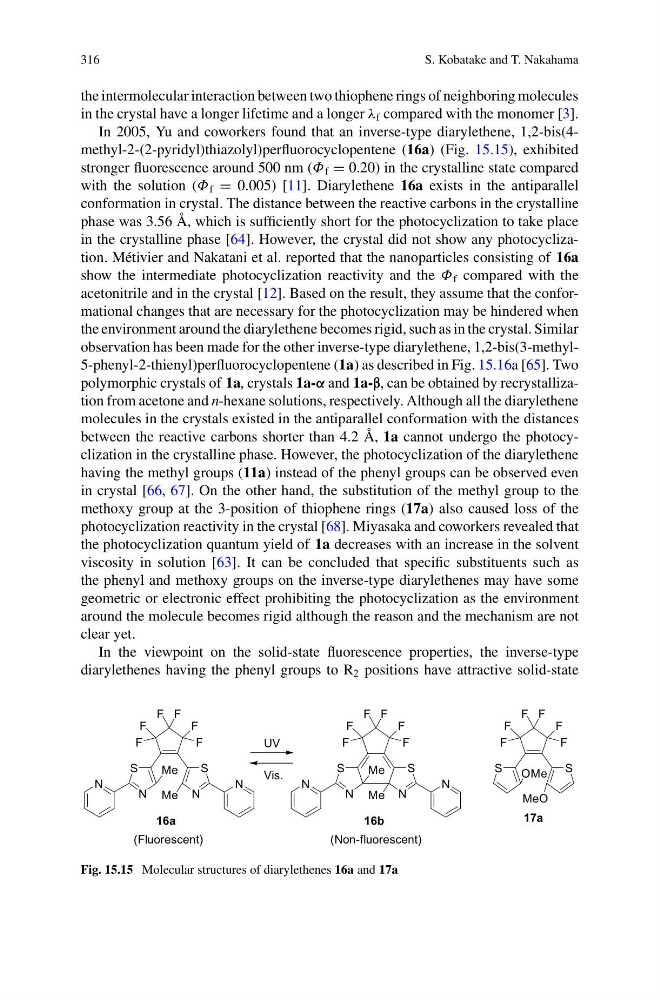
In 2005, Yu and coworkers found that an inverse-type diarylethene, 1,2-bis(4methyl-2-(2-pyridyl)thiazolyl)perfluorocyclopentene (16a) (Fig. 15.15), exhibited
stronger fluorescence around 500 nm (Φ f = 0.20) in the crystalline state compared
with the solution (Φ f = 0.005) [11]. Diarylethene 16a exists in the antiparallel
conformation in crystal. The distance between the reactive carbons in the crystalline
phase was 3.56 Å, which is sufficiently short for the photocyclization to take place
in the crystalline phase [64]. However, the crystal did not show any photocyclization. Métivier and Nakatani et al. reported that the nanoparticles consisting of 16a
show the intermediate photocyclization reactivity and the Φ f compared with the
acetonitrile and in the crystal [12]. Based on the result, they assume that the conformational changes that are necessary for the photocyclization may be hindered when
the environment around the diarylethene becomes rigid, such as in the crystal. Similar
observation has been made for the other inverse-type diarylethene, 1,2-bis(3-methyl5-phenyl-2-thienyl)perfluorocyclopentene (1a) as described in Fig. 15.16a [65]. Two
polymorphic crystals of 1a, crystals 1a-α and 1a-β, can be obtained by recrystallization from acetone and n-hexane solutions, respectively. Although all the diarylethene
molecules in the crystals existed in the antiparallel conformation with the distances
between the reactive carbons shorter than 4.2 Å, 1a cannot undergo the photocyclization in the crystalline phase. However, the photocyclization of the diarylethene
having the methyl groups (11a) instead of the phenyl groups can be observed even
in crystal [66, 67]. On the other hand, the substitution of the methyl group to the
methoxy group at the 3-position of thiophene rings (17a) also caused loss of the
photocyclization reactivity in the crystal [68]. Miyasaka and coworkers revealed that
the photocyclization quantum yield of 1a decreases with an increase in the solvent
viscosity in solution [63]. It can be concluded that specific substituents such as
the phenyl and methoxy groups on the inverse-type diarylethenes may have some
geometric or electronic effect prohibiting the photocyclization as the environment
around the molecule becomes rigid although the reason and the mechanism are not
clear yet.
In the viewpoint on the solid-state fluorescence properties, the inverse-type
diarylethenes having the phenyl groups to R 2 positions have attractive solid-state
S
S
N
N
Me
Me
F
F
F F
F
F
N
N
S
S
N
N
Me
Me
F
F
F F
F
F
N
N
UV
Vis.
b
6
1
a
6
1
)
t
n
e
c
s
e
r
o
u
l
f
-
n
o
N
(
)
t
n
e
c
s
e
r
o
u
l
F
(
S
S
OMe
MeO
F
F
F F
F
F
17a
Fig. 15.15 Molecular structures of diarylethenes 16a and 17a
S. Kobatake and T. Nakahama
the intermolecular interaction between two thiophene rings of neighboring molecules
in the crystal have a longer lifetime and a longer λ f compared with the monomer [3].
In 2005, Yu and coworkers found that an inverse-type diarylethene, 1,2-bis(4methyl-2-(2-pyridyl)thiazolyl)perfluorocyclopentene (16a) (Fig. 15.15), exhibited
stronger fluorescence around 500 nm (Φ f = 0.20) in the crystalline state compared
with the solution (Φ f = 0.005) [11]. Diarylethene 16a exists in the antiparallel
conformation in crystal. The distance between the reactive carbons in the crystalline
phase was 3.56 Å, which is sufficiently short for the photocyclization to take place
in the crystalline phase [64]. However, the crystal did not show any photocyclization. Métivier and Nakatani et al. reported that the nanoparticles consisting of 16a
show the intermediate photocyclization reactivity and the Φ f compared with the
acetonitrile and in the crystal [12]. Based on the result, they assume that the conformational changes that are necessary for the photocyclization may be hindered when
the environment around the diarylethene becomes rigid, such as in the crystal. Similar
observation has been made for the other inverse-type diarylethene, 1,2-bis(3-methyl5-phenyl-2-thienyl)perfluorocyclopentene (1a) as described in Fig. 15.16a [65]. Two
polymorphic crystals of 1a, crystals 1a-α and 1a-β, can be obtained by recrystallization from acetone and n-hexane solutions, respectively. Although all the diarylethene
molecules in the crystals existed in the antiparallel conformation with the distances
between the reactive carbons shorter than 4.2 Å, 1a cannot undergo the photocyclization in the crystalline phase. However, the photocyclization of the diarylethene
having the methyl groups (11a) instead of the phenyl groups can be observed even
in crystal [66, 67]. On the other hand, the substitution of the methyl group to the
methoxy group at the 3-position of thiophene rings (17a) also caused loss of the
photocyclization reactivity in the crystal [68]. Miyasaka and coworkers revealed that
the photocyclization quantum yield of 1a decreases with an increase in the solvent
viscosity in solution [63]. It can be concluded that specific substituents such as
the phenyl and methoxy groups on the inverse-type diarylethenes may have some
geometric or electronic effect prohibiting the photocyclization as the environment
around the molecule becomes rigid although the reason and the mechanism are not
clear yet.
In the viewpoint on the solid-state fluorescence properties, the inverse-type
diarylethenes having the phenyl groups to R 2 positions have attractive solid-state
S
S
N
N
Me
Me
F
F
F F
F
F
N
N
S
S
N
N
Me
Me
F
F
F F
F
F
N
N
UV
Vis.
b
6
1
a
6
1
)
t
n
e
c
s
e
r
o
u
l
f
-
n
o
N
(
)
t
n
e
c
s
e
r
o
u
l
F
(
S
S
OMe
MeO
F
F
F F
F
F
17a
Fig. 15.15 Molecular structures of diarylethenes 16a and 17a