

15 Solid-State Fluorescence Switching Using Photochromic …
315
S
S
F
F
F
F
F
F
Et
Et
UV
Vis.
14a: R = H,
O
O
O
O
R
R
15a: R =
Me
Me
S
S
F
F
F
F
F
F
Et
Et
14b : R = H,
O
O
O
O
R
R
15b : R =
Me
Me
(Non-fluorescent)
(Fluorescent)
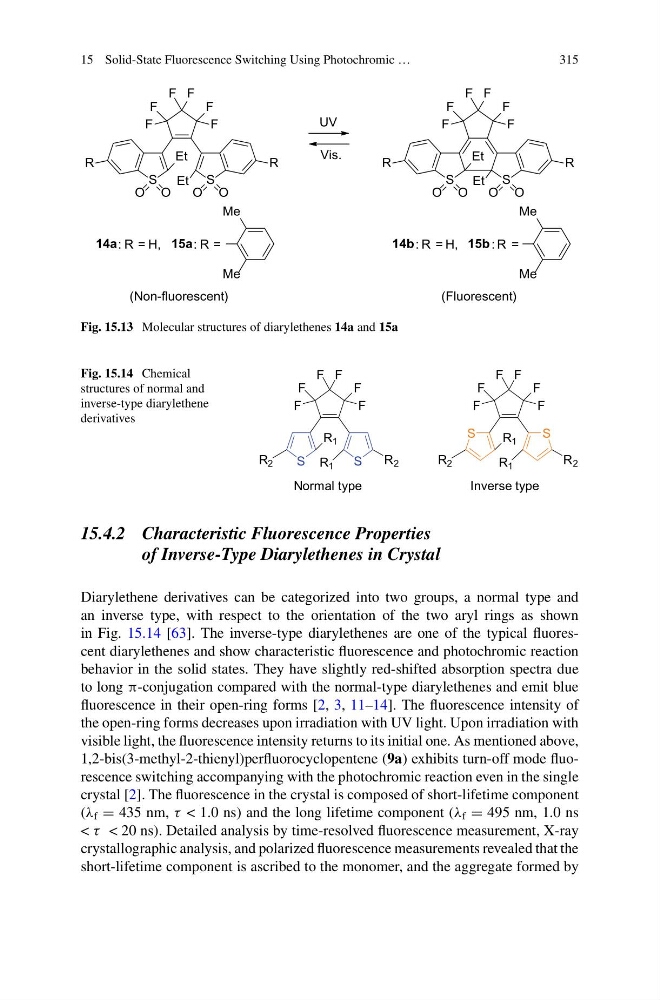
Fig. 15.13 Molecular structures of diarylethenes 14a and 15a
Fig. 15.14 Chemical
structures of normal and
inverse-type diarylethene
derivatives
S
S
R 2
R 2
R 1
R 1
F
F
F F
F
F
S
S
R 2
R 2
R 1
R 1
F
F
F F
F
F
Normal type
Inverse type
15.4.2 Characteristic Fluorescence Properties
of Inverse-Type Diarylethenes in Crystal
Diarylethene derivatives can be categorized into two groups, a normal type and
an inverse type, with respect to the orientation of the two aryl rings as shown
in Fig. 15.14 [63]. The inverse-type diarylethenes are one of the typical fluorescent diarylethenes and show characteristic fluorescence and photochromic reaction
behavior in the solid states. They have slightly red-shifted absorption spectra due
to long π-conjugation compared with the normal-type diarylethenes and emit blue
fluorescence in their open-ring forms [2, 3, 11–14]. The fluorescence intensity of
the open-ring forms decreases upon irradiation with UV light. Upon irradiation with
visible light, the fluorescence intensity returns to its initial one. As mentioned above,
1,2-bis(3-methyl-2-thienyl)perfluorocyclopentene (9a) exhibits turn-off mode fluorescence switching accompanying with the photochromic reaction even in the single
crystal [2]. The fluorescence in the crystal is composed of short-lifetime component
(λ f = 435 nm, τ < 1.0 ns) and the long lifetime component (λ f = 495 nm, 1.0 ns
< τ < 20 ns). Detailed analysis by time-resolved fluorescence measurement, X-ray
crystallographic analysis, and polarized fluorescence measurements revealed that the
short-lifetime component is ascribed to the monomer, and the aggregate formed by
315
S
S
F
F
F
F
F
F
Et
Et
UV
Vis.
14a: R = H,
O
O
O
O
R
R
15a: R =
Me
Me
S
S
F
F
F
F
F
F
Et
Et
14b : R = H,
O
O
O
O
R
R
15b : R =
Me
Me
(Non-fluorescent)
(Fluorescent)
Fig. 15.13 Molecular structures of diarylethenes 14a and 15a
Fig. 15.14 Chemical
structures of normal and
inverse-type diarylethene
derivatives
S
S
R 2
R 2
R 1
R 1
F
F
F F
F
F
S
S
R 2
R 2
R 1
R 1
F
F
F F
F
F
Normal type
Inverse type
15.4.2 Characteristic Fluorescence Properties
of Inverse-Type Diarylethenes in Crystal
Diarylethene derivatives can be categorized into two groups, a normal type and
an inverse type, with respect to the orientation of the two aryl rings as shown
in Fig. 15.14 [63]. The inverse-type diarylethenes are one of the typical fluorescent diarylethenes and show characteristic fluorescence and photochromic reaction
behavior in the solid states. They have slightly red-shifted absorption spectra due
to long π-conjugation compared with the normal-type diarylethenes and emit blue
fluorescence in their open-ring forms [2, 3, 11–14]. The fluorescence intensity of
the open-ring forms decreases upon irradiation with UV light. Upon irradiation with
visible light, the fluorescence intensity returns to its initial one. As mentioned above,
1,2-bis(3-methyl-2-thienyl)perfluorocyclopentene (9a) exhibits turn-off mode fluorescence switching accompanying with the photochromic reaction even in the single
crystal [2]. The fluorescence in the crystal is composed of short-lifetime component
(λ f = 435 nm, τ < 1.0 ns) and the long lifetime component (λ f = 495 nm, 1.0 ns
< τ < 20 ns). Detailed analysis by time-resolved fluorescence measurement, X-ray
crystallographic analysis, and polarized fluorescence measurements revealed that the
short-lifetime component is ascribed to the monomer, and the aggregate formed by