

314
S. Kobatake and T. Nakahama
S
S
Me
Me
UV
Vis.
F
F
F F
F
F
O
Me
N
S
N
S
S
Me
Me
F
F
F F
F
F
O
Me
N
S
N
13a
13b
(a)
(b) (i)
(ii)
(iii)
(iv)
(v)
(i)
(ii)
(iii)
(iv)
(v)
(c)
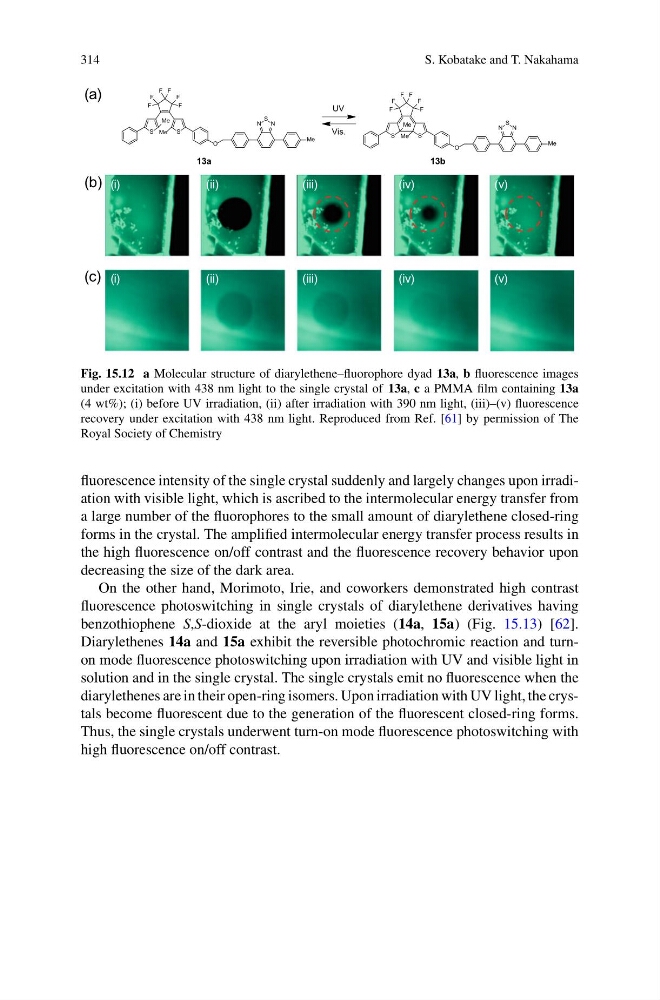
Fig. 15.12 a Molecular structure of diarylethene–fluorophore dyad 13a, b fluorescence images
under excitation with 438 nm light to the single crystal of 13a, c a PMMA film containing 13a
(4 wt%); (i) before UV irradiation, (ii) after irradiation with 390 nm light, (iii)–(v) fluorescence
recovery under excitation with 438 nm light. Reproduced from Ref. [61] by permission of The
Royal Society of Chemistry
fluorescence intensity of the single crystal suddenly and largely changes upon irradiation with visible light, which is ascribed to the intermolecular energy transfer from
a large number of the fluorophores to the small amount of diarylethene closed-ring
forms in the crystal. The amplified intermolecular energy transfer process results in
the high fluorescence on/off contrast and the fluorescence recovery behavior upon
decreasing the size of the dark area.
On the other hand, Morimoto, Irie, and coworkers demonstrated high contrast
fluorescence photoswitching in single crystals of diarylethene derivatives having
benzothiophene S,S-dioxide at the aryl moieties (14a, 15a) (Fig. 15.13) [62].
Diarylethenes 14a and 15a exhibit the reversible photochromic reaction and turnon mode fluorescence photoswitching upon irradiation with UV and visible light in
solution and in the single crystal. The single crystals emit no fluorescence when the
diarylethenes are in their open-ring isomers. Upon irradiation with UV light, the crystals become fluorescent due to the generation of the fluorescent closed-ring forms.
Thus, the single crystals underwent turn-on mode fluorescence photoswitching with
high fluorescence on/off contrast.
S. Kobatake and T. Nakahama
S
S
Me
Me
UV
Vis.
F
F
F F
F
F
O
Me
N
S
N
S
S
Me
Me
F
F
F F
F
F
O
Me
N
S
N
13a
13b
(a)
(b) (i)
(ii)
(iii)
(iv)
(v)
(i)
(ii)
(iii)
(iv)
(v)
(c)
Fig. 15.12 a Molecular structure of diarylethene–fluorophore dyad 13a, b fluorescence images
under excitation with 438 nm light to the single crystal of 13a, c a PMMA film containing 13a
(4 wt%); (i) before UV irradiation, (ii) after irradiation with 390 nm light, (iii)–(v) fluorescence
recovery under excitation with 438 nm light. Reproduced from Ref. [61] by permission of The
Royal Society of Chemistry
fluorescence intensity of the single crystal suddenly and largely changes upon irradiation with visible light, which is ascribed to the intermolecular energy transfer from
a large number of the fluorophores to the small amount of diarylethene closed-ring
forms in the crystal. The amplified intermolecular energy transfer process results in
the high fluorescence on/off contrast and the fluorescence recovery behavior upon
decreasing the size of the dark area.
On the other hand, Morimoto, Irie, and coworkers demonstrated high contrast
fluorescence photoswitching in single crystals of diarylethene derivatives having
benzothiophene S,S-dioxide at the aryl moieties (14a, 15a) (Fig. 15.13) [62].
Diarylethenes 14a and 15a exhibit the reversible photochromic reaction and turnon mode fluorescence photoswitching upon irradiation with UV and visible light in
solution and in the single crystal. The single crystals emit no fluorescence when the
diarylethenes are in their open-ring isomers. Upon irradiation with UV light, the crystals become fluorescent due to the generation of the fluorescent closed-ring forms.
Thus, the single crystals underwent turn-on mode fluorescence photoswitching with
high fluorescence on/off contrast.