

15 Solid-State Fluorescence Switching Using Photochromic …
311
O
O
DE
C6H13
C6H13
n
O
O
DE
n
S
S
DE
N
S
N
x
y n
(x = 0.05, y = 0.95)
O
OC9H19
C6H13
C6H13
n
n
O
OC9H19
S
S
N
S
N
x
y n
C8H17
C8H17
S
S
CH3
H3C
S
S
CH3
H3C
UV
Vis.
F
F
F F
F
F
F
F
F
F
F
F
O
O
O
C7H15
H3C
O
O
O
C7H15
H3C
P1
DE =
P2
P3
Photoresponsive moiety
P1'
P2'
P3'
Open-ring form
Closed-ring form
(a)
(b)
(c)
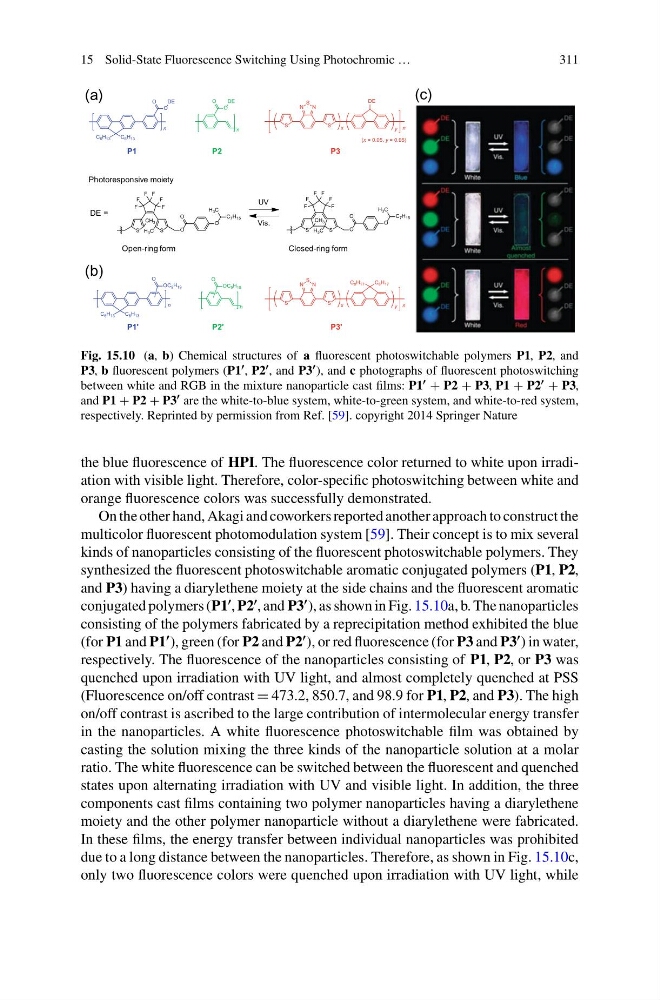
Fig. 15.10 (a, b) Chemical structures of a fluorescent photoswitchable polymers P1, P2, and
P3, b fluorescent polymers (P1 , P2 , and P3 ), and c photographs of fluorescent photoswitching
between white and RGB in the mixture nanoparticle cast films: P1 + P2 + P3, P1 + P2 + P3,
and P1 + P2 + P3 are the white-to-blue system, white-to-green system, and white-to-red system,
respectively. Reprinted by permission from Ref. [59]. copyright 2014 Springer Nature
the blue fluorescence of HPI. The fluorescence color returned to white upon irradiation with visible light. Therefore, color-specific photoswitching between white and
orange fluorescence colors was successfully demonstrated.
On the other hand, Akagi and coworkers reported another approach to construct the
multicolor fluorescent photomodulation system [59]. Their concept is to mix several
kinds of nanoparticles consisting of the fluorescent photoswitchable polymers. They
synthesized the fluorescent photoswitchable aromatic conjugated polymers (P1, P2,
and P3) having a diarylethene moiety at the side chains and the fluorescent aromatic
conjugated polymers (P1
, P2
, and P3
), as shown in Fig. 15.10a, b. The nanoparticles
consisting of the polymers fabricated by a reprecipitation method exhibited the blue
(for P1 and P1
), green (for P2 and P2
), or red fluorescence (for P3 and P3
) in water,
respectively. The fluorescence of the nanoparticles consisting of P1, P2, or P3 was
quenched upon irradiation with UV light, and almost completely quenched at PSS
(Fluorescence on/off contrast = 473.2, 850.7, and 98.9 for P1, P2, and P3). The high
on/off contrast is ascribed to the large contribution of intermolecular energy transfer
in the nanoparticles. A white fluorescence photoswitchable film was obtained by
casting the solution mixing the three kinds of the nanoparticle solution at a molar
ratio. The white fluorescence can be switched between the fluorescent and quenched
states upon alternating irradiation with UV and visible light. In addition, the three
components cast films containing two polymer nanoparticles having a diarylethene
moiety and the other polymer nanoparticle without a diarylethene were fabricated.
In these films, the energy transfer between individual nanoparticles was prohibited
due to a long distance between the nanoparticles. Therefore, as shown in Fig. 15.10c,
only two fluorescence colors were quenched upon irradiation with UV light, while
311
O
O
DE
C6H13
C6H13
n
O
O
DE
n
S
S
DE
N
S
N
x
y n
(x = 0.05, y = 0.95)
O
OC9H19
C6H13
C6H13
n
n
O
OC9H19
S
S
N
S
N
x
y n
C8H17
C8H17
S
S
CH3
H3C
S
S
CH3
H3C
UV
Vis.
F
F
F F
F
F
F
F
F
F
F
F
O
O
O
C7H15
H3C
O
O
O
C7H15
H3C
P1
DE =
P2
P3
Photoresponsive moiety
P1'
P2'
P3'
Open-ring form
Closed-ring form
(a)
(b)
(c)
Fig. 15.10 (a, b) Chemical structures of a fluorescent photoswitchable polymers P1, P2, and
P3, b fluorescent polymers (P1 , P2 , and P3 ), and c photographs of fluorescent photoswitching
between white and RGB in the mixture nanoparticle cast films: P1 + P2 + P3, P1 + P2 + P3,
and P1 + P2 + P3 are the white-to-blue system, white-to-green system, and white-to-red system,
respectively. Reprinted by permission from Ref. [59]. copyright 2014 Springer Nature
the blue fluorescence of HPI. The fluorescence color returned to white upon irradiation with visible light. Therefore, color-specific photoswitching between white and
orange fluorescence colors was successfully demonstrated.
On the other hand, Akagi and coworkers reported another approach to construct the
multicolor fluorescent photomodulation system [59]. Their concept is to mix several
kinds of nanoparticles consisting of the fluorescent photoswitchable polymers. They
synthesized the fluorescent photoswitchable aromatic conjugated polymers (P1, P2,
and P3) having a diarylethene moiety at the side chains and the fluorescent aromatic
conjugated polymers (P1
, P2
, and P3
), as shown in Fig. 15.10a, b. The nanoparticles
consisting of the polymers fabricated by a reprecipitation method exhibited the blue
(for P1 and P1
), green (for P2 and P2
), or red fluorescence (for P3 and P3
) in water,
respectively. The fluorescence of the nanoparticles consisting of P1, P2, or P3 was
quenched upon irradiation with UV light, and almost completely quenched at PSS
(Fluorescence on/off contrast = 473.2, 850.7, and 98.9 for P1, P2, and P3). The high
on/off contrast is ascribed to the large contribution of intermolecular energy transfer
in the nanoparticles. A white fluorescence photoswitchable film was obtained by
casting the solution mixing the three kinds of the nanoparticle solution at a molar
ratio. The white fluorescence can be switched between the fluorescent and quenched
states upon alternating irradiation with UV and visible light. In addition, the three
components cast films containing two polymer nanoparticles having a diarylethene
moiety and the other polymer nanoparticle without a diarylethene were fabricated.
In these films, the energy transfer between individual nanoparticles was prohibited
due to a long distance between the nanoparticles. Therefore, as shown in Fig. 15.10c,
only two fluorescence colors were quenched upon irradiation with UV light, while