

312
S. Kobatake and T. Nakahama
the other fluorescence was not altered. As a result, the color of the cast films was
converted from white to blue, white to green, and white to red, respectively.
15.3.2 Photo-Patternable Electroluminescence on Organic
Light-Emitting Diode
The rational designs of the fluorescent photoswitchable system enable not only
the single fluorescence color on/off switching but also the fluorescence modulation
between dual colors. Such materials have attracted much attention for the practical
application such as organic light-emitting diodes (OLEDs), which are promising
devices in flat-panel displays and in smart illumination technologies. The fabrication
process of full-color OLED display consisting of RGB-emissive dyes is complicated
and costly for fabricating large-area displays because the display must be selectively
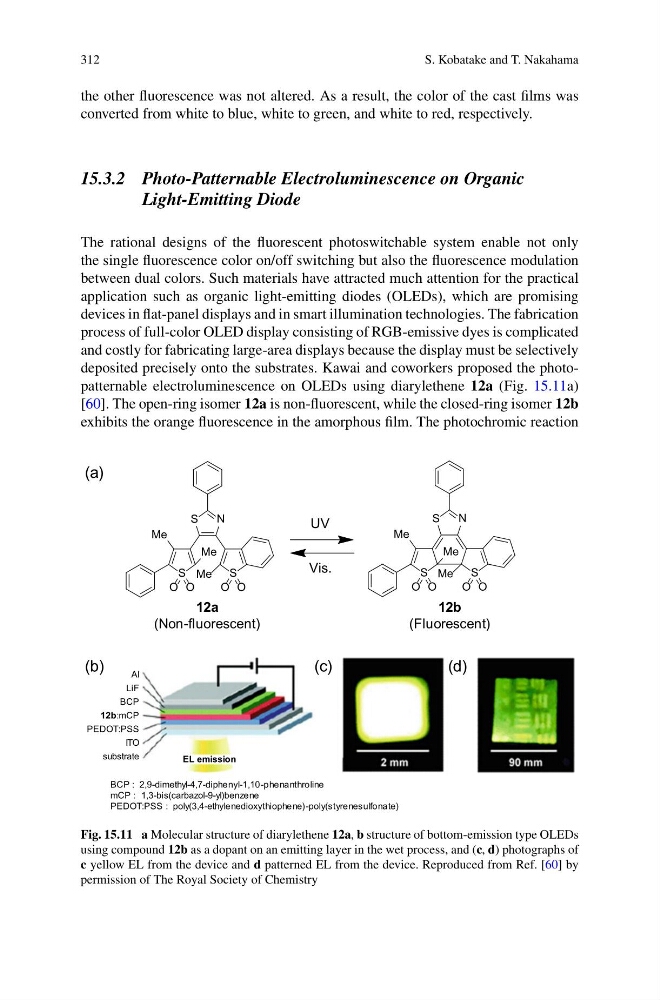
deposited precisely onto the substrates. Kawai and coworkers proposed the photopatternable electroluminescence on OLEDs using diarylethene 12a (Fig. 15.11a)
[60]. The open-ring isomer 12a is non-fluorescent, while the closed-ring isomer 12b
exhibits the orange fluorescence in the amorphous film. The photochromic reaction
S
S
Me
Me
S
S
Me
Me
UV
Vis.
N
S
N
S
Me
Me
O O
O O
O O
O O
12a
(Non-fluorescent)
12b
(Fluorescent)
(a)
(c)
(d)
Al
LiF
BCP
12b:mCP
PEDOT:PSS
ITO
substrate
(b)
BCP : 2,9-dimethyl-4,7-diphenyl-1,10-phenanthroline
mCP : 1,3-bis(carbazol-9-yl)benzene
PEDOT:PSS : poly(3,4-ethylenedioxythiophene)-poly(styrenesulfonate)
EL emission
Fig. 15.11 a Molecular structure of diarylethene 12a, b structure of bottom-emission type OLEDs
using compound 12b as a dopant on an emitting layer in the wet process, and (c, d) photographs of
c yellow EL from the device and d patterned EL from the device. Reproduced from Ref. [60] by
permission of The Royal Society of Chemistry
S. Kobatake and T. Nakahama
the other fluorescence was not altered. As a result, the color of the cast films was
converted from white to blue, white to green, and white to red, respectively.
15.3.2 Photo-Patternable Electroluminescence on Organic
Light-Emitting Diode
The rational designs of the fluorescent photoswitchable system enable not only
the single fluorescence color on/off switching but also the fluorescence modulation
between dual colors. Such materials have attracted much attention for the practical
application such as organic light-emitting diodes (OLEDs), which are promising
devices in flat-panel displays and in smart illumination technologies. The fabrication
process of full-color OLED display consisting of RGB-emissive dyes is complicated
and costly for fabricating large-area displays because the display must be selectively
deposited precisely onto the substrates. Kawai and coworkers proposed the photopatternable electroluminescence on OLEDs using diarylethene 12a (Fig. 15.11a)
[60]. The open-ring isomer 12a is non-fluorescent, while the closed-ring isomer 12b
exhibits the orange fluorescence in the amorphous film. The photochromic reaction
S
S
Me
Me
S
S
Me
Me
UV
Vis.
N
S
N
S
Me
Me
O O
O O
O O
O O
12a
(Non-fluorescent)
12b
(Fluorescent)
(a)
(c)
(d)
Al
LiF
BCP
12b:mCP
PEDOT:PSS
ITO
substrate
(b)
BCP : 2,9-dimethyl-4,7-diphenyl-1,10-phenanthroline
mCP : 1,3-bis(carbazol-9-yl)benzene
PEDOT:PSS : poly(3,4-ethylenedioxythiophene)-poly(styrenesulfonate)
EL emission
Fig. 15.11 a Molecular structure of diarylethene 12a, b structure of bottom-emission type OLEDs
using compound 12b as a dopant on an emitting layer in the wet process, and (c, d) photographs of
c yellow EL from the device and d patterned EL from the device. Reproduced from Ref. [60] by
permission of The Royal Society of Chemistry