

15 Solid-State Fluorescence Switching Using Photochromic …
305
concentration of the diarylethenes and the fluorophores results in more efficient fluorescence photoswitching when strong fluorescence of the fluorophore is observed
even in high concentrations. However, a further increase in the number of doped
molecules to the polymer film may cause problems such as a phase separation.
Herein, a polymer bearing diarylethene and cyanostilbene moieties in the main chain
were prepared and the fluorescence photoswitching behavior was investigated [47].
The neat polymer film exhibited strong fluorescence and the reversible fluorescence
photoswitching with high on/off contrast (>10).
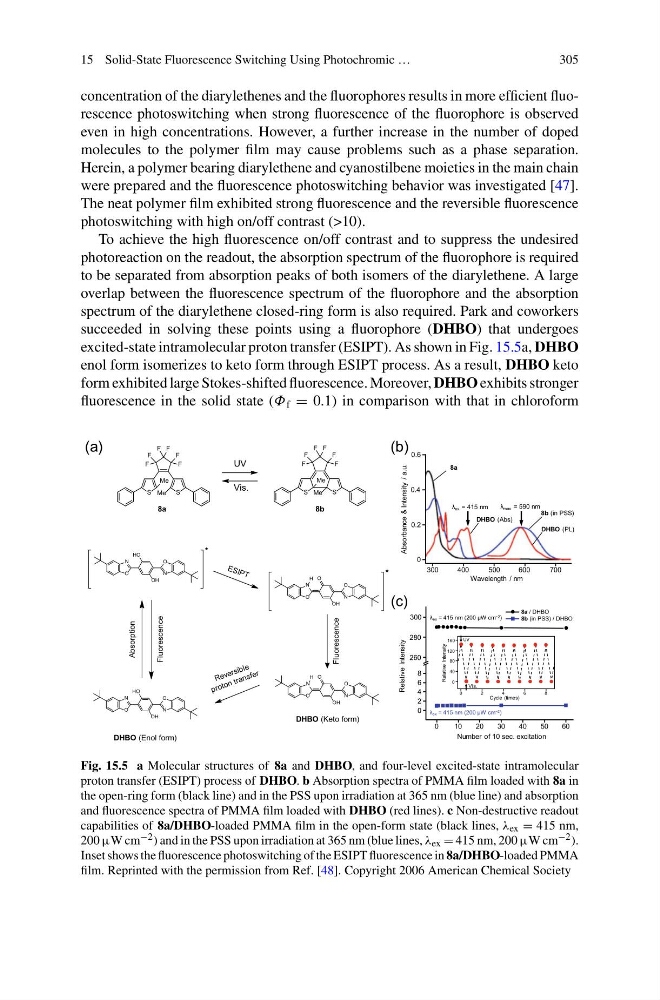
To achieve the high fluorescence on/off contrast and to suppress the undesired
photoreaction on the readout, the absorption spectrum of the fluorophore is required
to be separated from absorption peaks of both isomers of the diarylethene. A large
overlap between the fluorescence spectrum of the fluorophore and the absorption
spectrum of the diarylethene closed-ring form is also required. Park and coworkers
succeeded in solving these points using a fluorophore (DHBO) that undergoes
excited-state intramolecular proton transfer (ESIPT). As shown in Fig. 15.5a, DHBO
enol form isomerizes to keto form through ESIPT process. As a result, DHBO keto
form exhibited large Stokes-shifted fluorescence. Moreover, DHBO exhibits stronger
fluorescence in the solid state (Φ f = 0.1) in comparison with that in chloroform
O
N
N
O
HO
OH
O
N
N
O
HO
OH
*
O
N
N
O
O
OH
H
*
Absorption
Fluorescence
DHBO (Enol form)
DHBO (Keto form)
Fluorescence
O
N
N
O
O
OH
H
S
S
Me
Me
S
S
Me
Me
UV
Vis.
F
F
F F
F
F
F
F
F
F
F
F
8a
8b
(a)
(b)
(c)
8a / DHBO
8b (in PSS) / DHBO
8a
DHBO (PL)
8b (in PSS)
Wavelength / nm
300
400
500
600
700
0.6
0.4
0.2
0
Absorbance & Intensity / a.u.
Relative Intensity
300
280
260
8
6
4
2
0
Relative Intensity
0
1 0
2 0
3 0
4 0
5 0
6 0
0
2
8
Cycle (times)
6
4
λex = 415 nm (200 μW cm −2 )
λex = 415 nm (200 μW cm −2 )
0
40
80
120
160
Number of 10 sec. excitation
Vis.
UV
λex = 415 nm
λmax = 590 nm
DHBO (Abs)
Fig. 15.5 a Molecular structures of 8a and DHBO, and four-level excited-state intramolecular
proton transfer (ESIPT) process of DHBO. b Absorption spectra of PMMA film loaded with 8a in
the open-ring form (black line) and in the PSS upon irradiation at 365 nm (blue line) and absorption
and fluorescence spectra of PMMA film loaded with DHBO (red lines). c Non-destructive readout
capabilities of 8a/DHBO-loaded PMMA film in the open-form state (black lines, λ ex = 415 nm,
200 μW cm −2 ) and in the PSS upon irradiation at 365 nm (blue lines, λ ex = 415 nm, 200 μW cm −2 ).
Inset shows the fluorescence photoswitching of the ESIPT fluorescence in 8a/DHBO-loaded PMMA
film. Reprinted with the permission from Ref. [48]. Copyright 2006 American Chemical Society
305
concentration of the diarylethenes and the fluorophores results in more efficient fluorescence photoswitching when strong fluorescence of the fluorophore is observed
even in high concentrations. However, a further increase in the number of doped
molecules to the polymer film may cause problems such as a phase separation.
Herein, a polymer bearing diarylethene and cyanostilbene moieties in the main chain
were prepared and the fluorescence photoswitching behavior was investigated [47].
The neat polymer film exhibited strong fluorescence and the reversible fluorescence
photoswitching with high on/off contrast (>10).
To achieve the high fluorescence on/off contrast and to suppress the undesired
photoreaction on the readout, the absorption spectrum of the fluorophore is required
to be separated from absorption peaks of both isomers of the diarylethene. A large
overlap between the fluorescence spectrum of the fluorophore and the absorption
spectrum of the diarylethene closed-ring form is also required. Park and coworkers
succeeded in solving these points using a fluorophore (DHBO) that undergoes
excited-state intramolecular proton transfer (ESIPT). As shown in Fig. 15.5a, DHBO
enol form isomerizes to keto form through ESIPT process. As a result, DHBO keto
form exhibited large Stokes-shifted fluorescence. Moreover, DHBO exhibits stronger
fluorescence in the solid state (Φ f = 0.1) in comparison with that in chloroform
O
N
N
O
HO
OH
O
N
N
O
HO
OH
*
O
N
N
O
O
OH
H
*
Absorption
Fluorescence
DHBO (Enol form)
DHBO (Keto form)
Fluorescence
O
N
N
O
O
OH
H
S
S
Me
Me
S
S
Me
Me
UV
Vis.
F
F
F F
F
F
F
F
F
F
F
F
8a
8b
(a)
(b)
(c)
8a / DHBO
8b (in PSS) / DHBO
8a
DHBO (PL)
8b (in PSS)
Wavelength / nm
300
400
500
600
700
0.6
0.4
0.2
0
Absorbance & Intensity / a.u.
Relative Intensity
300
280
260
8
6
4
2
0
Relative Intensity
0
1 0
2 0
3 0
4 0
5 0
6 0
0
2
8
Cycle (times)
6
4
λex = 415 nm (200 μW cm −2 )
λex = 415 nm (200 μW cm −2 )
0
40
80
120
160
Number of 10 sec. excitation
Vis.
UV
λex = 415 nm
λmax = 590 nm
DHBO (Abs)
Fig. 15.5 a Molecular structures of 8a and DHBO, and four-level excited-state intramolecular
proton transfer (ESIPT) process of DHBO. b Absorption spectra of PMMA film loaded with 8a in
the open-ring form (black line) and in the PSS upon irradiation at 365 nm (blue line) and absorption
and fluorescence spectra of PMMA film loaded with DHBO (red lines). c Non-destructive readout
capabilities of 8a/DHBO-loaded PMMA film in the open-form state (black lines, λ ex = 415 nm,
200 μW cm −2 ) and in the PSS upon irradiation at 365 nm (blue lines, λ ex = 415 nm, 200 μW cm −2 ).
Inset shows the fluorescence photoswitching of the ESIPT fluorescence in 8a/DHBO-loaded PMMA
film. Reprinted with the permission from Ref. [48]. Copyright 2006 American Chemical Society