

304
S. Kobatake and T. Nakahama
fluorescence photoswitching in the solid states loaded with a large amount of the
molecules. However, most of the organic fluorophores become non- or very weak
fluorescent with increasing concentration of the fluorophores due to concentration
quenching, which is a serious problem for the application. To overcome this problem,
Park and coworkers proposed to use cyanostilbene derivative as the fluorophore
moiety [39]. Cyanostilbene is one of the molecules exhibiting aggregation-induced
emission (AIE) [40–42]. The molecules having AIE characteristics exhibit weak or
no emission in dilute solution but exhibit strong emission in the aggregated state.
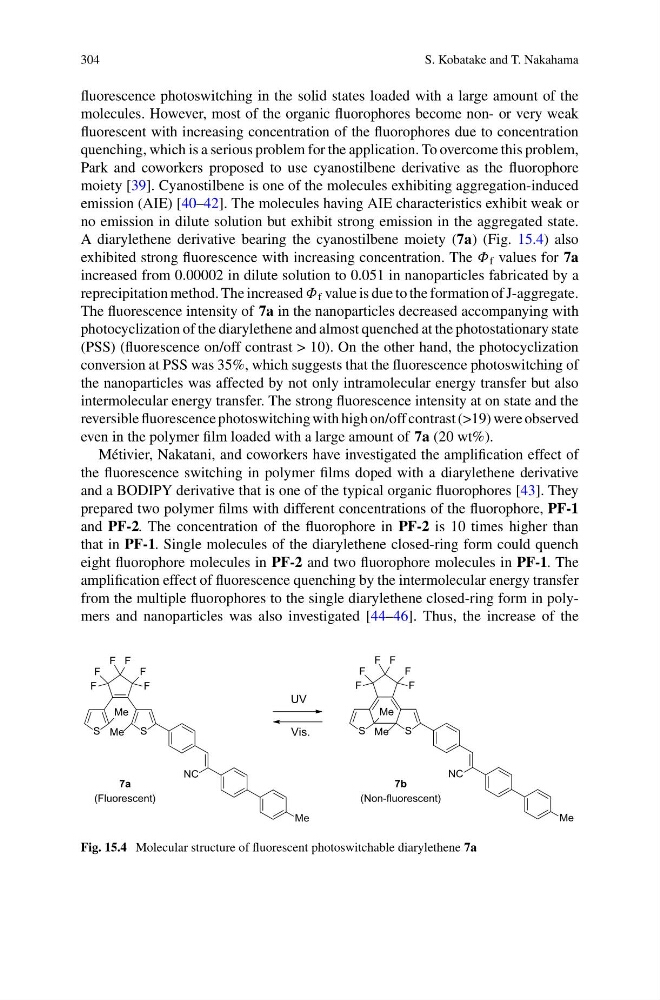
A diarylethene derivative bearing the cyanostilbene moiety (7a) (Fig. 15.4) also
exhibited strong fluorescence with increasing concentration. The Φ f values for 7a
increased from 0.00002 in dilute solution to 0.051 in nanoparticles fabricated by a
reprecipitation method. The increased Φ f value is due to the formation of J-aggregate.
The fluorescence intensity of 7a in the nanoparticles decreased accompanying with
photocyclization of the diarylethene and almost quenched at the photostationary state
(PSS) (fluorescence on/off contrast > 10). On the other hand, the photocyclization
conversion at PSS was 35%, which suggests that the fluorescence photoswitching of
the nanoparticles was affected by not only intramolecular energy transfer but also
intermolecular energy transfer. The strong fluorescence intensity at on state and the
reversible fluorescence photoswitching with high on/off contrast (>19) were observed
even in the polymer film loaded with a large amount of 7a (20 wt%).
Métivier, Nakatani, and coworkers have investigated the amplification effect of
the fluorescence switching in polymer films doped with a diarylethene derivative
and a BODIPY derivative that is one of the typical organic fluorophores [43]. They
prepared two polymer films with different concentrations of the fluorophore, PF-1
and PF-2. The concentration of the fluorophore in PF-2 is 10 times higher than
that in PF-1. Single molecules of the diarylethene closed-ring form could quench
eight fluorophore molecules in PF-2 and two fluorophore molecules in PF-1. The
amplification effect of fluorescence quenching by the intermolecular energy transfer
from the multiple fluorophores to the single diarylethene closed-ring form in polymers and nanoparticles was also investigated [44–46]. Thus, the increase of the
S
S
Me
Me
F
F
F
F
F
F
NC
Me
S
S
Me
Me
F
F
F
F
F
F
NC
Me
UV
Vis.
7a
(Fluorescent)
7b
(Non-fluorescent)
Fig. 15.4 Molecular structure of fluorescent photoswitchable diarylethene 7a
S. Kobatake and T. Nakahama
fluorescence photoswitching in the solid states loaded with a large amount of the
molecules. However, most of the organic fluorophores become non- or very weak
fluorescent with increasing concentration of the fluorophores due to concentration
quenching, which is a serious problem for the application. To overcome this problem,
Park and coworkers proposed to use cyanostilbene derivative as the fluorophore
moiety [39]. Cyanostilbene is one of the molecules exhibiting aggregation-induced
emission (AIE) [40–42]. The molecules having AIE characteristics exhibit weak or
no emission in dilute solution but exhibit strong emission in the aggregated state.
A diarylethene derivative bearing the cyanostilbene moiety (7a) (Fig. 15.4) also
exhibited strong fluorescence with increasing concentration. The Φ f values for 7a
increased from 0.00002 in dilute solution to 0.051 in nanoparticles fabricated by a
reprecipitation method. The increased Φ f value is due to the formation of J-aggregate.
The fluorescence intensity of 7a in the nanoparticles decreased accompanying with
photocyclization of the diarylethene and almost quenched at the photostationary state
(PSS) (fluorescence on/off contrast > 10). On the other hand, the photocyclization
conversion at PSS was 35%, which suggests that the fluorescence photoswitching of
the nanoparticles was affected by not only intramolecular energy transfer but also
intermolecular energy transfer. The strong fluorescence intensity at on state and the
reversible fluorescence photoswitching with high on/off contrast (>19) were observed
even in the polymer film loaded with a large amount of 7a (20 wt%).
Métivier, Nakatani, and coworkers have investigated the amplification effect of
the fluorescence switching in polymer films doped with a diarylethene derivative
and a BODIPY derivative that is one of the typical organic fluorophores [43]. They
prepared two polymer films with different concentrations of the fluorophore, PF-1
and PF-2. The concentration of the fluorophore in PF-2 is 10 times higher than
that in PF-1. Single molecules of the diarylethene closed-ring form could quench
eight fluorophore molecules in PF-2 and two fluorophore molecules in PF-1. The
amplification effect of fluorescence quenching by the intermolecular energy transfer
from the multiple fluorophores to the single diarylethene closed-ring form in polymers and nanoparticles was also investigated [44–46]. Thus, the increase of the
S
S
Me
Me
F
F
F
F
F
F
NC
Me
S
S
Me
Me
F
F
F
F
F
F
NC
Me
UV
Vis.
7a
(Fluorescent)
7b
(Non-fluorescent)
Fig. 15.4 Molecular structure of fluorescent photoswitchable diarylethene 7a