

15 Solid-State Fluorescence Switching Using Photochromic …
303
N
S
S
Me
Me
F
F
F
F
F
F
OMe
R
N
O
O
O
O
C6H13
C6H13
N
S
S
Me
Me
F
F
F
F
F
F
OMe
R
N
O
O
O
O
C6H13
C6H13
5b: R = Me
6b: R = OMe
5a: R = Me
6a: R = OMe
UV
Vis.
(a)
(b)
(c)
(d)
(f)
(g)
Energy
Energy
CI
CI
CI
CI
CI
S 0
S 1
S 1
S 0
(PnBMA)
(PnBMA)
(PMMA)
(PMMA)
1000
0
2000 3000 4000 5000
ON-Time / msec
0
5
10
15
20
25
30
35
Occurrence
10
15
20
Occurrence
5
1000
0
2000 3000 4000 5000
ON-Time / msec
0
10
15
20
Occurrence
5
0
(e)
200
0
400 600 800 1000
ON-Time / msec
0
200
0
400 600 800 1000
ON-Time / msec
10
20
30
40
Occurrence
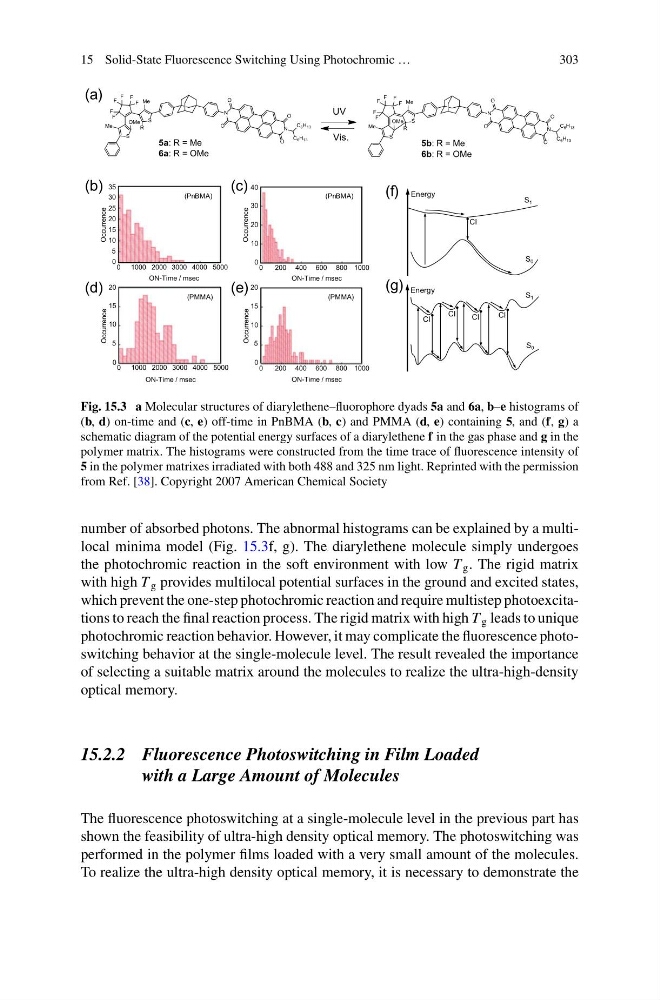
Fig. 15.3 a Molecular structures of diarylethene–fluorophore dyads 5a and 6a, b–e histograms of
(b, d) on-time and (c, e) off-time in PnBMA (b, c) and PMMA (d, e) containing 5, and (f, g) a
schematic diagram of the potential energy surfaces of a diarylethene f in the gas phase and g in the
polymer matrix. The histograms were constructed from the time trace of fluorescence intensity of
5 in the polymer matrixes irradiated with both 488 and 325 nm light. Reprinted with the permission
from Ref. [38]. Copyright 2007 American Chemical Society
number of absorbed photons. The abnormal histograms can be explained by a multilocal minima model (Fig. 15.3f, g). The diarylethene molecule simply undergoes
the photochromic reaction in the soft environment with low T g . The rigid matrix
with high T g provides multilocal potential surfaces in the ground and excited states,
which prevent the one-step photochromic reaction and require multistep photoexcitations to reach the final reaction process. The rigid matrix with high T g leads to unique
photochromic reaction behavior. However, it may complicate the fluorescence photoswitching behavior at the single-molecule level. The result revealed the importance
of selecting a suitable matrix around the molecules to realize the ultra-high-density
optical memory.
15.2.2 Fluorescence Photoswitching in Film Loaded
with a Large Amount of Molecules
The fluorescence photoswitching at a single-molecule level in the previous part has
shown the feasibility of ultra-high density optical memory. The photoswitching was
performed in the polymer films loaded with a very small amount of the molecules.
To realize the ultra-high density optical memory, it is necessary to demonstrate the
303
N
S
S
Me
Me
F
F
F
F
F
F
OMe
R
N
O
O
O
O
C6H13
C6H13
N
S
S
Me
Me
F
F
F
F
F
F
OMe
R
N
O
O
O
O
C6H13
C6H13
5b: R = Me
6b: R = OMe
5a: R = Me
6a: R = OMe
UV
Vis.
(a)
(b)
(c)
(d)
(f)
(g)
Energy
Energy
CI
CI
CI
CI
CI
S 0
S 1
S 1
S 0
(PnBMA)
(PnBMA)
(PMMA)
(PMMA)
1000
0
2000 3000 4000 5000
ON-Time / msec
0
5
10
15
20
25
30
35
Occurrence
10
15
20
Occurrence
5
1000
0
2000 3000 4000 5000
ON-Time / msec
0
10
15
20
Occurrence
5
0
(e)
200
0
400 600 800 1000
ON-Time / msec
0
200
0
400 600 800 1000
ON-Time / msec
10
20
30
40
Occurrence
Fig. 15.3 a Molecular structures of diarylethene–fluorophore dyads 5a and 6a, b–e histograms of
(b, d) on-time and (c, e) off-time in PnBMA (b, c) and PMMA (d, e) containing 5, and (f, g) a
schematic diagram of the potential energy surfaces of a diarylethene f in the gas phase and g in the
polymer matrix. The histograms were constructed from the time trace of fluorescence intensity of
5 in the polymer matrixes irradiated with both 488 and 325 nm light. Reprinted with the permission
from Ref. [38]. Copyright 2007 American Chemical Society
number of absorbed photons. The abnormal histograms can be explained by a multilocal minima model (Fig. 15.3f, g). The diarylethene molecule simply undergoes
the photochromic reaction in the soft environment with low T g . The rigid matrix
with high T g provides multilocal potential surfaces in the ground and excited states,
which prevent the one-step photochromic reaction and require multistep photoexcitations to reach the final reaction process. The rigid matrix with high T g leads to unique
photochromic reaction behavior. However, it may complicate the fluorescence photoswitching behavior at the single-molecule level. The result revealed the importance
of selecting a suitable matrix around the molecules to realize the ultra-high-density
optical memory.
15.2.2 Fluorescence Photoswitching in Film Loaded
with a Large Amount of Molecules
The fluorescence photoswitching at a single-molecule level in the previous part has
shown the feasibility of ultra-high density optical memory. The photoswitching was
performed in the polymer films loaded with a very small amount of the molecules.
To realize the ultra-high density optical memory, it is necessary to demonstrate the