

302
S. Kobatake and T. Nakahama
OMe
MeO
S
S
Me
Me
F
F
F
F
F
F
OMe
OMe
OMe
MeO
S
S
Me
Me
F
F
F
F
F
F
OMe
OMe
F
F
F
F
F
F
S
S
Me
Me
OMe
MeO
4b
(Fluorescence OFF)
4a
(Fluorescence ON)
UV
Vis.
UV
Vis.
Open-ring form
Closed-ring form
(287 nm)
(618 nm)
(488 nm)
Energy transfer
F
F
F
F
F
F
S
S
Me
Me
OMe
MeO
(a)
(b)
Fluorescence
MeO
OMe
(c)
Vis.
Vis.
UV
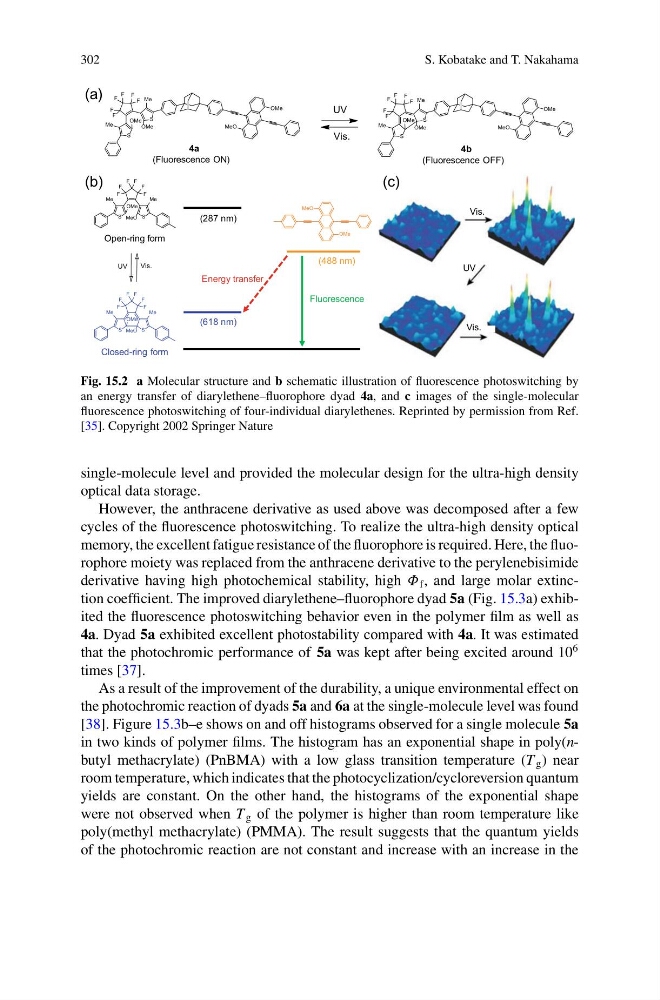
Fig. 15.2 a Molecular structure and b schematic illustration of fluorescence photoswitching by
an energy transfer of diarylethene–fluorophore dyad 4a, and c images of the single-molecular
fluorescence photoswitching of four-individual diarylethenes. Reprinted by permission from Ref.
[35]. Copyright 2002 Springer Nature
single-molecule level and provided the molecular design for the ultra-high density
optical data storage.
However, the anthracene derivative as used above was decomposed after a few
cycles of the fluorescence photoswitching. To realize the ultra-high density optical
memory, the excellent fatigue resistance of the fluorophore is required. Here, the fluorophore moiety was replaced from the anthracene derivative to the perylenebisimide
derivative having high photochemical stability, high Φ f , and large molar extinction coefficient. The improved diarylethene–fluorophore dyad 5a (Fig. 15.3a) exhibited the fluorescence photoswitching behavior even in the polymer film as well as
4a. Dyad 5a exhibited excellent photostability compared with 4a. It was estimated
that the photochromic performance of 5a was kept after being excited around 10
6
times [37].
As a result of the improvement of the durability, a unique environmental effect on
the photochromic reaction of dyads 5a and 6a at the single-molecule level was found
[38]. Figure 15.3b–e shows on and off histograms observed for a single molecule 5a
in two kinds of polymer films. The histogram has an exponential shape in poly(nbutyl methacrylate) (PnBMA) with a low glass transition temperature (T g ) near
room temperature, which indicates that the photocyclization/cycloreversion quantum
yields are constant. On the other hand, the histograms of the exponential shape
were not observed when T g of the polymer is higher than room temperature like
poly(methyl methacrylate) (PMMA). The result suggests that the quantum yields
of the photochromic reaction are not constant and increase with an increase in the
S. Kobatake and T. Nakahama
OMe
MeO
S
S
Me
Me
F
F
F
F
F
F
OMe
OMe
OMe
MeO
S
S
Me
Me
F
F
F
F
F
F
OMe
OMe
F
F
F
F
F
F
S
S
Me
Me
OMe
MeO
4b
(Fluorescence OFF)
4a
(Fluorescence ON)
UV
Vis.
UV
Vis.
Open-ring form
Closed-ring form
(287 nm)
(618 nm)
(488 nm)
Energy transfer
F
F
F
F
F
F
S
S
Me
Me
OMe
MeO
(a)
(b)
Fluorescence
MeO
OMe
(c)
Vis.
Vis.
UV
Fig. 15.2 a Molecular structure and b schematic illustration of fluorescence photoswitching by
an energy transfer of diarylethene–fluorophore dyad 4a, and c images of the single-molecular
fluorescence photoswitching of four-individual diarylethenes. Reprinted by permission from Ref.
[35]. Copyright 2002 Springer Nature
single-molecule level and provided the molecular design for the ultra-high density
optical data storage.
However, the anthracene derivative as used above was decomposed after a few
cycles of the fluorescence photoswitching. To realize the ultra-high density optical
memory, the excellent fatigue resistance of the fluorophore is required. Here, the fluorophore moiety was replaced from the anthracene derivative to the perylenebisimide
derivative having high photochemical stability, high Φ f , and large molar extinction coefficient. The improved diarylethene–fluorophore dyad 5a (Fig. 15.3a) exhibited the fluorescence photoswitching behavior even in the polymer film as well as
4a. Dyad 5a exhibited excellent photostability compared with 4a. It was estimated
that the photochromic performance of 5a was kept after being excited around 10
6
times [37].
As a result of the improvement of the durability, a unique environmental effect on
the photochromic reaction of dyads 5a and 6a at the single-molecule level was found
[38]. Figure 15.3b–e shows on and off histograms observed for a single molecule 5a
in two kinds of polymer films. The histogram has an exponential shape in poly(nbutyl methacrylate) (PnBMA) with a low glass transition temperature (T g ) near
room temperature, which indicates that the photocyclization/cycloreversion quantum
yields are constant. On the other hand, the histograms of the exponential shape
were not observed when T g of the polymer is higher than room temperature like
poly(methyl methacrylate) (PMMA). The result suggests that the quantum yields
of the photochromic reaction are not constant and increase with an increase in the