

13 Creation of Organic-Metal Hybridized Nanocrystals …
257
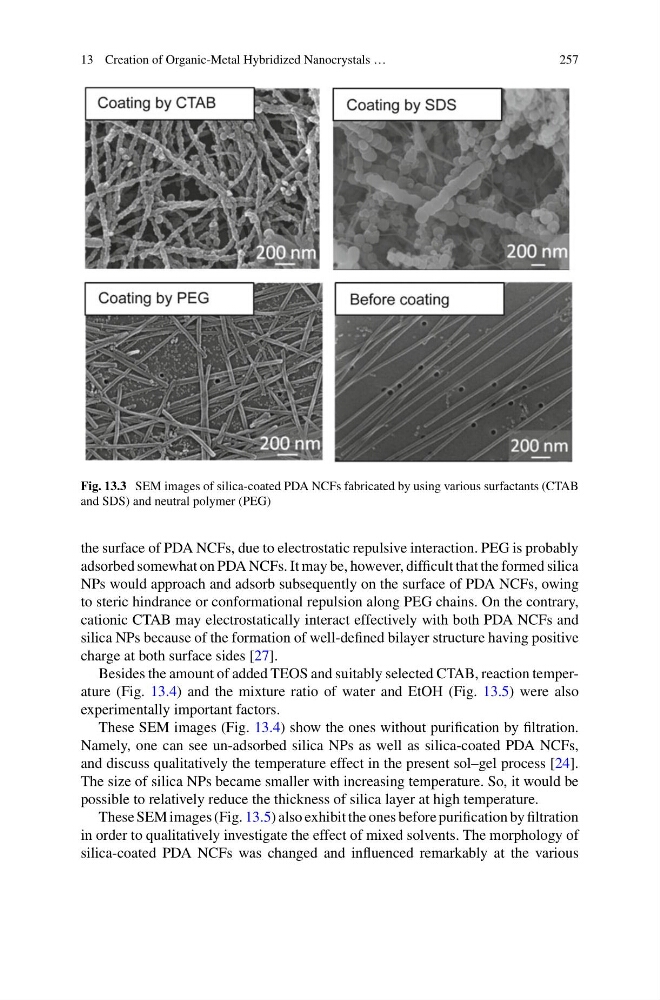
Fig. 13.3 SEM images of silica-coated PDA NCFs fabricated by using various surfactants (CTAB
and SDS) and neutral polymer (PEG)
the surface of PDA NCFs, due to electrostatic repulsive interaction. PEG is probably
adsorbed somewhat on PDA NCFs. It may be, however, difficult that the formed silica
NPs would approach and adsorb subsequently on the surface of PDA NCFs, owing
to steric hindrance or conformational repulsion along PEG chains. On the contrary,
cationic CTAB may electrostatically interact effectively with both PDA NCFs and
silica NPs because of the formation of well-defined bilayer structure having positive
charge at both surface sides [27].
Besides the amount of added TEOS and suitably selected CTAB, reaction temperature (Fig. 13.4) and the mixture ratio of water and EtOH (Fig. 13.5) were also
experimentally important factors.
These SEM images (Fig. 13.4) show the ones without purification by filtration.
Namely, one can see un-adsorbed silica NPs as well as silica-coated PDA NCFs,
and discuss qualitatively the temperature effect in the present sol–gel process [24].
The size of silica NPs became smaller with increasing temperature. So, it would be
possible to relatively reduce the thickness of silica layer at high temperature.
These SEM images (Fig. 13.5) also exhibit the ones before purification by filtration
in order to qualitatively investigate the effect of mixed solvents. The morphology of
silica-coated PDA NCFs was changed and influenced remarkably at the various
257
Fig. 13.3 SEM images of silica-coated PDA NCFs fabricated by using various surfactants (CTAB
and SDS) and neutral polymer (PEG)
the surface of PDA NCFs, due to electrostatic repulsive interaction. PEG is probably
adsorbed somewhat on PDA NCFs. It may be, however, difficult that the formed silica
NPs would approach and adsorb subsequently on the surface of PDA NCFs, owing
to steric hindrance or conformational repulsion along PEG chains. On the contrary,
cationic CTAB may electrostatically interact effectively with both PDA NCFs and
silica NPs because of the formation of well-defined bilayer structure having positive
charge at both surface sides [27].
Besides the amount of added TEOS and suitably selected CTAB, reaction temperature (Fig. 13.4) and the mixture ratio of water and EtOH (Fig. 13.5) were also
experimentally important factors.
These SEM images (Fig. 13.4) show the ones without purification by filtration.
Namely, one can see un-adsorbed silica NPs as well as silica-coated PDA NCFs,
and discuss qualitatively the temperature effect in the present sol–gel process [24].
The size of silica NPs became smaller with increasing temperature. So, it would be
possible to relatively reduce the thickness of silica layer at high temperature.
These SEM images (Fig. 13.5) also exhibit the ones before purification by filtration
in order to qualitatively investigate the effect of mixed solvents. The morphology of
silica-coated PDA NCFs was changed and influenced remarkably at the various