

256
T. Onodera et al.
ADVANCE) [22]. The surface potential of PDA NCFs is −40 to −60 mV, and PDA
NCFs are dispersed stably for half a year in water medium. However, the dispersion
stability was not so good in the case of CTAB.
The oriented thin films of PDA NCFs were fabricated easily by means of so-called
convective assembly method, which order parameter determined experimentally by
the dichroic ratio was high and about 0.87 [22].
13.2.2 Silica Coating of PDA Nanocrystal Fibers
The surface of PDA NCFs was coated with silica layer by using so-called sol–gel
method [24], and this layer is much important to control optoelectronic interaction
at the interface in the resulting hybridized NCFs [23]. A given amount of EtOH
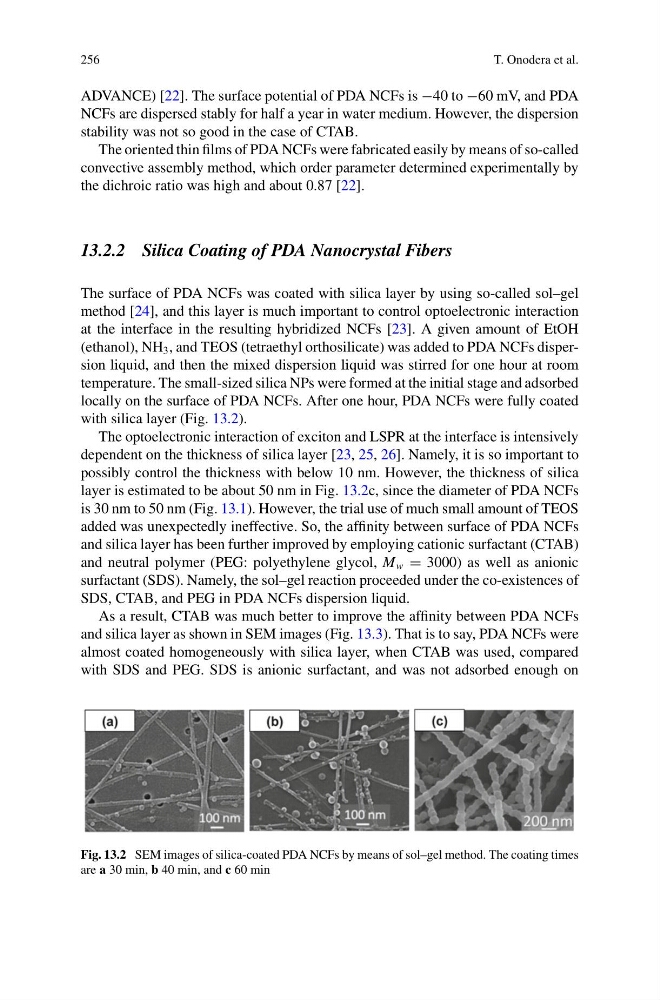
(ethanol), NH 3 , and TEOS (tetraethyl orthosilicate) was added to PDA NCFs dispersion liquid, and then the mixed dispersion liquid was stirred for one hour at room
temperature. The small-sized silica NPs were formed at the initial stage and adsorbed
locally on the surface of PDA NCFs. After one hour, PDA NCFs were fully coated
with silica layer (Fig. 13.2).
The optoelectronic interaction of exciton and LSPR at the interface is intensively
dependent on the thickness of silica layer [23, 25, 26]. Namely, it is so important to
possibly control the thickness with below 10 nm. However, the thickness of silica
layer is estimated to be about 50 nm in Fig. 13.2c, since the diameter of PDA NCFs
is 30 nm to 50 nm (Fig. 13.1). However, the trial use of much small amount of TEOS
added was unexpectedly ineffective. So, the affinity between surface of PDA NCFs
and silica layer has been further improved by employing cationic surfactant (CTAB)
and neutral polymer (PEG: polyethylene glycol, M w = 3000) as well as anionic
surfactant (SDS). Namely, the sol–gel reaction proceeded under the co-existences of
SDS, CTAB, and PEG in PDA NCFs dispersion liquid.
As a result, CTAB was much better to improve the affinity between PDA NCFs
and silica layer as shown in SEM images (Fig. 13.3). That is to say, PDA NCFs were
almost coated homogeneously with silica layer, when CTAB was used, compared
with SDS and PEG. SDS is anionic surfactant, and was not adsorbed enough on
Fig. 13.2 SEM images of silica-coated PDA NCFs by means of sol–gel method. The coating times
are a 30 min, b 40 min, and c 60 min
T. Onodera et al.
ADVANCE) [22]. The surface potential of PDA NCFs is −40 to −60 mV, and PDA
NCFs are dispersed stably for half a year in water medium. However, the dispersion
stability was not so good in the case of CTAB.
The oriented thin films of PDA NCFs were fabricated easily by means of so-called
convective assembly method, which order parameter determined experimentally by
the dichroic ratio was high and about 0.87 [22].
13.2.2 Silica Coating of PDA Nanocrystal Fibers
The surface of PDA NCFs was coated with silica layer by using so-called sol–gel
method [24], and this layer is much important to control optoelectronic interaction
at the interface in the resulting hybridized NCFs [23]. A given amount of EtOH
(ethanol), NH 3 , and TEOS (tetraethyl orthosilicate) was added to PDA NCFs dispersion liquid, and then the mixed dispersion liquid was stirred for one hour at room
temperature. The small-sized silica NPs were formed at the initial stage and adsorbed
locally on the surface of PDA NCFs. After one hour, PDA NCFs were fully coated
with silica layer (Fig. 13.2).
The optoelectronic interaction of exciton and LSPR at the interface is intensively
dependent on the thickness of silica layer [23, 25, 26]. Namely, it is so important to
possibly control the thickness with below 10 nm. However, the thickness of silica
layer is estimated to be about 50 nm in Fig. 13.2c, since the diameter of PDA NCFs
is 30 nm to 50 nm (Fig. 13.1). However, the trial use of much small amount of TEOS
added was unexpectedly ineffective. So, the affinity between surface of PDA NCFs
and silica layer has been further improved by employing cationic surfactant (CTAB)
and neutral polymer (PEG: polyethylene glycol, M w = 3000) as well as anionic
surfactant (SDS). Namely, the sol–gel reaction proceeded under the co-existences of
SDS, CTAB, and PEG in PDA NCFs dispersion liquid.
As a result, CTAB was much better to improve the affinity between PDA NCFs
and silica layer as shown in SEM images (Fig. 13.3). That is to say, PDA NCFs were
almost coated homogeneously with silica layer, when CTAB was used, compared
with SDS and PEG. SDS is anionic surfactant, and was not adsorbed enough on
Fig. 13.2 SEM images of silica-coated PDA NCFs by means of sol–gel method. The coating times
are a 30 min, b 40 min, and c 60 min