

18
K. D. M. Harris et al.
Here, we use the common abbreviations for the different liquid crystal phases: Iso
(isotropic liquid), N (nematic), SmA (smectic A), and SmB (smectic B). On cooling
the smectic B phase, a transition occurs to a crystalline phase, with the temperature
of this transition depending on the experimental conditions as a consequence of
supercooling.
The existence of the nematic phase (although over a narrow temperature range)
offers the possibility for molecular alignment in the magnetic field on cooling, with
the expectation that the terminal C–Br bond should be coincident with, or at least
oriented very close to, the director (n). As the experimental setup (Figs. 1.8 and
1.9) allows the orientation of the magnetic field to be varied with respect to the
direction of linear polarization of the incident X-ray beam, the experimental design
gives the opportunity to establish good-quality orientational information from XBI
data recorded using an X-ray energy close to the Br K-edge.
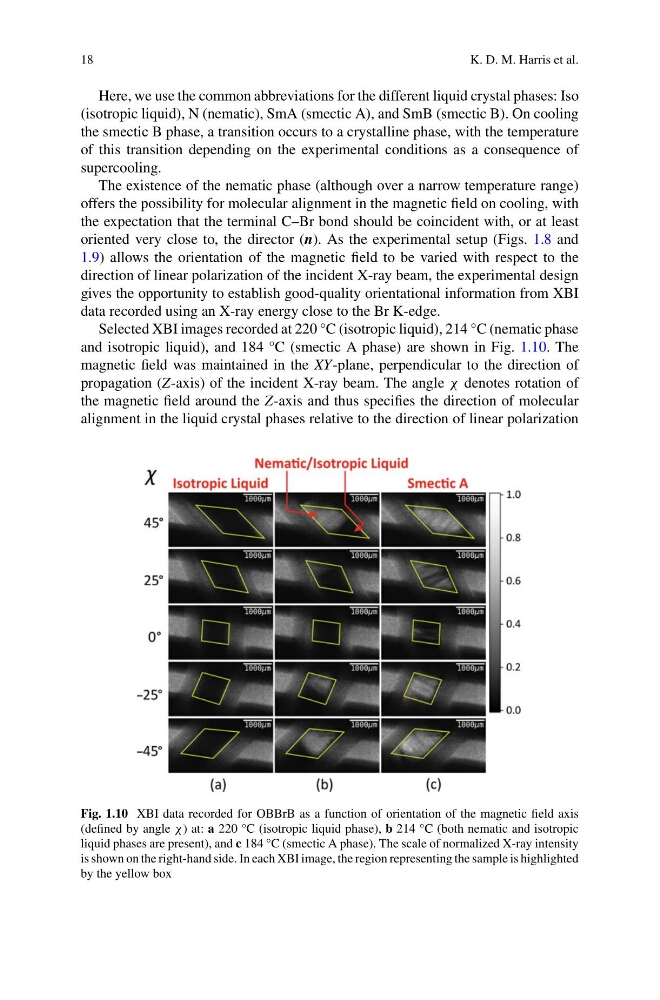
Selected XBI images recorded at 220 °C (isotropic liquid), 214 °C (nematic phase
and isotropic liquid), and 184 °C (smectic A phase) are shown in Fig. 1.10. The
magnetic field was maintained in the XY-plane, perpendicular to the direction of
propagation (Z-axis) of the incident X-ray beam. The angle χ denotes rotation of
the magnetic field around the Z-axis and thus specifies the direction of molecular
alignment in the liquid crystal phases relative to the direction of linear polarization
Fig. 1.10 XBI data recorded for OBBrB as a function of orientation of the magnetic field axis
(defined by angle χ) at: a 220 °C (isotropic liquid phase), b 214 °C (both nematic and isotropic
liquid phases are present), and c 184 °C (smectic A phase). The scale of normalized X-ray intensity
is shown on the right-hand side. In each XBI image, the region representing the sample is highlighted
by the yellow box
K. D. M. Harris et al.
Here, we use the common abbreviations for the different liquid crystal phases: Iso
(isotropic liquid), N (nematic), SmA (smectic A), and SmB (smectic B). On cooling
the smectic B phase, a transition occurs to a crystalline phase, with the temperature
of this transition depending on the experimental conditions as a consequence of
supercooling.
The existence of the nematic phase (although over a narrow temperature range)
offers the possibility for molecular alignment in the magnetic field on cooling, with
the expectation that the terminal C–Br bond should be coincident with, or at least
oriented very close to, the director (n). As the experimental setup (Figs. 1.8 and
1.9) allows the orientation of the magnetic field to be varied with respect to the
direction of linear polarization of the incident X-ray beam, the experimental design
gives the opportunity to establish good-quality orientational information from XBI
data recorded using an X-ray energy close to the Br K-edge.
Selected XBI images recorded at 220 °C (isotropic liquid), 214 °C (nematic phase
and isotropic liquid), and 184 °C (smectic A phase) are shown in Fig. 1.10. The
magnetic field was maintained in the XY-plane, perpendicular to the direction of
propagation (Z-axis) of the incident X-ray beam. The angle χ denotes rotation of
the magnetic field around the Z-axis and thus specifies the direction of molecular
alignment in the liquid crystal phases relative to the direction of linear polarization
Fig. 1.10 XBI data recorded for OBBrB as a function of orientation of the magnetic field axis
(defined by angle χ) at: a 220 °C (isotropic liquid phase), b 214 °C (both nematic and isotropic
liquid phases are present), and c 184 °C (smectic A phase). The scale of normalized X-ray intensity
is shown on the right-hand side. In each XBI image, the region representing the sample is highlighted
by the yellow box