

1 X-Ray Birefringence Imaging (XBI): A New Technique …
17
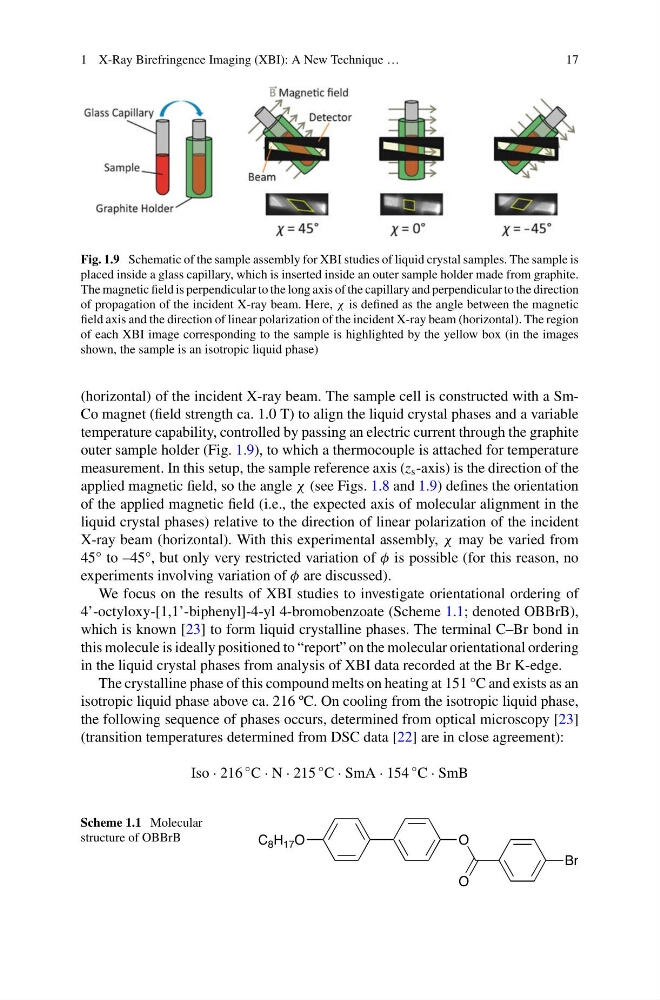
Fig. 1.9 Schematic of the sample assembly for XBI studies of liquid crystal samples. The sample is
placed inside a glass capillary, which is inserted inside an outer sample holder made from graphite.
The magnetic field is perpendicular to the long axis of the capillary and perpendicular to the direction
of propagation of the incident X-ray beam. Here, χ is defined as the angle between the magnetic
field axis and the direction of linear polarization of the incident X-ray beam (horizontal). The region
of each XBI image corresponding to the sample is highlighted by the yellow box (in the images
shown, the sample is an isotropic liquid phase)
(horizontal) of the incident X-ray beam. The sample cell is constructed with a SmCo magnet (field strength ca. 1.0 T) to align the liquid crystal phases and a variable
temperature capability, controlled by passing an electric current through the graphite
outer sample holder (Fig. 1.9), to which a thermocouple is attached for temperature
measurement. In this setup, the sample reference axis (z s -axis) is the direction of the
applied magnetic field, so the angle χ (see Figs. 1.8 and 1.9) defines the orientation
of the applied magnetic field (i.e., the expected axis of molecular alignment in the
liquid crystal phases) relative to the direction of linear polarization of the incident
X-ray beam (horizontal). With this experimental assembly, χ may be varied from
45° to –45°, but only very restricted variation of φ is possible (for this reason, no
experiments involving variation of φ are discussed).
We focus on the results of XBI studies to investigate orientational ordering of
4’-octyloxy-[1,1’-biphenyl]-4-yl 4-bromobenzoate (Scheme 1.1; denoted OBBrB),
which is known [23] to form liquid crystalline phases. The terminal C–Br bond in
this molecule is ideally positioned to “report” on the molecular orientational ordering
in the liquid crystal phases from analysis of XBI data recorded at the Br K-edge.
The crystalline phase of this compound melts on heating at 151 °C and exists as an
isotropic liquid phase above ca. 216 ºC. On cooling from the isotropic liquid phase,
the following sequence of phases occurs, determined from optical microscopy [23]
(transition temperatures determined from DSC data [22] are in close agreement):
Iso · 216
◦ C · N · 215
◦ C · SmA · 154
◦ C · SmB
Scheme 1.1 Molecular
structure of OBBrB
17
Fig. 1.9 Schematic of the sample assembly for XBI studies of liquid crystal samples. The sample is
placed inside a glass capillary, which is inserted inside an outer sample holder made from graphite.
The magnetic field is perpendicular to the long axis of the capillary and perpendicular to the direction
of propagation of the incident X-ray beam. Here, χ is defined as the angle between the magnetic
field axis and the direction of linear polarization of the incident X-ray beam (horizontal). The region
of each XBI image corresponding to the sample is highlighted by the yellow box (in the images
shown, the sample is an isotropic liquid phase)
(horizontal) of the incident X-ray beam. The sample cell is constructed with a SmCo magnet (field strength ca. 1.0 T) to align the liquid crystal phases and a variable
temperature capability, controlled by passing an electric current through the graphite
outer sample holder (Fig. 1.9), to which a thermocouple is attached for temperature
measurement. In this setup, the sample reference axis (z s -axis) is the direction of the
applied magnetic field, so the angle χ (see Figs. 1.8 and 1.9) defines the orientation
of the applied magnetic field (i.e., the expected axis of molecular alignment in the
liquid crystal phases) relative to the direction of linear polarization of the incident
X-ray beam (horizontal). With this experimental assembly, χ may be varied from
45° to –45°, but only very restricted variation of φ is possible (for this reason, no
experiments involving variation of φ are discussed).
We focus on the results of XBI studies to investigate orientational ordering of
4’-octyloxy-[1,1’-biphenyl]-4-yl 4-bromobenzoate (Scheme 1.1; denoted OBBrB),
which is known [23] to form liquid crystalline phases. The terminal C–Br bond in
this molecule is ideally positioned to “report” on the molecular orientational ordering
in the liquid crystal phases from analysis of XBI data recorded at the Br K-edge.
The crystalline phase of this compound melts on heating at 151 °C and exists as an
isotropic liquid phase above ca. 216 ºC. On cooling from the isotropic liquid phase,
the following sequence of phases occurs, determined from optical microscopy [23]
(transition temperatures determined from DSC data [22] are in close agreement):
Iso · 216
◦ C · N · 215
◦ C · SmA · 154
◦ C · SmB
Scheme 1.1 Molecular
structure of OBBrB