

238
H. Ohtsu et al.
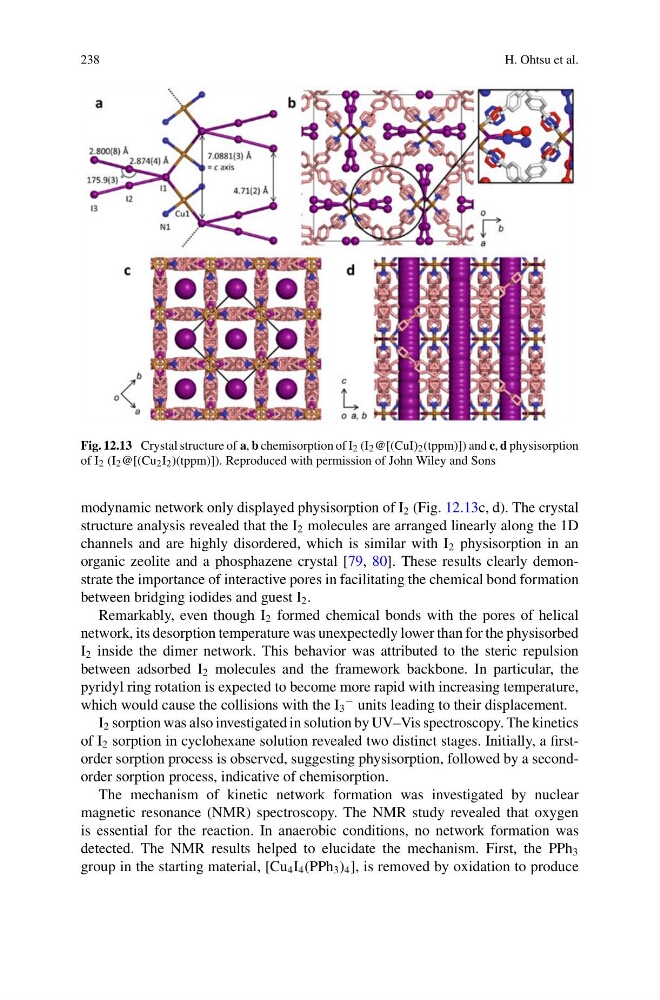
Fig. 12.13 Crystal structure of a, b chemisorption of I 2 (I 2 @[(CuI) 2 (tppm)]) and c, d physisorption
of I 2 (I 2 @[(Cu 2 I 2 )(tppm)]). Reproduced with permission of John Wiley and Sons
modynamic network only displayed physisorption of I 2 (Fig. 12.13c, d). The crystal
structure analysis revealed that the I 2 molecules are arranged linearly along the 1D
channels and are highly disordered, which is similar with I 2 physisorption in an
organic zeolite and a phosphazene crystal [79, 80]. These results clearly demonstrate the importance of interactive pores in facilitating the chemical bond formation
between bridging iodides and guest I 2 .
Remarkably, even though I 2 formed chemical bonds with the pores of helical
network, its desorption temperature was unexpectedly lower than for the physisorbed
I 2 inside the dimer network. This behavior was attributed to the steric repulsion
between adsorbed I 2 molecules and the framework backbone. In particular, the
pyridyl ring rotation is expected to become more rapid with increasing temperature,
which would cause the collisions with the I 3
− units leading to their displacement.
I 2 sorption was also investigated in solution by UV–Vis spectroscopy. The kinetics
of I 2 sorption in cyclohexane solution revealed two distinct stages. Initially, a firstorder sorption process is observed, suggesting physisorption, followed by a secondorder sorption process, indicative of chemisorption.
The mechanism of kinetic network formation was investigated by nuclear
magnetic resonance (NMR) spectroscopy. The NMR study revealed that oxygen
is essential for the reaction. In anaerobic conditions, no network formation was
detected. The NMR results helped to elucidate the mechanism. First, the PPh 3
group in the starting material, [Cu 4 I 4 (PPh 3 ) 4 ], is removed by oxidation to produce
H. Ohtsu et al.
Fig. 12.13 Crystal structure of a, b chemisorption of I 2 (I 2 @[(CuI) 2 (tppm)]) and c, d physisorption
of I 2 (I 2 @[(Cu 2 I 2 )(tppm)]). Reproduced with permission of John Wiley and Sons
modynamic network only displayed physisorption of I 2 (Fig. 12.13c, d). The crystal
structure analysis revealed that the I 2 molecules are arranged linearly along the 1D
channels and are highly disordered, which is similar with I 2 physisorption in an
organic zeolite and a phosphazene crystal [79, 80]. These results clearly demonstrate the importance of interactive pores in facilitating the chemical bond formation
between bridging iodides and guest I 2 .
Remarkably, even though I 2 formed chemical bonds with the pores of helical
network, its desorption temperature was unexpectedly lower than for the physisorbed
I 2 inside the dimer network. This behavior was attributed to the steric repulsion
between adsorbed I 2 molecules and the framework backbone. In particular, the
pyridyl ring rotation is expected to become more rapid with increasing temperature,
which would cause the collisions with the I 3
− units leading to their displacement.
I 2 sorption was also investigated in solution by UV–Vis spectroscopy. The kinetics
of I 2 sorption in cyclohexane solution revealed two distinct stages. Initially, a firstorder sorption process is observed, suggesting physisorption, followed by a secondorder sorption process, indicative of chemisorption.
The mechanism of kinetic network formation was investigated by nuclear
magnetic resonance (NMR) spectroscopy. The NMR study revealed that oxygen
is essential for the reaction. In anaerobic conditions, no network formation was
detected. The NMR results helped to elucidate the mechanism. First, the PPh 3
group in the starting material, [Cu 4 I 4 (PPh 3 ) 4 ], is removed by oxidation to produce