

12 Kinetic Assembly of Porous Coordination Networks …
239
a vacant copper site and O = PPh 3 . Second, DMSO rapidly occupies the coordinatively unsaturated site to generate a solvated CuI monomer at 453 K. Then,
a tppm ligand coordinates to the resultant CuI monomer to generate the intermediate species, [(CuI(DMSO) 2 ) 4 (tppm)]. The kinetic network can be crystallized from
this intermediate complex by rapid cooling of the reaction mixture. The outlined
kinetic assembly process is a powerful method for creating interactive pore sites in
coordination networks.
12.1.8 S 2 Trapping in Thermodynamically Assembled
Network
Because thermodynamic network has small pores, it can be particularly suitable for
small sulfur allotrope encapsulation, similar to the studies described in Sect. 12.1.4.
The small pore size cannot accommodate sulfur clusters larger than S 3 , and it was
expected to predominantly encapsulate disulfur, S 2 . This favorable characteristic
prompted us to conduct an in-depth study into sulfur encapsulation in the dimer
network [81].
Sulfur was encapsulated from the gas phase by the kinetic trapping method, in
which only sulfur vapor was present in the glassware while the network was kept at
room temperature to create a temperature gradient (as described in Sect. 12.1.9).
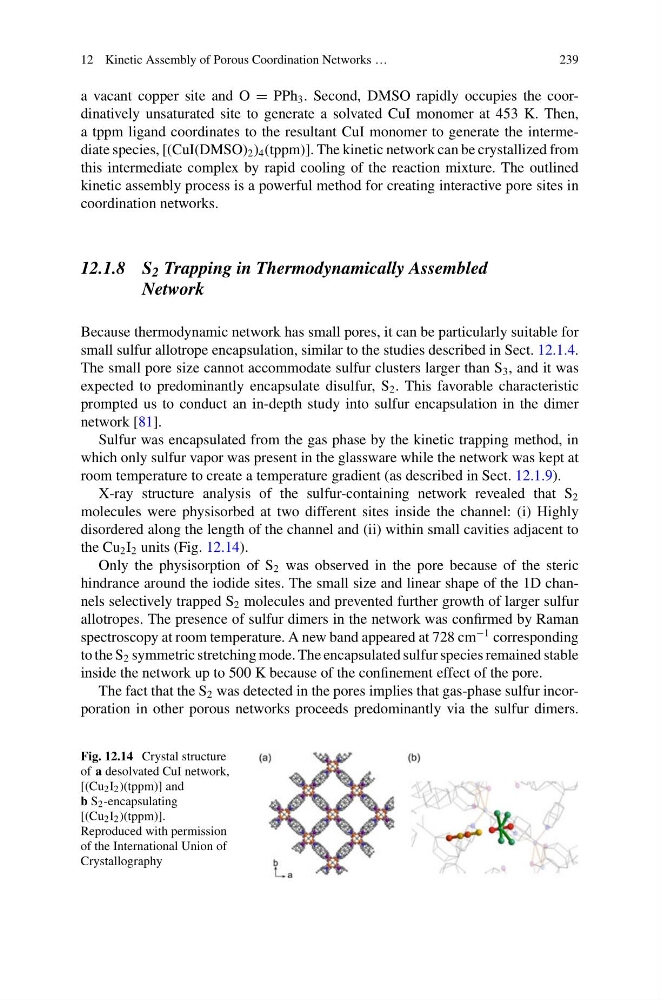
X-ray structure analysis of the sulfur-containing network revealed that S 2
molecules were physisorbed at two different sites inside the channel: (i) Highly
disordered along the length of the channel and (ii) within small cavities adjacent to
the Cu 2 I 2 units (Fig. 12.14).
Only the physisorption of S 2 was observed in the pore because of the steric
hindrance around the iodide sites. The small size and linear shape of the 1D channels selectively trapped S 2 molecules and prevented further growth of larger sulfur
allotropes. The presence of sulfur dimers in the network was confirmed by Raman
spectroscopy at room temperature. A new band appeared at 728 cm
−1 corresponding
to the S 2 symmetric stretching mode. The encapsulated sulfur species remained stable
inside the network up to 500 K because of the confinement effect of the pore.
The fact that the S 2 was detected in the pores implies that gas-phase sulfur incorporation in other porous networks proceeds predominantly via the sulfur dimers.
Fig. 12.14 Crystal structure
of a desolvated CuI network,
[(Cu 2 I 2 )(tppm)] and
b S 2 -encapsulating
[(Cu 2 I 2 )(tppm)].
Reproduced with permission
of the International Union of
Crystallography
239
a vacant copper site and O = PPh 3 . Second, DMSO rapidly occupies the coordinatively unsaturated site to generate a solvated CuI monomer at 453 K. Then,
a tppm ligand coordinates to the resultant CuI monomer to generate the intermediate species, [(CuI(DMSO) 2 ) 4 (tppm)]. The kinetic network can be crystallized from
this intermediate complex by rapid cooling of the reaction mixture. The outlined
kinetic assembly process is a powerful method for creating interactive pore sites in
coordination networks.
12.1.8 S 2 Trapping in Thermodynamically Assembled
Network
Because thermodynamic network has small pores, it can be particularly suitable for
small sulfur allotrope encapsulation, similar to the studies described in Sect. 12.1.4.
The small pore size cannot accommodate sulfur clusters larger than S 3 , and it was
expected to predominantly encapsulate disulfur, S 2 . This favorable characteristic
prompted us to conduct an in-depth study into sulfur encapsulation in the dimer
network [81].
Sulfur was encapsulated from the gas phase by the kinetic trapping method, in
which only sulfur vapor was present in the glassware while the network was kept at
room temperature to create a temperature gradient (as described in Sect. 12.1.9).
X-ray structure analysis of the sulfur-containing network revealed that S 2
molecules were physisorbed at two different sites inside the channel: (i) Highly
disordered along the length of the channel and (ii) within small cavities adjacent to
the Cu 2 I 2 units (Fig. 12.14).
Only the physisorption of S 2 was observed in the pore because of the steric
hindrance around the iodide sites. The small size and linear shape of the 1D channels selectively trapped S 2 molecules and prevented further growth of larger sulfur
allotropes. The presence of sulfur dimers in the network was confirmed by Raman
spectroscopy at room temperature. A new band appeared at 728 cm
−1 corresponding
to the S 2 symmetric stretching mode. The encapsulated sulfur species remained stable
inside the network up to 500 K because of the confinement effect of the pore.
The fact that the S 2 was detected in the pores implies that gas-phase sulfur incorporation in other porous networks proceeds predominantly via the sulfur dimers.
Fig. 12.14 Crystal structure
of a desolvated CuI network,
[(Cu 2 I 2 )(tppm)] and
b S 2 -encapsulating
[(Cu 2 I 2 )(tppm)].
Reproduced with permission
of the International Union of
Crystallography