

12 Kinetic Assembly of Porous Coordination Networks …
237
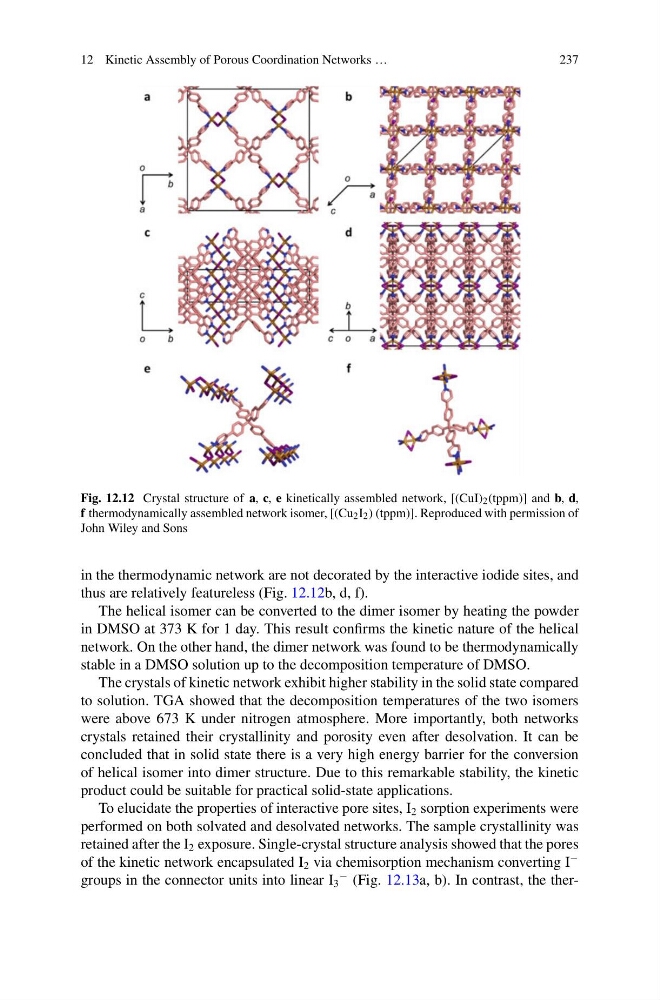
Fig. 12.12 Crystal structure of a, c, e kinetically assembled network, [(CuI) 2 (tppm)] and b, d,
f thermodynamically assembled network isomer, [(Cu 2 I 2 ) (tppm)]. Reproduced with permission of
John Wiley and Sons
in the thermodynamic network are not decorated by the interactive iodide sites, and
thus are relatively featureless (Fig. 12.12b, d, f).
The helical isomer can be converted to the dimer isomer by heating the powder
in DMSO at 373 K for 1 day. This result confirms the kinetic nature of the helical
network. On the other hand, the dimer network was found to be thermodynamically
stable in a DMSO solution up to the decomposition temperature of DMSO.
The crystals of kinetic network exhibit higher stability in the solid state compared
to solution. TGA showed that the decomposition temperatures of the two isomers
were above 673 K under nitrogen atmosphere. More importantly, both networks
crystals retained their crystallinity and porosity even after desolvation. It can be
concluded that in solid state there is a very high energy barrier for the conversion
of helical isomer into dimer structure. Due to this remarkable stability, the kinetic
product could be suitable for practical solid-state applications.
To elucidate the properties of interactive pore sites, I 2 sorption experiments were
performed on both solvated and desolvated networks. The sample crystallinity was
retained after the I 2 exposure. Single-crystal structure analysis showed that the pores
of the kinetic network encapsulated I 2 via chemisorption mechanism converting I
−
groups in the connector units into linear I 3
− (Fig. 12.13a, b). In contrast, the ther-
237
Fig. 12.12 Crystal structure of a, c, e kinetically assembled network, [(CuI) 2 (tppm)] and b, d,
f thermodynamically assembled network isomer, [(Cu 2 I 2 ) (tppm)]. Reproduced with permission of
John Wiley and Sons
in the thermodynamic network are not decorated by the interactive iodide sites, and
thus are relatively featureless (Fig. 12.12b, d, f).
The helical isomer can be converted to the dimer isomer by heating the powder
in DMSO at 373 K for 1 day. This result confirms the kinetic nature of the helical
network. On the other hand, the dimer network was found to be thermodynamically
stable in a DMSO solution up to the decomposition temperature of DMSO.
The crystals of kinetic network exhibit higher stability in the solid state compared
to solution. TGA showed that the decomposition temperatures of the two isomers
were above 673 K under nitrogen atmosphere. More importantly, both networks
crystals retained their crystallinity and porosity even after desolvation. It can be
concluded that in solid state there is a very high energy barrier for the conversion
of helical isomer into dimer structure. Due to this remarkable stability, the kinetic
product could be suitable for practical solid-state applications.
To elucidate the properties of interactive pore sites, I 2 sorption experiments were
performed on both solvated and desolvated networks. The sample crystallinity was
retained after the I 2 exposure. Single-crystal structure analysis showed that the pores
of the kinetic network encapsulated I 2 via chemisorption mechanism converting I
−
groups in the connector units into linear I 3
− (Fig. 12.13a, b). In contrast, the ther-