

232
H. Ohtsu et al.
12.1.5 Encapsulation of Reactive Molecules, P 4 and Br 2
In addition, we used the saddle network to capture and stabilize other reactive
elemental species, namely P 4 , also known as white phosphorous, and Br 2 [69, 70].
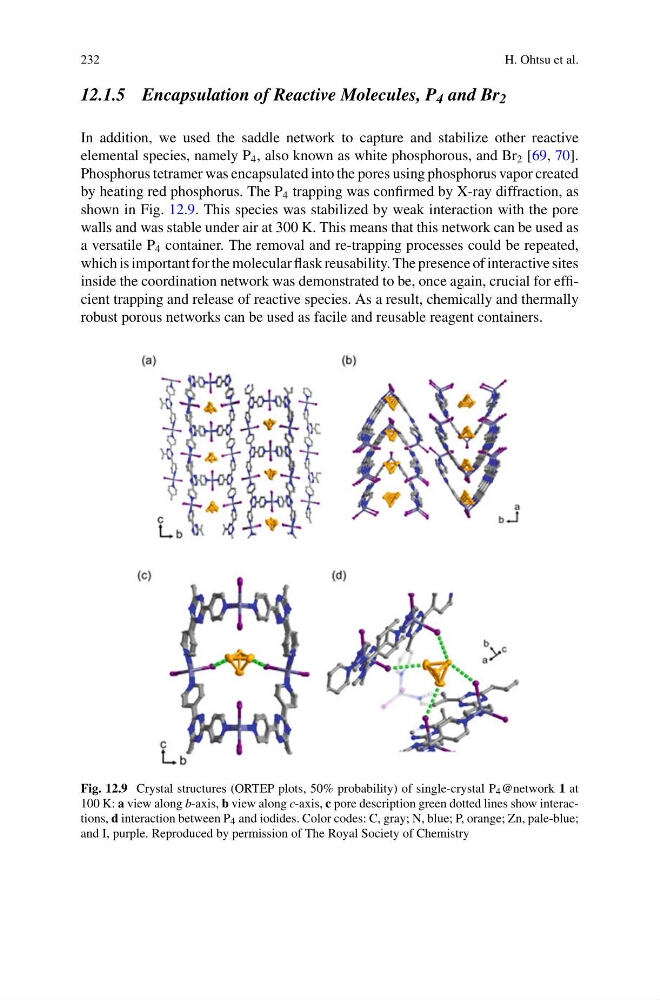
Phosphorus tetramer was encapsulated into the pores using phosphorus vapor created
by heating red phosphorus. The P 4 trapping was confirmed by X-ray diffraction, as
shown in Fig. 12.9. This species was stabilized by weak interaction with the pore
walls and was stable under air at 300 K. This means that this network can be used as
a versatile P 4 container. The removal and re-trapping processes could be repeated,
which is important for the molecular flask reusability. The presence of interactive sites
inside the coordination network was demonstrated to be, once again, crucial for efficient trapping and release of reactive species. As a result, chemically and thermally
robust porous networks can be used as facile and reusable reagent containers.
Fig. 12.9 Crystal structures (ORTEP plots, 50% probability) of single-crystal P 4 @network 1 at
100 K: a view along b-axis, b view along c-axis, c pore description green dotted lines show interactions, d interaction between P 4 and iodides. Color codes: C, gray; N, blue; P, orange; Zn, pale-blue;
and I, purple. Reproduced by permission of The Royal Society of Chemistry
H. Ohtsu et al.
12.1.5 Encapsulation of Reactive Molecules, P 4 and Br 2
In addition, we used the saddle network to capture and stabilize other reactive
elemental species, namely P 4 , also known as white phosphorous, and Br 2 [69, 70].
Phosphorus tetramer was encapsulated into the pores using phosphorus vapor created
by heating red phosphorus. The P 4 trapping was confirmed by X-ray diffraction, as
shown in Fig. 12.9. This species was stabilized by weak interaction with the pore
walls and was stable under air at 300 K. This means that this network can be used as
a versatile P 4 container. The removal and re-trapping processes could be repeated,
which is important for the molecular flask reusability. The presence of interactive sites
inside the coordination network was demonstrated to be, once again, crucial for efficient trapping and release of reactive species. As a result, chemically and thermally
robust porous networks can be used as facile and reusable reagent containers.
Fig. 12.9 Crystal structures (ORTEP plots, 50% probability) of single-crystal P 4 @network 1 at
100 K: a view along b-axis, b view along c-axis, c pore description green dotted lines show interactions, d interaction between P 4 and iodides. Color codes: C, gray; N, blue; P, orange; Zn, pale-blue;
and I, purple. Reproduced by permission of The Royal Society of Chemistry