

12 Kinetic Assembly of Porous Coordination Networks …
231
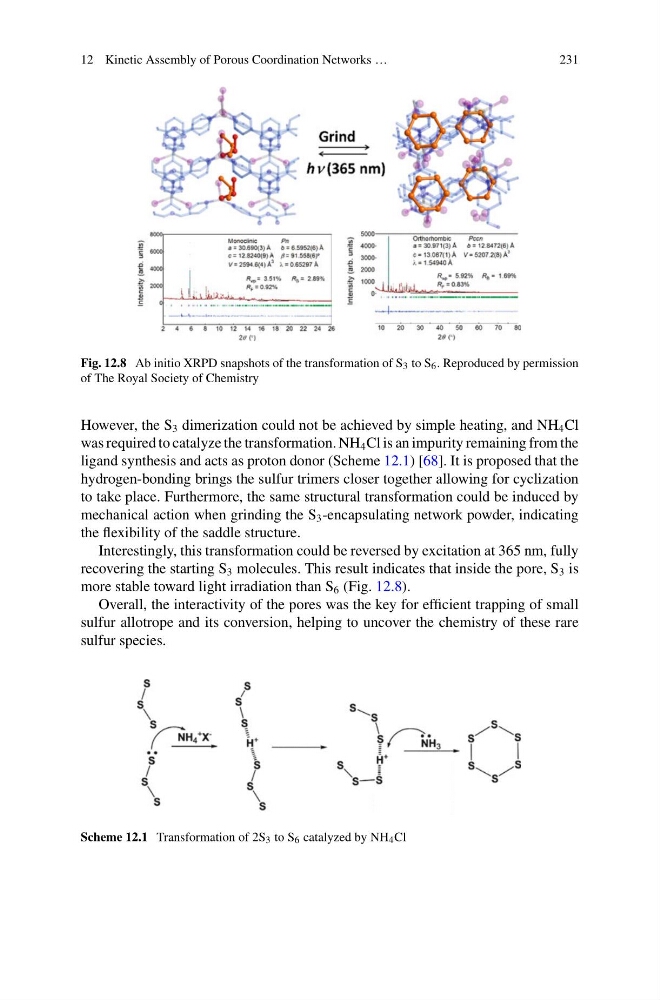
Fig. 12.8 Ab initio XRPD snapshots of the transformation of S 3 to S 6 . Reproduced by permission
of The Royal Society of Chemistry
However, the S 3 dimerization could not be achieved by simple heating, and NH 4 Cl
was required to catalyze the transformation. NH 4 Cl is an impurity remaining from the
ligand synthesis and acts as proton donor (Scheme 12.1) [68]. It is proposed that the
hydrogen-bonding brings the sulfur trimers closer together allowing for cyclization
to take place. Furthermore, the same structural transformation could be induced by
mechanical action when grinding the S 3 -encapsulating network powder, indicating
the flexibility of the saddle structure.
Interestingly, this transformation could be reversed by excitation at 365 nm, fully
recovering the starting S 3 molecules. This result indicates that inside the pore, S 3 is
more stable toward light irradiation than S 6 (Fig. 12.8).
Overall, the interactivity of the pores was the key for efficient trapping of small
sulfur allotrope and its conversion, helping to uncover the chemistry of these rare
sulfur species.
Scheme 12.1 Transformation of 2S 3 to S 6 catalyzed by NH 4 Cl
231
Fig. 12.8 Ab initio XRPD snapshots of the transformation of S 3 to S 6 . Reproduced by permission
of The Royal Society of Chemistry
However, the S 3 dimerization could not be achieved by simple heating, and NH 4 Cl
was required to catalyze the transformation. NH 4 Cl is an impurity remaining from the
ligand synthesis and acts as proton donor (Scheme 12.1) [68]. It is proposed that the
hydrogen-bonding brings the sulfur trimers closer together allowing for cyclization
to take place. Furthermore, the same structural transformation could be induced by
mechanical action when grinding the S 3 -encapsulating network powder, indicating
the flexibility of the saddle structure.
Interestingly, this transformation could be reversed by excitation at 365 nm, fully
recovering the starting S 3 molecules. This result indicates that inside the pore, S 3 is
more stable toward light irradiation than S 6 (Fig. 12.8).
Overall, the interactivity of the pores was the key for efficient trapping of small
sulfur allotrope and its conversion, helping to uncover the chemistry of these rare
sulfur species.
Scheme 12.1 Transformation of 2S 3 to S 6 catalyzed by NH 4 Cl