

230
H. Ohtsu et al.
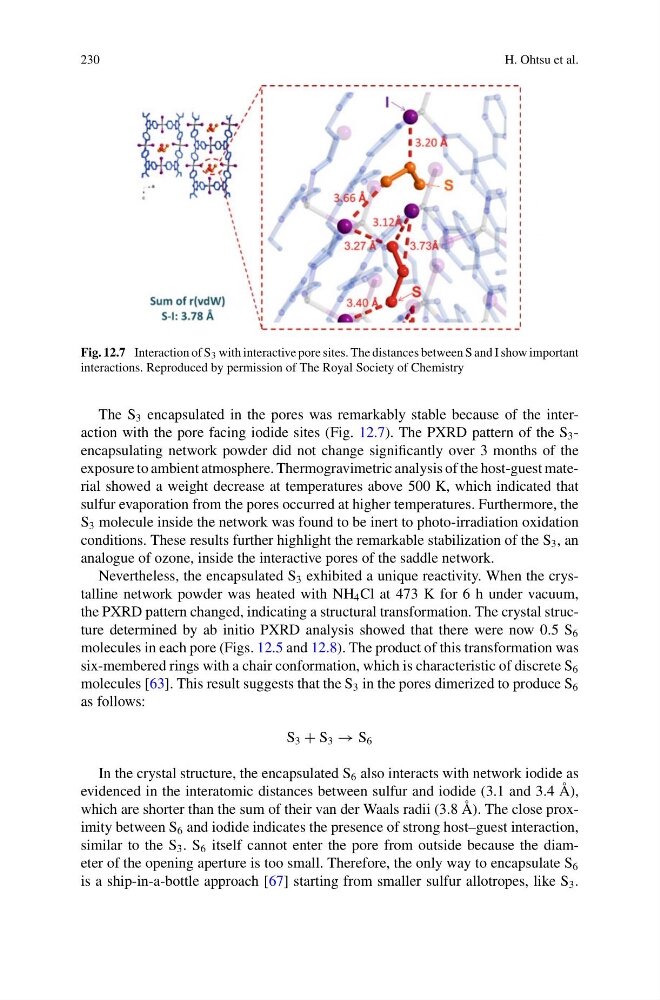
Fig. 12.7 Interaction of S 3 with interactive pore sites. The distances between S and I show important
interactions. Reproduced by permission of The Royal Society of Chemistry
The S 3 encapsulated in the pores was remarkably stable because of the interaction with the pore facing iodide sites (Fig. 12.7). The PXRD pattern of the S 3 -
encapsulating network powder did not change significantly over 3 months of the
exposure to ambient atmosphere. Thermogravimetric analysis of the host-guest material showed a weight decrease at temperatures above 500 K, which indicated that
sulfur evaporation from the pores occurred at higher temperatures. Furthermore, the
S 3 molecule inside the network was found to be inert to photo-irradiation oxidation
conditions. These results further highlight the remarkable stabilization of the S 3 , an
analogue of ozone, inside the interactive pores of the saddle network.
Nevertheless, the encapsulated S 3 exhibited a unique reactivity. When the crystalline network powder was heated with NH 4 Cl at 473 K for 6 h under vacuum,
the PXRD pattern changed, indicating a structural transformation. The crystal structure determined by ab initio PXRD analysis showed that there were now 0.5 S 6
molecules in each pore (Figs. 12.5 and 12.8). The product of this transformation was
six-membered rings with a chair conformation, which is characteristic of discrete S 6
molecules [63]. This result suggests that the S 3 in the pores dimerized to produce S 6
as follows:
S 3 + S 3 → S 6
In the crystal structure, the encapsulated S 6 also interacts with network iodide as
evidenced in the interatomic distances between sulfur and iodide (3.1 and 3.4 Å),
which are shorter than the sum of their van der Waals radii (3.8 Å). The close proximity between S 6 and iodide indicates the presence of strong host–guest interaction,
similar to the S 3 . S 6 itself cannot enter the pore from outside because the diameter of the opening aperture is too small. Therefore, the only way to encapsulate S 6
is a ship-in-a-bottle approach [67] starting from smaller sulfur allotropes, like S 3 .
H. Ohtsu et al.
Fig. 12.7 Interaction of S 3 with interactive pore sites. The distances between S and I show important
interactions. Reproduced by permission of The Royal Society of Chemistry
The S 3 encapsulated in the pores was remarkably stable because of the interaction with the pore facing iodide sites (Fig. 12.7). The PXRD pattern of the S 3 -
encapsulating network powder did not change significantly over 3 months of the
exposure to ambient atmosphere. Thermogravimetric analysis of the host-guest material showed a weight decrease at temperatures above 500 K, which indicated that
sulfur evaporation from the pores occurred at higher temperatures. Furthermore, the
S 3 molecule inside the network was found to be inert to photo-irradiation oxidation
conditions. These results further highlight the remarkable stabilization of the S 3 , an
analogue of ozone, inside the interactive pores of the saddle network.
Nevertheless, the encapsulated S 3 exhibited a unique reactivity. When the crystalline network powder was heated with NH 4 Cl at 473 K for 6 h under vacuum,
the PXRD pattern changed, indicating a structural transformation. The crystal structure determined by ab initio PXRD analysis showed that there were now 0.5 S 6
molecules in each pore (Figs. 12.5 and 12.8). The product of this transformation was
six-membered rings with a chair conformation, which is characteristic of discrete S 6
molecules [63]. This result suggests that the S 3 in the pores dimerized to produce S 6
as follows:
S 3 + S 3 → S 6
In the crystal structure, the encapsulated S 6 also interacts with network iodide as
evidenced in the interatomic distances between sulfur and iodide (3.1 and 3.4 Å),
which are shorter than the sum of their van der Waals radii (3.8 Å). The close proximity between S 6 and iodide indicates the presence of strong host–guest interaction,
similar to the S 3 . S 6 itself cannot enter the pore from outside because the diameter of the opening aperture is too small. Therefore, the only way to encapsulate S 6
is a ship-in-a-bottle approach [67] starting from smaller sulfur allotropes, like S 3 .