

12 Kinetic Assembly of Porous Coordination Networks …
229
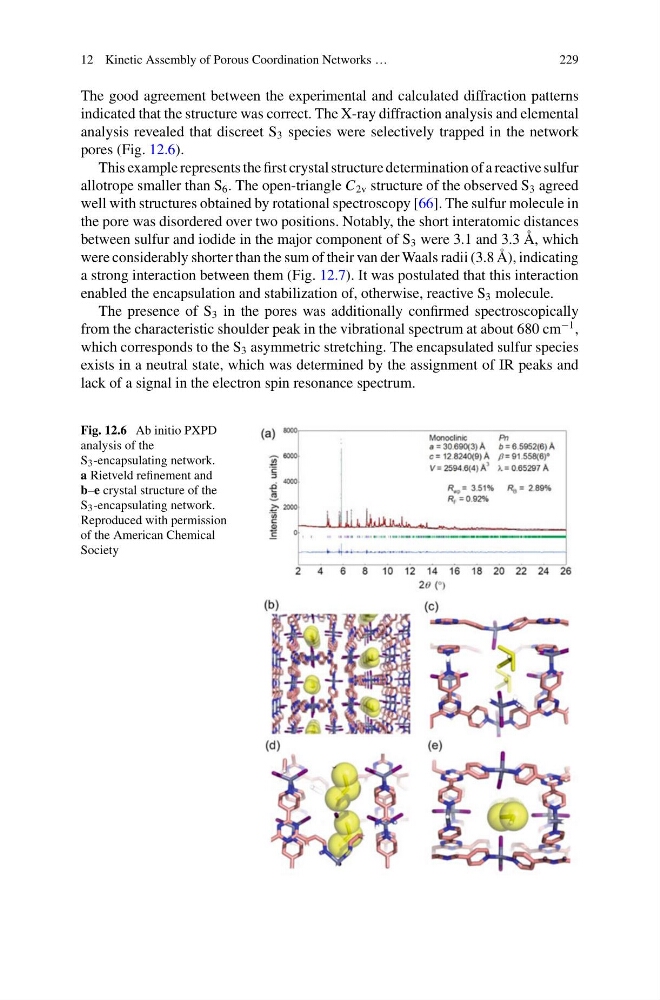
The good agreement between the experimental and calculated diffraction patterns
indicated that the structure was correct. The X-ray diffraction analysis and elemental
analysis revealed that discreet S 3 species were selectively trapped in the network
pores (Fig. 12.6).
This example represents the first crystal structure determination of a reactive sulfur
allotrope smaller than S 6 . The open-triangle C 2v structure of the observed S 3 agreed
well with structures obtained by rotational spectroscopy [66]. The sulfur molecule in
the pore was disordered over two positions. Notably, the short interatomic distances
between sulfur and iodide in the major component of S 3 were 3.1 and 3.3 Å, which
were considerably shorter than the sum of their van der Waals radii (3.8 Å), indicating
a strong interaction between them (Fig. 12.7). It was postulated that this interaction
enabled the encapsulation and stabilization of, otherwise, reactive S 3 molecule.
The presence of S 3 in the pores was additionally confirmed spectroscopically
from the characteristic shoulder peak in the vibrational spectrum at about 680 cm
−1 ,
which corresponds to the S 3 asymmetric stretching. The encapsulated sulfur species
exists in a neutral state, which was determined by the assignment of IR peaks and
lack of a signal in the electron spin resonance spectrum.
Fig. 12.6 Ab initio PXPD
analysis of the
S 3 -encapsulating network.
a Rietveld refinement and
b–e crystal structure of the
S 3 -encapsulating network.
Reproduced with permission
of the American Chemical
Society
229
The good agreement between the experimental and calculated diffraction patterns
indicated that the structure was correct. The X-ray diffraction analysis and elemental
analysis revealed that discreet S 3 species were selectively trapped in the network
pores (Fig. 12.6).
This example represents the first crystal structure determination of a reactive sulfur
allotrope smaller than S 6 . The open-triangle C 2v structure of the observed S 3 agreed
well with structures obtained by rotational spectroscopy [66]. The sulfur molecule in
the pore was disordered over two positions. Notably, the short interatomic distances
between sulfur and iodide in the major component of S 3 were 3.1 and 3.3 Å, which
were considerably shorter than the sum of their van der Waals radii (3.8 Å), indicating
a strong interaction between them (Fig. 12.7). It was postulated that this interaction
enabled the encapsulation and stabilization of, otherwise, reactive S 3 molecule.
The presence of S 3 in the pores was additionally confirmed spectroscopically
from the characteristic shoulder peak in the vibrational spectrum at about 680 cm
−1 ,
which corresponds to the S 3 asymmetric stretching. The encapsulated sulfur species
exists in a neutral state, which was determined by the assignment of IR peaks and
lack of a signal in the electron spin resonance spectrum.
Fig. 12.6 Ab initio PXPD
analysis of the
S 3 -encapsulating network.
a Rietveld refinement and
b–e crystal structure of the
S 3 -encapsulating network.
Reproduced with permission
of the American Chemical
Society