

228
H. Ohtsu et al.
directly by X-ray analysis [53–61]. Therefore, we decided to use the crystalline
powder of this network for this role and selectively trap metastable and reactive
species [62].
The small sulfur allotropes, S n (n < 6), are unstable and cannot be isolated from
the allotrope mixture either in the gas phase or in a solid Ar matrix [63–65]. These
sulfur species are highly reactive and readily condense into heavier allotropes under
ambient conditions. Therefore, their structures cannot be determined directly by
X-ray diffraction. To overcome this issue, we trapped these unstable species inside
a crystal matrix using the crystalline molecular flask method. We used interactive
pore sites in the saddle porous coordination network, [(ZnI 2 ) 3 (TPT) 2 ], where the
pore facing iodide groups could interact with the guest sulfur atoms and stabilize the
reactive species.
Sulfur was encapsulated in the saddle network structure by vapor diffusion at
533 K under vacuum for 6 h. Under these conditions, the gaseous sulfur and the
host network were fully equilibrated. After this treatment, the pale-yellow network
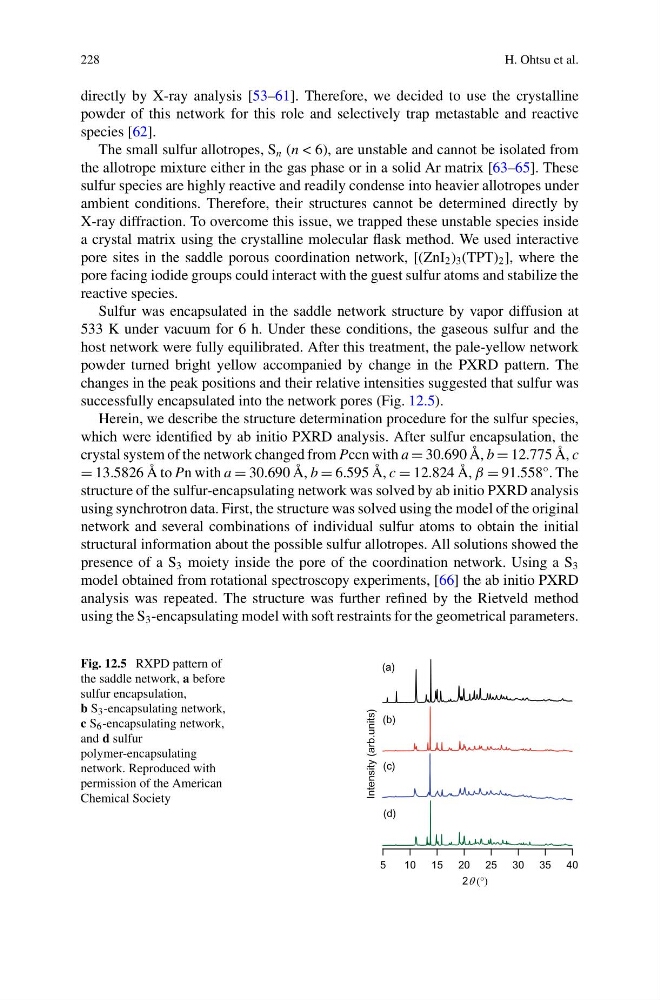
powder turned bright yellow accompanied by change in the PXRD pattern. The
changes in the peak positions and their relative intensities suggested that sulfur was
successfully encapsulated into the network pores (Fig. 12.5).
Herein, we describe the structure determination procedure for the sulfur species,
which were identified by ab initio PXRD analysis. After sulfur encapsulation, the
crystal system of the network changed from Pccn with a = 30.690 Å, b = 12.775 Å, c
= 13.5826 Å to Pn with a = 30.690 Å, b = 6.595 Å, c = 12.824 Å, β = 91.558°. The
structure of the sulfur-encapsulating network was solved by ab initio PXRD analysis
using synchrotron data. First, the structure was solved using the model of the original
network and several combinations of individual sulfur atoms to obtain the initial
structural information about the possible sulfur allotropes. All solutions showed the
presence of a S 3 moiety inside the pore of the coordination network. Using a S 3
model obtained from rotational spectroscopy experiments, [66] the ab initio PXRD
analysis was repeated. The structure was further refined by the Rietveld method
using the S 3 -encapsulating model with soft restraints for the geometrical parameters.
Fig. 12.5 RXPD pattern of
the saddle network, a before
sulfur encapsulation,
b S 3 -encapsulating network,
c S 6 -encapsulating network,
and d sulfur
polymer-encapsulating
network. Reproduced with
permission of the American
Chemical Society
40
35
30
25
20
15
10
5
2
Intensity (arb.units)
(a)
(b)
(c)
(d)
H. Ohtsu et al.
directly by X-ray analysis [53–61]. Therefore, we decided to use the crystalline
powder of this network for this role and selectively trap metastable and reactive
species [62].
The small sulfur allotropes, S n (n < 6), are unstable and cannot be isolated from
the allotrope mixture either in the gas phase or in a solid Ar matrix [63–65]. These
sulfur species are highly reactive and readily condense into heavier allotropes under
ambient conditions. Therefore, their structures cannot be determined directly by
X-ray diffraction. To overcome this issue, we trapped these unstable species inside
a crystal matrix using the crystalline molecular flask method. We used interactive
pore sites in the saddle porous coordination network, [(ZnI 2 ) 3 (TPT) 2 ], where the
pore facing iodide groups could interact with the guest sulfur atoms and stabilize the
reactive species.
Sulfur was encapsulated in the saddle network structure by vapor diffusion at
533 K under vacuum for 6 h. Under these conditions, the gaseous sulfur and the
host network were fully equilibrated. After this treatment, the pale-yellow network
powder turned bright yellow accompanied by change in the PXRD pattern. The
changes in the peak positions and their relative intensities suggested that sulfur was
successfully encapsulated into the network pores (Fig. 12.5).
Herein, we describe the structure determination procedure for the sulfur species,
which were identified by ab initio PXRD analysis. After sulfur encapsulation, the
crystal system of the network changed from Pccn with a = 30.690 Å, b = 12.775 Å, c
= 13.5826 Å to Pn with a = 30.690 Å, b = 6.595 Å, c = 12.824 Å, β = 91.558°. The
structure of the sulfur-encapsulating network was solved by ab initio PXRD analysis
using synchrotron data. First, the structure was solved using the model of the original
network and several combinations of individual sulfur atoms to obtain the initial
structural information about the possible sulfur allotropes. All solutions showed the
presence of a S 3 moiety inside the pore of the coordination network. Using a S 3
model obtained from rotational spectroscopy experiments, [66] the ab initio PXRD
analysis was repeated. The structure was further refined by the Rietveld method
using the S 3 -encapsulating model with soft restraints for the geometrical parameters.
Fig. 12.5 RXPD pattern of
the saddle network, a before
sulfur encapsulation,
b S 3 -encapsulating network,
c S 6 -encapsulating network,
and d sulfur
polymer-encapsulating
network. Reproduced with
permission of the American
Chemical Society
40
35
30
25
20
15
10
5
2
Intensity (arb.units)
(a)
(b)
(c)
(d)