

12 Kinetic Assembly of Porous Coordination Networks …
227
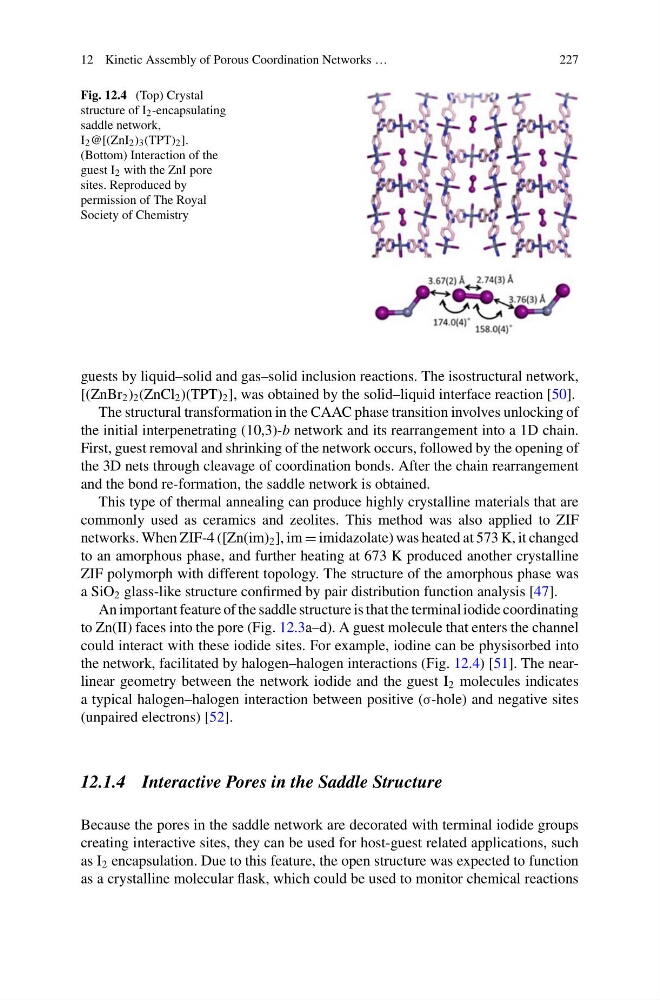
Fig. 12.4 (Top) Crystal
structure of I 2 -encapsulating
saddle network,
I 2 @[(ZnI 2 ) 3 (TPT) 2 ].
(Bottom) Interaction of the
guest I 2 with the ZnI pore
sites. Reproduced by
permission of The Royal
Society of Chemistry
guests by liquid–solid and gas–solid inclusion reactions. The isostructural network,
[(ZnBr 2 ) 2 (ZnCl 2 )(TPT) 2 ], was obtained by the solid–liquid interface reaction [50].
The structural transformation in the CAAC phase transition involves unlocking of
the initial interpenetrating (10,3)-b network and its rearrangement into a 1D chain.
First, guest removal and shrinking of the network occurs, followed by the opening of
the 3D nets through cleavage of coordination bonds. After the chain rearrangement
and the bond re-formation, the saddle network is obtained.
This type of thermal annealing can produce highly crystalline materials that are
commonly used as ceramics and zeolites. This method was also applied to ZIF
networks. When ZIF-4 ([Zn(im) 2 ], im = imidazolate) was heated at 573 K, it changed
to an amorphous phase, and further heating at 673 K produced another crystalline
ZIF polymorph with different topology. The structure of the amorphous phase was
a SiO 2 glass-like structure confirmed by pair distribution function analysis [47].
An important feature of the saddle structure is that the terminal iodide coordinating
to Zn(II) faces into the pore (Fig. 12.3a–d). A guest molecule that enters the channel
could interact with these iodide sites. For example, iodine can be physisorbed into
the network, facilitated by halogen–halogen interactions (Fig. 12.4) [51]. The nearlinear geometry between the network iodide and the guest I 2 molecules indicates
a typical halogen–halogen interaction between positive (σ-hole) and negative sites
(unpaired electrons) [52].
12.1.4 Interactive Pores in the Saddle Structure
Because the pores in the saddle network are decorated with terminal iodide groups
creating interactive sites, they can be used for host-guest related applications, such
as I 2 encapsulation. Due to this feature, the open structure was expected to function
as a crystalline molecular flask, which could be used to monitor chemical reactions
227
Fig. 12.4 (Top) Crystal
structure of I 2 -encapsulating
saddle network,
I 2 @[(ZnI 2 ) 3 (TPT) 2 ].
(Bottom) Interaction of the
guest I 2 with the ZnI pore
sites. Reproduced by
permission of The Royal
Society of Chemistry
guests by liquid–solid and gas–solid inclusion reactions. The isostructural network,
[(ZnBr 2 ) 2 (ZnCl 2 )(TPT) 2 ], was obtained by the solid–liquid interface reaction [50].
The structural transformation in the CAAC phase transition involves unlocking of
the initial interpenetrating (10,3)-b network and its rearrangement into a 1D chain.
First, guest removal and shrinking of the network occurs, followed by the opening of
the 3D nets through cleavage of coordination bonds. After the chain rearrangement
and the bond re-formation, the saddle network is obtained.
This type of thermal annealing can produce highly crystalline materials that are
commonly used as ceramics and zeolites. This method was also applied to ZIF
networks. When ZIF-4 ([Zn(im) 2 ], im = imidazolate) was heated at 573 K, it changed
to an amorphous phase, and further heating at 673 K produced another crystalline
ZIF polymorph with different topology. The structure of the amorphous phase was
a SiO 2 glass-like structure confirmed by pair distribution function analysis [47].
An important feature of the saddle structure is that the terminal iodide coordinating
to Zn(II) faces into the pore (Fig. 12.3a–d). A guest molecule that enters the channel
could interact with these iodide sites. For example, iodine can be physisorbed into
the network, facilitated by halogen–halogen interactions (Fig. 12.4) [51]. The nearlinear geometry between the network iodide and the guest I 2 molecules indicates
a typical halogen–halogen interaction between positive (σ-hole) and negative sites
(unpaired electrons) [52].
12.1.4 Interactive Pores in the Saddle Structure
Because the pores in the saddle network are decorated with terminal iodide groups
creating interactive sites, they can be used for host-guest related applications, such
as I 2 encapsulation. Due to this feature, the open structure was expected to function
as a crystalline molecular flask, which could be used to monitor chemical reactions