

226
H. Ohtsu et al.
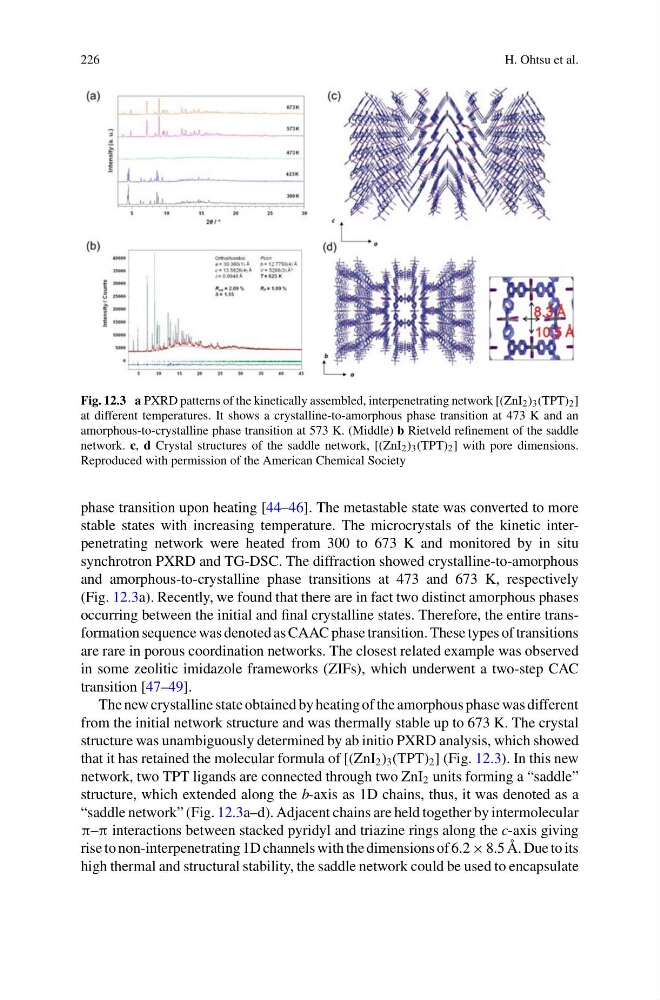
Fig. 12.3 a PXRD patterns of the kinetically assembled, interpenetrating network [(ZnI 2 ) 3 (TPT) 2 ]
at different temperatures. It shows a crystalline-to-amorphous phase transition at 473 K and an
amorphous-to-crystalline phase transition at 573 K. (Middle) b Rietveld refinement of the saddle
network. c, d Crystal structures of the saddle network, [(ZnI 2 ) 3 (TPT) 2 ] with pore dimensions.
Reproduced with permission of the American Chemical Society
phase transition upon heating [44–46]. The metastable state was converted to more
stable states with increasing temperature. The microcrystals of the kinetic interpenetrating network were heated from 300 to 673 K and monitored by in situ
synchrotron PXRD and TG-DSC. The diffraction showed crystalline-to-amorphous
and amorphous-to-crystalline phase transitions at 473 and 673 K, respectively
(Fig. 12.3a). Recently, we found that there are in fact two distinct amorphous phases
occurring between the initial and final crystalline states. Therefore, the entire transformation sequence was denoted as CAAC phase transition. These types of transitions
are rare in porous coordination networks. The closest related example was observed
in some zeolitic imidazole frameworks (ZIFs), which underwent a two-step CAC
transition [47–49].
The new crystalline state obtained by heating of the amorphous phase was different
from the initial network structure and was thermally stable up to 673 K. The crystal
structure was unambiguously determined by ab initio PXRD analysis, which showed
that it has retained the molecular formula of [(ZnI 2 ) 3 (TPT) 2 ] (Fig. 12.3). In this new
network, two TPT ligands are connected through two ZnI 2 units forming a “saddle”
structure, which extended along the b-axis as 1D chains, thus, it was denoted as a
“saddle network” (Fig. 12.3a–d). Adjacent chains are held together by intermolecular
π–π interactions between stacked pyridyl and triazine rings along the c-axis giving
rise to non-interpenetrating 1D channels with the dimensions of 6.2 × 8.5 Å. Due to its
high thermal and structural stability, the saddle network could be used to encapsulate
H. Ohtsu et al.
Fig. 12.3 a PXRD patterns of the kinetically assembled, interpenetrating network [(ZnI 2 ) 3 (TPT) 2 ]
at different temperatures. It shows a crystalline-to-amorphous phase transition at 473 K and an
amorphous-to-crystalline phase transition at 573 K. (Middle) b Rietveld refinement of the saddle
network. c, d Crystal structures of the saddle network, [(ZnI 2 ) 3 (TPT) 2 ] with pore dimensions.
Reproduced with permission of the American Chemical Society
phase transition upon heating [44–46]. The metastable state was converted to more
stable states with increasing temperature. The microcrystals of the kinetic interpenetrating network were heated from 300 to 673 K and monitored by in situ
synchrotron PXRD and TG-DSC. The diffraction showed crystalline-to-amorphous
and amorphous-to-crystalline phase transitions at 473 and 673 K, respectively
(Fig. 12.3a). Recently, we found that there are in fact two distinct amorphous phases
occurring between the initial and final crystalline states. Therefore, the entire transformation sequence was denoted as CAAC phase transition. These types of transitions
are rare in porous coordination networks. The closest related example was observed
in some zeolitic imidazole frameworks (ZIFs), which underwent a two-step CAC
transition [47–49].
The new crystalline state obtained by heating of the amorphous phase was different
from the initial network structure and was thermally stable up to 673 K. The crystal
structure was unambiguously determined by ab initio PXRD analysis, which showed
that it has retained the molecular formula of [(ZnI 2 ) 3 (TPT) 2 ] (Fig. 12.3). In this new
network, two TPT ligands are connected through two ZnI 2 units forming a “saddle”
structure, which extended along the b-axis as 1D chains, thus, it was denoted as a
“saddle network” (Fig. 12.3a–d). Adjacent chains are held together by intermolecular
π–π interactions between stacked pyridyl and triazine rings along the c-axis giving
rise to non-interpenetrating 1D channels with the dimensions of 6.2 × 8.5 Å. Due to its
high thermal and structural stability, the saddle network could be used to encapsulate