

12 Kinetic Assembly of Porous Coordination Networks …
225
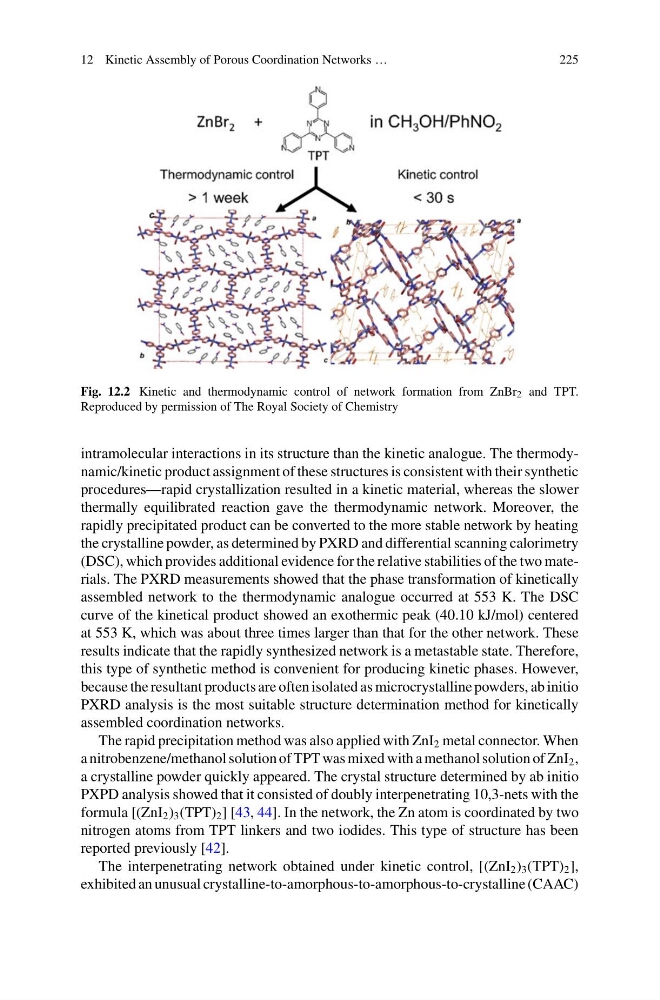
Fig. 12.2 Kinetic and thermodynamic control of network formation from ZnBr 2 and TPT.
Reproduced by permission of The Royal Society of Chemistry
intramolecular interactions in its structure than the kinetic analogue. The thermodynamic/kinetic product assignment of these structures is consistent with their synthetic
procedures—rapid crystallization resulted in a kinetic material, whereas the slower
thermally equilibrated reaction gave the thermodynamic network. Moreover, the
rapidly precipitated product can be converted to the more stable network by heating
the crystalline powder, as determined by PXRD and differential scanning calorimetry
(DSC), which provides additional evidence for the relative stabilities of the two materials. The PXRD measurements showed that the phase transformation of kinetically
assembled network to the thermodynamic analogue occurred at 553 K. The DSC
curve of the kinetical product showed an exothermic peak (40.10 kJ/mol) centered
at 553 K, which was about three times larger than that for the other network. These
results indicate that the rapidly synthesized network is a metastable state. Therefore,
this type of synthetic method is convenient for producing kinetic phases. However,
because the resultant products are often isolated as microcrystalline powders, ab initio
PXRD analysis is the most suitable structure determination method for kinetically
assembled coordination networks.
The rapid precipitation method was also applied with ZnI 2 metal connector. When
a nitrobenzene/methanol solution of TPT was mixed with a methanol solution of ZnI 2 ,
a crystalline powder quickly appeared. The crystal structure determined by ab initio
PXPD analysis showed that it consisted of doubly interpenetrating 10,3-nets with the
formula [(ZnI 2 ) 3 (TPT) 2 ] [43, 44]. In the network, the Zn atom is coordinated by two
nitrogen atoms from TPT linkers and two iodides. This type of structure has been
reported previously [42].
The interpenetrating network obtained under kinetic control, [(ZnI 2 ) 3 (TPT) 2 ],
exhibited an unusual crystalline-to-amorphous-to-amorphous-to-crystalline (CAAC)
225
Fig. 12.2 Kinetic and thermodynamic control of network formation from ZnBr 2 and TPT.
Reproduced by permission of The Royal Society of Chemistry
intramolecular interactions in its structure than the kinetic analogue. The thermodynamic/kinetic product assignment of these structures is consistent with their synthetic
procedures—rapid crystallization resulted in a kinetic material, whereas the slower
thermally equilibrated reaction gave the thermodynamic network. Moreover, the
rapidly precipitated product can be converted to the more stable network by heating
the crystalline powder, as determined by PXRD and differential scanning calorimetry
(DSC), which provides additional evidence for the relative stabilities of the two materials. The PXRD measurements showed that the phase transformation of kinetically
assembled network to the thermodynamic analogue occurred at 553 K. The DSC
curve of the kinetical product showed an exothermic peak (40.10 kJ/mol) centered
at 553 K, which was about three times larger than that for the other network. These
results indicate that the rapidly synthesized network is a metastable state. Therefore,
this type of synthetic method is convenient for producing kinetic phases. However,
because the resultant products are often isolated as microcrystalline powders, ab initio
PXRD analysis is the most suitable structure determination method for kinetically
assembled coordination networks.
The rapid precipitation method was also applied with ZnI 2 metal connector. When
a nitrobenzene/methanol solution of TPT was mixed with a methanol solution of ZnI 2 ,
a crystalline powder quickly appeared. The crystal structure determined by ab initio
PXPD analysis showed that it consisted of doubly interpenetrating 10,3-nets with the
formula [(ZnI 2 ) 3 (TPT) 2 ] [43, 44]. In the network, the Zn atom is coordinated by two
nitrogen atoms from TPT linkers and two iodides. This type of structure has been
reported previously [42].
The interpenetrating network obtained under kinetic control, [(ZnI 2 ) 3 (TPT) 2 ],
exhibited an unusual crystalline-to-amorphous-to-amorphous-to-crystalline (CAAC)