

224
H. Ohtsu et al.
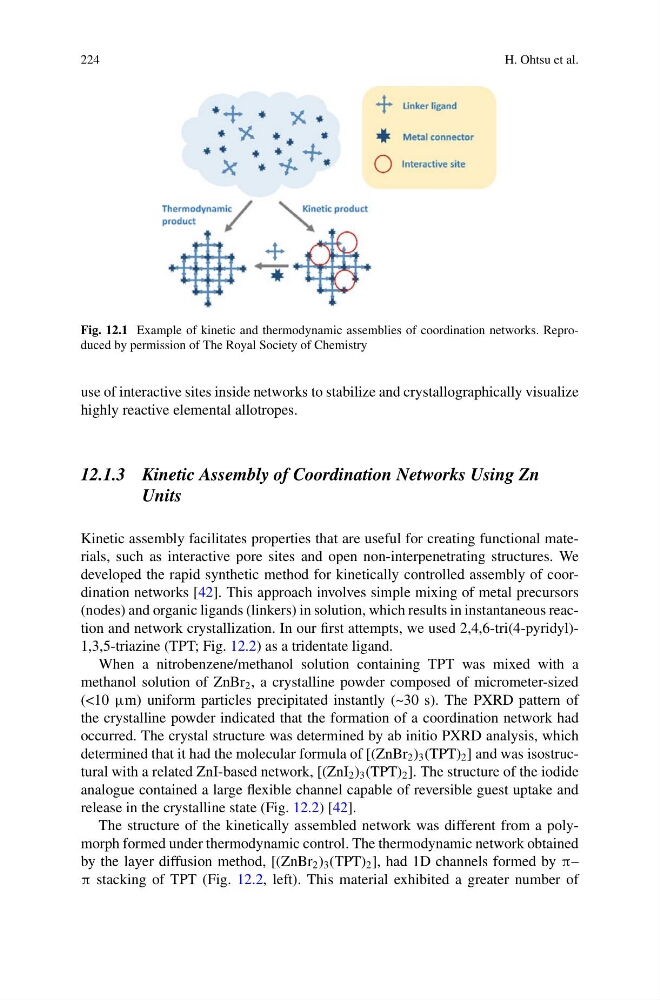
Fig. 12.1 Example of kinetic and thermodynamic assemblies of coordination networks. Reproduced by permission of The Royal Society of Chemistry
use of interactive sites inside networks to stabilize and crystallographically visualize
highly reactive elemental allotropes.
12.1.3 Kinetic Assembly of Coordination Networks Using Zn
Units
Kinetic assembly facilitates properties that are useful for creating functional materials, such as interactive pore sites and open non-interpenetrating structures. We
developed the rapid synthetic method for kinetically controlled assembly of coordination networks [42]. This approach involves simple mixing of metal precursors
(nodes) and organic ligands (linkers) in solution, which results in instantaneous reaction and network crystallization. In our first attempts, we used 2,4,6-tri(4-pyridyl)1,3,5-triazine (TPT; Fig. 12.2) as a tridentate ligand.
When a nitrobenzene/methanol solution containing TPT was mixed with a
methanol solution of ZnBr 2 , a crystalline powder composed of micrometer-sized
(<10 μm) uniform particles precipitated instantly (~30 s). The PXRD pattern of
the crystalline powder indicated that the formation of a coordination network had
occurred. The crystal structure was determined by ab initio PXRD analysis, which
determined that it had the molecular formula of [(ZnBr 2 ) 3 (TPT) 2 ] and was isostructural with a related ZnI-based network, [(ZnI 2 ) 3 (TPT) 2 ]. The structure of the iodide
analogue contained a large flexible channel capable of reversible guest uptake and
release in the crystalline state (Fig. 12.2) [42].
The structure of the kinetically assembled network was different from a polymorph formed under thermodynamic control. The thermodynamic network obtained
by the layer diffusion method, [(ZnBr 2 ) 3 (TPT) 2 ], had 1D channels formed by π–
π stacking of TPT (Fig. 12.2, left). This material exhibited a greater number of
H. Ohtsu et al.
Fig. 12.1 Example of kinetic and thermodynamic assemblies of coordination networks. Reproduced by permission of The Royal Society of Chemistry
use of interactive sites inside networks to stabilize and crystallographically visualize
highly reactive elemental allotropes.
12.1.3 Kinetic Assembly of Coordination Networks Using Zn
Units
Kinetic assembly facilitates properties that are useful for creating functional materials, such as interactive pore sites and open non-interpenetrating structures. We
developed the rapid synthetic method for kinetically controlled assembly of coordination networks [42]. This approach involves simple mixing of metal precursors
(nodes) and organic ligands (linkers) in solution, which results in instantaneous reaction and network crystallization. In our first attempts, we used 2,4,6-tri(4-pyridyl)1,3,5-triazine (TPT; Fig. 12.2) as a tridentate ligand.
When a nitrobenzene/methanol solution containing TPT was mixed with a
methanol solution of ZnBr 2 , a crystalline powder composed of micrometer-sized
(<10 μm) uniform particles precipitated instantly (~30 s). The PXRD pattern of
the crystalline powder indicated that the formation of a coordination network had
occurred. The crystal structure was determined by ab initio PXRD analysis, which
determined that it had the molecular formula of [(ZnBr 2 ) 3 (TPT) 2 ] and was isostructural with a related ZnI-based network, [(ZnI 2 ) 3 (TPT) 2 ]. The structure of the iodide
analogue contained a large flexible channel capable of reversible guest uptake and
release in the crystalline state (Fig. 12.2) [42].
The structure of the kinetically assembled network was different from a polymorph formed under thermodynamic control. The thermodynamic network obtained
by the layer diffusion method, [(ZnBr 2 ) 3 (TPT) 2 ], had 1D channels formed by π–
π stacking of TPT (Fig. 12.2, left). This material exhibited a greater number of