

12 Kinetic Assembly of Porous Coordination Networks …
233
12.1.6 Br 2 Encapuslation
To further investigate the trapping ability of the saddle network, we performed
bromine encapsulation to determine whether Br 2 can be safely stored inside [70].
During this investigation, it was found that instead of just simply encapsulating Br 2
through physisorption, the oxidation of coordinated iodide had occurred, producing
I 2 . Furthermore, this reaction caused the displacement of iodide by bromide in the
coordination sphere of Zn(II), giving rise to the ZnBr-based network containing I 2
as a guest:
(ZnI 2 ) 3 (TPT) 2
+ 3Br 2 →
(ZnBr 2 ) 3 (TPT) 2 (I 2 )
+ 2I 2
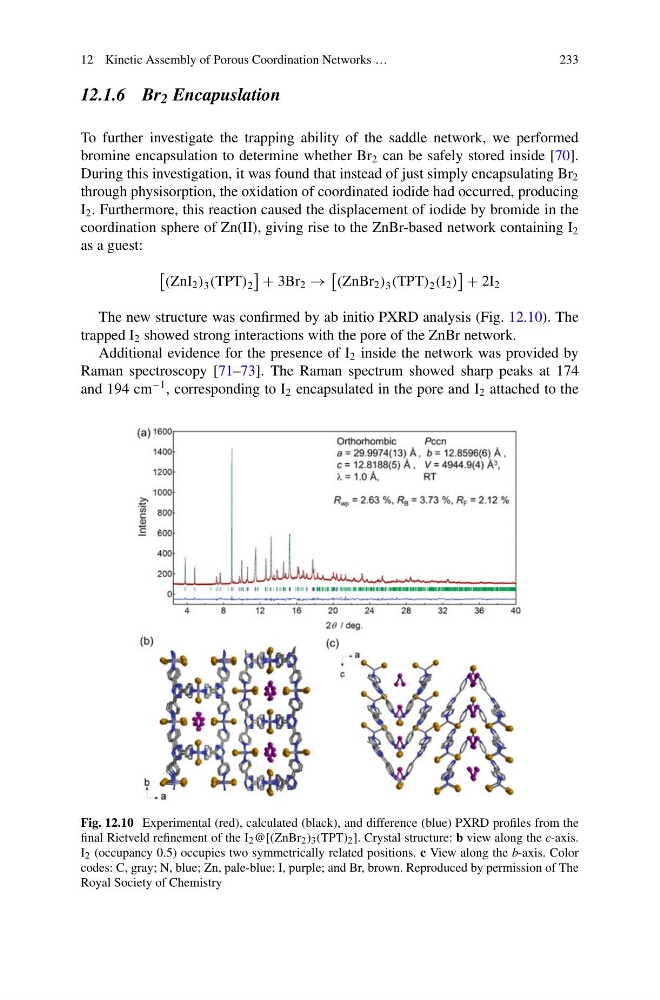
The new structure was confirmed by ab initio PXRD analysis (Fig. 12.10). The
trapped I 2 showed strong interactions with the pore of the ZnBr network.
Additional evidence for the presence of I 2 inside the network was provided by
Raman spectroscopy [71–73]. The Raman spectrum showed sharp peaks at 174
and 194 cm
−1 , corresponding to I 2 encapsulated in the pore and I 2 attached to the
Fig. 12.10 Experimental (red), calculated (black), and difference (blue) PXRD profiles from the
final Rietveld refinement of the I 2 @[(ZnBr 2 ) 3 (TPT) 2 ]. Crystal structure: b view along the c-axis.
I 2 (occupancy 0.5) occupies two symmetrically related positions. c View along the b-axis. Color
codes: C, gray; N, blue; Zn, pale-blue; I, purple; and Br, brown. Reproduced by permission of The
Royal Society of Chemistry
233
12.1.6 Br 2 Encapuslation
To further investigate the trapping ability of the saddle network, we performed
bromine encapsulation to determine whether Br 2 can be safely stored inside [70].
During this investigation, it was found that instead of just simply encapsulating Br 2
through physisorption, the oxidation of coordinated iodide had occurred, producing
I 2 . Furthermore, this reaction caused the displacement of iodide by bromide in the
coordination sphere of Zn(II), giving rise to the ZnBr-based network containing I 2
as a guest:
(ZnI 2 ) 3 (TPT) 2
+ 3Br 2 →
(ZnBr 2 ) 3 (TPT) 2 (I 2 )
+ 2I 2
The new structure was confirmed by ab initio PXRD analysis (Fig. 12.10). The
trapped I 2 showed strong interactions with the pore of the ZnBr network.
Additional evidence for the presence of I 2 inside the network was provided by
Raman spectroscopy [71–73]. The Raman spectrum showed sharp peaks at 174
and 194 cm
−1 , corresponding to I 2 encapsulated in the pore and I 2 attached to the
Fig. 12.10 Experimental (red), calculated (black), and difference (blue) PXRD profiles from the
final Rietveld refinement of the I 2 @[(ZnBr 2 ) 3 (TPT) 2 ]. Crystal structure: b view along the c-axis.
I 2 (occupancy 0.5) occupies two symmetrically related positions. c View along the b-axis. Color
codes: C, gray; N, blue; Zn, pale-blue; I, purple; and Br, brown. Reproduced by permission of The
Royal Society of Chemistry