

11 Layered Hydrogen-Bonded Organic …
215
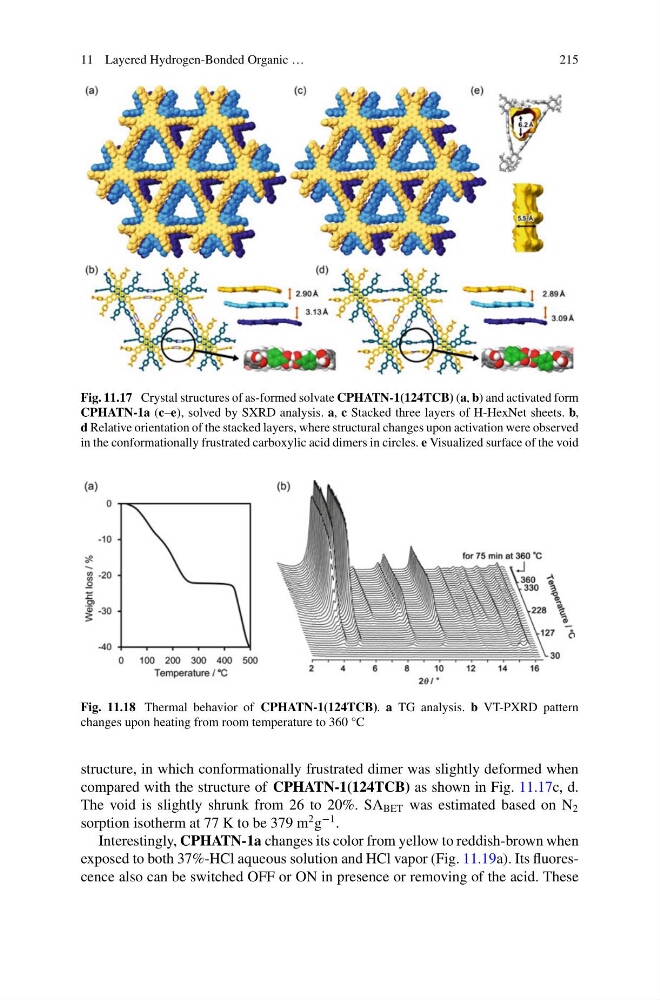
Fig. 11.17 Crystal structures of as-formed solvate CPHATN-1(124TCB) (a, b) and activated form
CPHATN-1a (c–e), solved by SXRD analysis. a, c Stacked three layers of H-HexNet sheets. b,
d Relative orientation of the stacked layers, where structural changes upon activation were observed
in the conformationally frustrated carboxylic acid dimers in circles. e Visualized surface of the void
Fig. 11.18 Thermal behavior of CPHATN-1(124TCB). a TG analysis. b VT-PXRD pattern
changes upon heating from room temperature to 360 °C
structure, in which conformationally frustrated dimer was slightly deformed when
compared with the structure of CPHATN-1(124TCB) as shown in Fig. 11.17c, d.
The void is slightly shrunk from 26 to 20%. SA BET was estimated based on N 2
sorption isotherm at 77 K to be 379 m
2 g
−1 .
Interestingly, CPHATN-1a changes its color from yellow to reddish-brown when
exposed to both 37%-HCl aqueous solution and HCl vapor (Fig. 11.19a). Its fluorescence also can be switched OFF or ON in presence or removing of the acid. These
215
Fig. 11.17 Crystal structures of as-formed solvate CPHATN-1(124TCB) (a, b) and activated form
CPHATN-1a (c–e), solved by SXRD analysis. a, c Stacked three layers of H-HexNet sheets. b,
d Relative orientation of the stacked layers, where structural changes upon activation were observed
in the conformationally frustrated carboxylic acid dimers in circles. e Visualized surface of the void
Fig. 11.18 Thermal behavior of CPHATN-1(124TCB). a TG analysis. b VT-PXRD pattern
changes upon heating from room temperature to 360 °C
structure, in which conformationally frustrated dimer was slightly deformed when
compared with the structure of CPHATN-1(124TCB) as shown in Fig. 11.17c, d.
The void is slightly shrunk from 26 to 20%. SA BET was estimated based on N 2
sorption isotherm at 77 K to be 379 m
2 g
−1 .
Interestingly, CPHATN-1a changes its color from yellow to reddish-brown when
exposed to both 37%-HCl aqueous solution and HCl vapor (Fig. 11.19a). Its fluorescence also can be switched OFF or ON in presence or removing of the acid. These