

216
I. Hisaki et al.
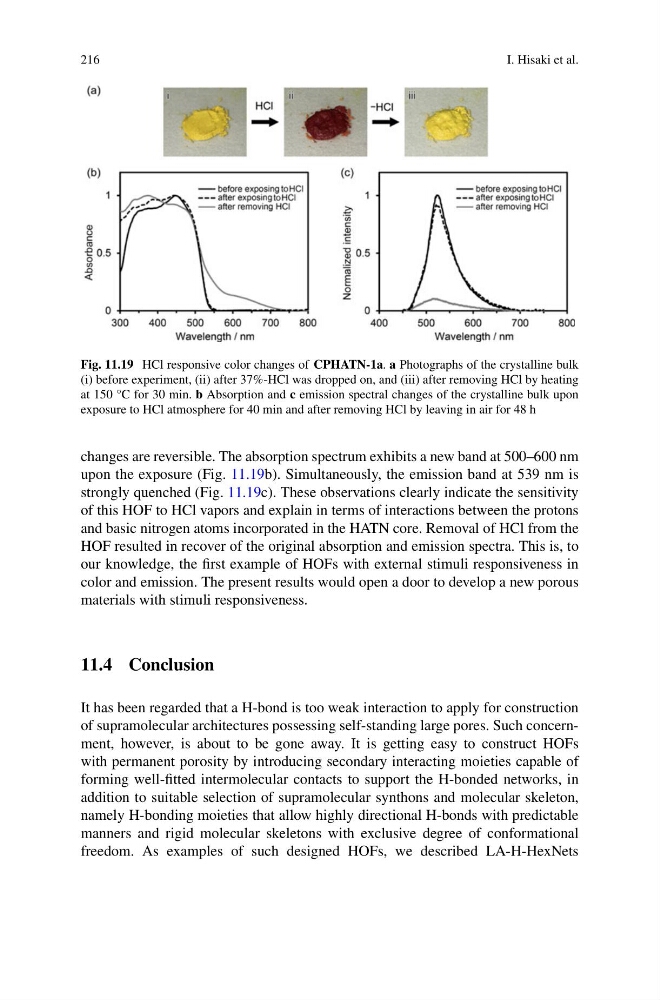
Fig. 11.19 HCl responsive color changes of CPHATN-1a. a Photographs of the crystalline bulk
(i) before experiment, (ii) after 37%-HCl was dropped on, and (iii) after removing HCl by heating
at 150 °C for 30 min. b Absorption and c emission spectral changes of the crystalline bulk upon
exposure to HCl atmosphere for 40 min and after removing HCl by leaving in air for 48 h
changes are reversible. The absorption spectrum exhibits a new band at 500–600 nm
upon the exposure (Fig. 11.19b). Simultaneously, the emission band at 539 nm is
strongly quenched (Fig. 11.19c). These observations clearly indicate the sensitivity
of this HOF to HCl vapors and explain in terms of interactions between the protons
and basic nitrogen atoms incorporated in the HATN core. Removal of HCl from the
HOF resulted in recover of the original absorption and emission spectra. This is, to
our knowledge, the first example of HOFs with external stimuli responsiveness in
color and emission. The present results would open a door to develop a new porous
materials with stimuli responsiveness.
11.4 Conclusion
It has been regarded that a H-bond is too weak interaction to apply for construction
of supramolecular architectures possessing self-standing large pores. Such concernment, however, is about to be gone away. It is getting easy to construct HOFs
with permanent porosity by introducing secondary interacting moieties capable of
forming well-fitted intermolecular contacts to support the H-bonded networks, in
addition to suitable selection of supramolecular synthons and molecular skeleton,
namely H-bonding moieties that allow highly directional H-bonds with predictable
manners and rigid molecular skeletons with exclusive degree of conformational
freedom. As examples of such designed HOFs, we described LA-H-HexNets
I. Hisaki et al.
Fig. 11.19 HCl responsive color changes of CPHATN-1a. a Photographs of the crystalline bulk
(i) before experiment, (ii) after 37%-HCl was dropped on, and (iii) after removing HCl by heating
at 150 °C for 30 min. b Absorption and c emission spectral changes of the crystalline bulk upon
exposure to HCl atmosphere for 40 min and after removing HCl by leaving in air for 48 h
changes are reversible. The absorption spectrum exhibits a new band at 500–600 nm
upon the exposure (Fig. 11.19b). Simultaneously, the emission band at 539 nm is
strongly quenched (Fig. 11.19c). These observations clearly indicate the sensitivity
of this HOF to HCl vapors and explain in terms of interactions between the protons
and basic nitrogen atoms incorporated in the HATN core. Removal of HCl from the
HOF resulted in recover of the original absorption and emission spectra. This is, to
our knowledge, the first example of HOFs with external stimuli responsiveness in
color and emission. The present results would open a door to develop a new porous
materials with stimuli responsiveness.
11.4 Conclusion
It has been regarded that a H-bond is too weak interaction to apply for construction
of supramolecular architectures possessing self-standing large pores. Such concernment, however, is about to be gone away. It is getting easy to construct HOFs
with permanent porosity by introducing secondary interacting moieties capable of
forming well-fitted intermolecular contacts to support the H-bonded networks, in
addition to suitable selection of supramolecular synthons and molecular skeleton,
namely H-bonding moieties that allow highly directional H-bonds with predictable
manners and rigid molecular skeletons with exclusive degree of conformational
freedom. As examples of such designed HOFs, we described LA-H-HexNets