

11 Layered Hydrogen-Bonded Organic …
213
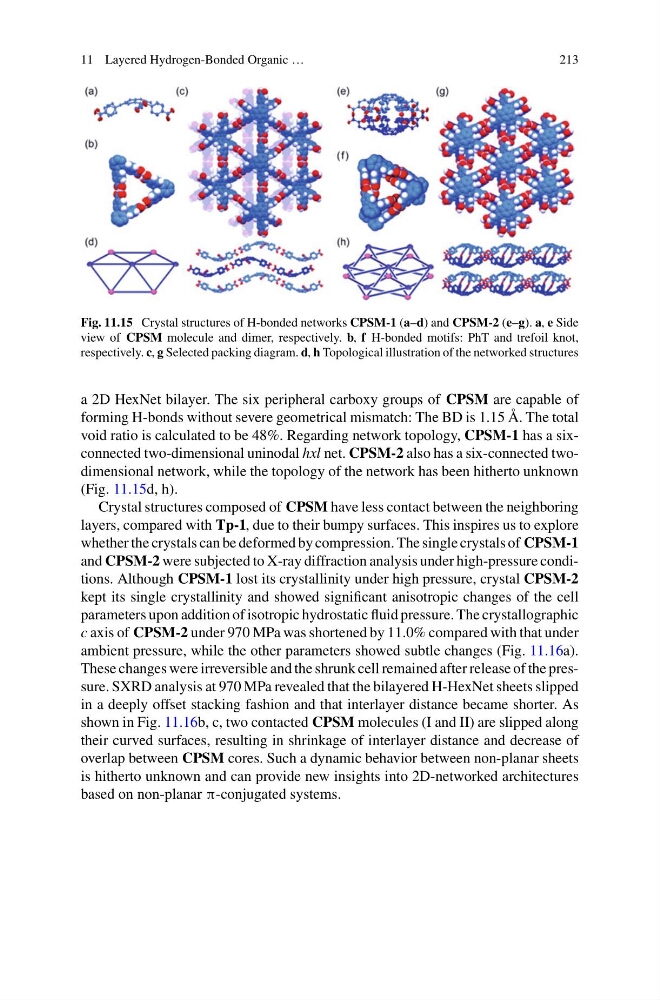
Fig. 11.15 Crystal structures of H-bonded networks CPSM-1 (a–d) and CPSM-2 (e–g). a, e Side
view of CPSM molecule and dimer, respectively. b, f H-bonded motifs: PhT and trefoil knot,
respectively. c, g Selected packing diagram. d, h Topological illustration of the networked structures
a 2D HexNet bilayer. The six peripheral carboxy groups of CPSM are capable of
forming H-bonds without severe geometrical mismatch: The BD is 1.15 Å. The total
void ratio is calculated to be 48%. Regarding network topology, CPSM-1 has a sixconnected two-dimensional uninodal hxl net. CPSM-2 also has a six-connected twodimensional network, while the topology of the network has been hitherto unknown
(Fig. 11.15d, h).
Crystal structures composed of CPSM have less contact between the neighboring
layers, compared with Tp-1, due to their bumpy surfaces. This inspires us to explore
whether the crystals can be deformed by compression. The single crystals of CPSM-1
and CPSM-2 were subjected to X-ray diffraction analysis under high-pressure conditions. Although CPSM-1 lost its crystallinity under high pressure, crystal CPSM-2
kept its single crystallinity and showed significant anisotropic changes of the cell
parameters upon addition of isotropic hydrostatic fluid pressure. The crystallographic
c axis of CPSM-2 under 970 MPa was shortened by 11.0% compared with that under
ambient pressure, while the other parameters showed subtle changes (Fig. 11.16a).
These changes were irreversible and the shrunk cell remained after release of the pressure. SXRD analysis at 970 MPa revealed that the bilayered H-HexNet sheets slipped
in a deeply offset stacking fashion and that interlayer distance became shorter. As
shown in Fig. 11.16b, c, two contacted CPSM molecules (I and II) are slipped along
their curved surfaces, resulting in shrinkage of interlayer distance and decrease of
overlap between CPSM cores. Such a dynamic behavior between non-planar sheets
is hitherto unknown and can provide new insights into 2D-networked architectures
based on non-planar π-conjugated systems.
213
Fig. 11.15 Crystal structures of H-bonded networks CPSM-1 (a–d) and CPSM-2 (e–g). a, e Side
view of CPSM molecule and dimer, respectively. b, f H-bonded motifs: PhT and trefoil knot,
respectively. c, g Selected packing diagram. d, h Topological illustration of the networked structures
a 2D HexNet bilayer. The six peripheral carboxy groups of CPSM are capable of
forming H-bonds without severe geometrical mismatch: The BD is 1.15 Å. The total
void ratio is calculated to be 48%. Regarding network topology, CPSM-1 has a sixconnected two-dimensional uninodal hxl net. CPSM-2 also has a six-connected twodimensional network, while the topology of the network has been hitherto unknown
(Fig. 11.15d, h).
Crystal structures composed of CPSM have less contact between the neighboring
layers, compared with Tp-1, due to their bumpy surfaces. This inspires us to explore
whether the crystals can be deformed by compression. The single crystals of CPSM-1
and CPSM-2 were subjected to X-ray diffraction analysis under high-pressure conditions. Although CPSM-1 lost its crystallinity under high pressure, crystal CPSM-2
kept its single crystallinity and showed significant anisotropic changes of the cell
parameters upon addition of isotropic hydrostatic fluid pressure. The crystallographic
c axis of CPSM-2 under 970 MPa was shortened by 11.0% compared with that under
ambient pressure, while the other parameters showed subtle changes (Fig. 11.16a).
These changes were irreversible and the shrunk cell remained after release of the pressure. SXRD analysis at 970 MPa revealed that the bilayered H-HexNet sheets slipped
in a deeply offset stacking fashion and that interlayer distance became shorter. As
shown in Fig. 11.16b, c, two contacted CPSM molecules (I and II) are slipped along
their curved surfaces, resulting in shrinkage of interlayer distance and decrease of
overlap between CPSM cores. Such a dynamic behavior between non-planar sheets
is hitherto unknown and can provide new insights into 2D-networked architectures
based on non-planar π-conjugated systems.