

212
I. Hisaki et al.
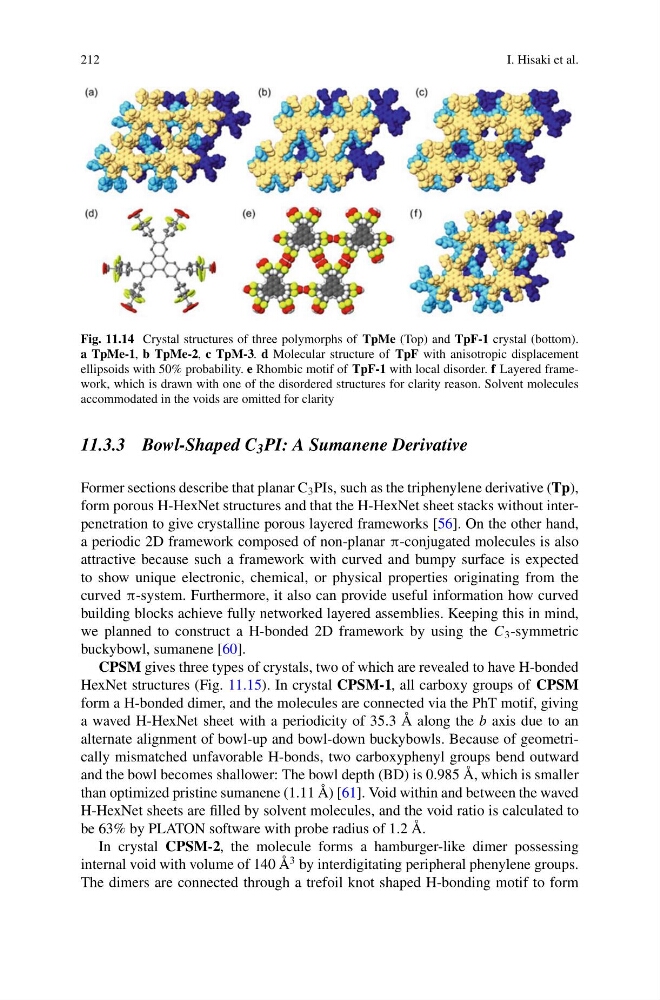
Fig. 11.14 Crystal structures of three polymorphs of TpMe (Top) and TpF-1 crystal (bottom).
a TpMe-1, b TpMe-2, c TpM-3. d Molecular structure of TpF with anisotropic displacement
ellipsoids with 50% probability. e Rhombic motif of TpF-1 with local disorder. f Layered framework, which is drawn with one of the disordered structures for clarity reason. Solvent molecules
accommodated in the voids are omitted for clarity
11.3.3 Bowl-Shaped C 3 PI: A Sumanene Derivative
Former sections describe that planar C 3 PIs, such as the triphenylene derivative (Tp),
form porous H-HexNet structures and that the H-HexNet sheet stacks without interpenetration to give crystalline porous layered frameworks [56]. On the other hand,
a periodic 2D framework composed of non-planar π-conjugated molecules is also
attractive because such a framework with curved and bumpy surface is expected
to show unique electronic, chemical, or physical properties originating from the
curved π-system. Furthermore, it also can provide useful information how curved
building blocks achieve fully networked layered assemblies. Keeping this in mind,
we planned to construct a H-bonded 2D framework by using the C 3 -symmetric
buckybowl, sumanene [60].
CPSM gives three types of crystals, two of which are revealed to have H-bonded
HexNet structures (Fig. 11.15). In crystal CPSM-1, all carboxy groups of CPSM
form a H-bonded dimer, and the molecules are connected via the PhT motif, giving
a waved H-HexNet sheet with a periodicity of 35.3 Å along the b axis due to an
alternate alignment of bowl-up and bowl-down buckybowls. Because of geometrically mismatched unfavorable H-bonds, two carboxyphenyl groups bend outward
and the bowl becomes shallower: The bowl depth (BD) is 0.985 Å, which is smaller
than optimized pristine sumanene (1.11 Å) [61]. Void within and between the waved
H-HexNet sheets are filled by solvent molecules, and the void ratio is calculated to
be 63% by PLATON software with probe radius of 1.2 Å.
In crystal CPSM-2, the molecule forms a hamburger-like dimer possessing
internal void with volume of 140 Å
3 by interdigitating peripheral phenylene groups.
The dimers are connected through a trefoil knot shaped H-bonding motif to form
I. Hisaki et al.
Fig. 11.14 Crystal structures of three polymorphs of TpMe (Top) and TpF-1 crystal (bottom).
a TpMe-1, b TpMe-2, c TpM-3. d Molecular structure of TpF with anisotropic displacement
ellipsoids with 50% probability. e Rhombic motif of TpF-1 with local disorder. f Layered framework, which is drawn with one of the disordered structures for clarity reason. Solvent molecules
accommodated in the voids are omitted for clarity
11.3.3 Bowl-Shaped C 3 PI: A Sumanene Derivative
Former sections describe that planar C 3 PIs, such as the triphenylene derivative (Tp),
form porous H-HexNet structures and that the H-HexNet sheet stacks without interpenetration to give crystalline porous layered frameworks [56]. On the other hand,
a periodic 2D framework composed of non-planar π-conjugated molecules is also
attractive because such a framework with curved and bumpy surface is expected
to show unique electronic, chemical, or physical properties originating from the
curved π-system. Furthermore, it also can provide useful information how curved
building blocks achieve fully networked layered assemblies. Keeping this in mind,
we planned to construct a H-bonded 2D framework by using the C 3 -symmetric
buckybowl, sumanene [60].
CPSM gives three types of crystals, two of which are revealed to have H-bonded
HexNet structures (Fig. 11.15). In crystal CPSM-1, all carboxy groups of CPSM
form a H-bonded dimer, and the molecules are connected via the PhT motif, giving
a waved H-HexNet sheet with a periodicity of 35.3 Å along the b axis due to an
alternate alignment of bowl-up and bowl-down buckybowls. Because of geometrically mismatched unfavorable H-bonds, two carboxyphenyl groups bend outward
and the bowl becomes shallower: The bowl depth (BD) is 0.985 Å, which is smaller
than optimized pristine sumanene (1.11 Å) [61]. Void within and between the waved
H-HexNet sheets are filled by solvent molecules, and the void ratio is calculated to
be 63% by PLATON software with probe radius of 1.2 Å.
In crystal CPSM-2, the molecule forms a hamburger-like dimer possessing
internal void with volume of 140 Å
3 by interdigitating peripheral phenylene groups.
The dimers are connected through a trefoil knot shaped H-bonding motif to form