

11 Layered Hydrogen-Bonded Organic …
211
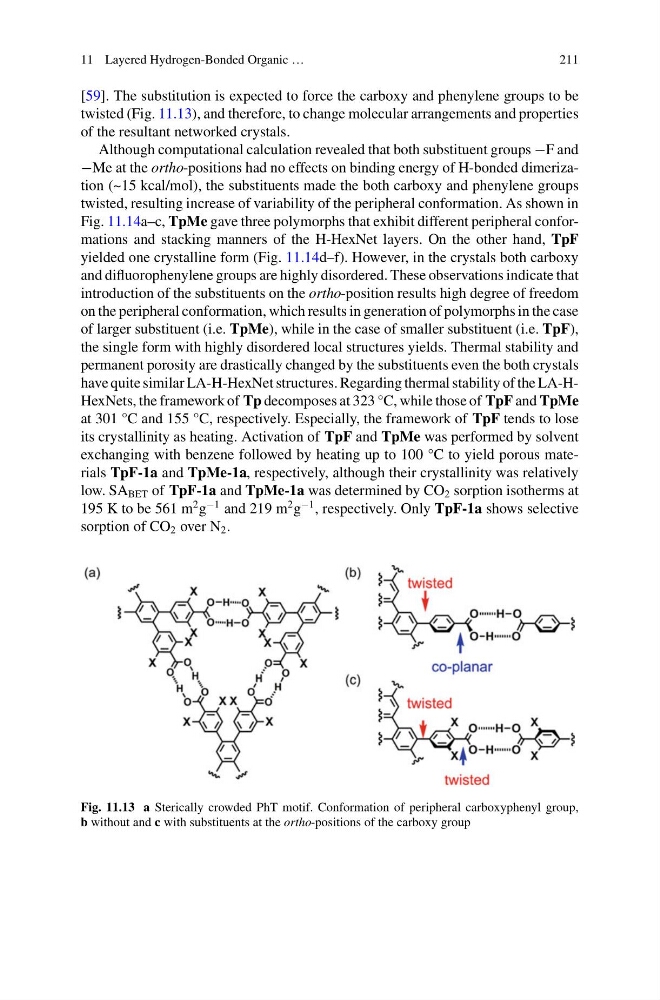
[59]. The substitution is expected to force the carboxy and phenylene groups to be
twisted (Fig. 11.13), and therefore, to change molecular arrangements and properties
of the resultant networked crystals.
Although computational calculation revealed that both substituent groups −F and
−Me at the ortho-positions had no effects on binding energy of H-bonded dimerization (~15 kcal/mol), the substituents made the both carboxy and phenylene groups
twisted, resulting increase of variability of the peripheral conformation. As shown in
Fig. 11.14a–c, TpMe gave three polymorphs that exhibit different peripheral conformations and stacking manners of the H-HexNet layers. On the other hand, TpF
yielded one crystalline form (Fig. 11.14d–f). However, in the crystals both carboxy
and difluorophenylene groups are highly disordered. These observations indicate that
introduction of the substituents on the ortho-position results high degree of freedom
on the peripheral conformation, which results in generation of polymorphs in the case
of larger substituent (i.e. TpMe), while in the case of smaller substituent (i.e. TpF),
the single form with highly disordered local structures yields. Thermal stability and
permanent porosity are drastically changed by the substituents even the both crystals
have quite similar LA-H-HexNet structures. Regarding thermal stability of the LA-HHexNets, the framework of Tp decomposes at 323 °C, while those of TpF and TpMe
at 301 °C and 155 °C, respectively. Especially, the framework of TpF tends to lose
its crystallinity as heating. Activation of TpF and TpMe was performed by solvent
exchanging with benzene followed by heating up to 100 °C to yield porous materials TpF-1a and TpMe-1a, respectively, although their crystallinity was relatively
low. SA BET of TpF-1a and TpMe-1a was determined by CO 2 sorption isotherms at
195 K to be 561 m
2 g
−1 and 219 m
2 g
−1 , respectively. Only TpF-1a shows selective
sorption of CO 2 over N 2 .
Fig. 11.13 a Sterically crowded PhT motif. Conformation of peripheral carboxyphenyl group,
b without and c with substituents at the ortho-positions of the carboxy group
211
[59]. The substitution is expected to force the carboxy and phenylene groups to be
twisted (Fig. 11.13), and therefore, to change molecular arrangements and properties
of the resultant networked crystals.
Although computational calculation revealed that both substituent groups −F and
−Me at the ortho-positions had no effects on binding energy of H-bonded dimerization (~15 kcal/mol), the substituents made the both carboxy and phenylene groups
twisted, resulting increase of variability of the peripheral conformation. As shown in
Fig. 11.14a–c, TpMe gave three polymorphs that exhibit different peripheral conformations and stacking manners of the H-HexNet layers. On the other hand, TpF
yielded one crystalline form (Fig. 11.14d–f). However, in the crystals both carboxy
and difluorophenylene groups are highly disordered. These observations indicate that
introduction of the substituents on the ortho-position results high degree of freedom
on the peripheral conformation, which results in generation of polymorphs in the case
of larger substituent (i.e. TpMe), while in the case of smaller substituent (i.e. TpF),
the single form with highly disordered local structures yields. Thermal stability and
permanent porosity are drastically changed by the substituents even the both crystals
have quite similar LA-H-HexNet structures. Regarding thermal stability of the LA-HHexNets, the framework of Tp decomposes at 323 °C, while those of TpF and TpMe
at 301 °C and 155 °C, respectively. Especially, the framework of TpF tends to lose
its crystallinity as heating. Activation of TpF and TpMe was performed by solvent
exchanging with benzene followed by heating up to 100 °C to yield porous materials TpF-1a and TpMe-1a, respectively, although their crystallinity was relatively
low. SA BET of TpF-1a and TpMe-1a was determined by CO 2 sorption isotherms at
195 K to be 561 m
2 g
−1 and 219 m
2 g
−1 , respectively. Only TpF-1a shows selective
sorption of CO 2 over N 2 .
Fig. 11.13 a Sterically crowded PhT motif. Conformation of peripheral carboxyphenyl group,
b without and c with substituents at the ortho-positions of the carboxy group