

210
I. Hisaki et al.
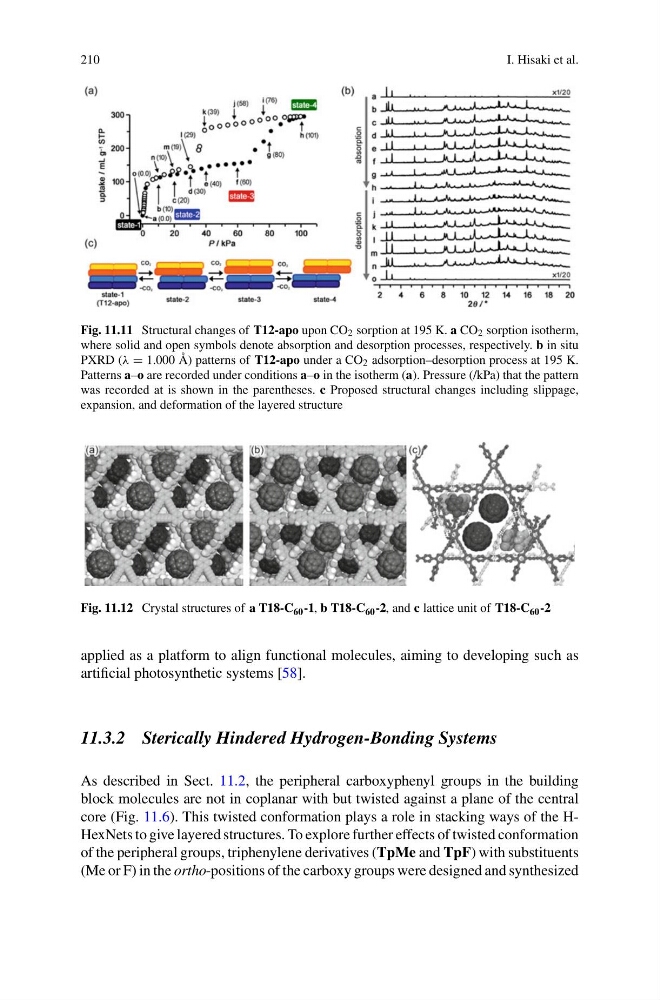
Fig. 11.11 Structural changes of T12-apo upon CO 2 sorption at 195 K. a CO 2 sorption isotherm,
where solid and open symbols denote absorption and desorption processes, respectively. b in situ
PXRD (λ = 1.000 Å) patterns of T12-apo under a CO 2 adsorption–desorption process at 195 K.
Patterns a–o are recorded under conditions a–o in the isotherm (a). Pressure (/kPa) that the pattern
was recorded at is shown in the parentheses. c Proposed structural changes including slippage,
expansion, and deformation of the layered structure
Fig. 11.12 Crystal structures of a T18-C 60 -1, b T18-C 60 -2, and c lattice unit of T18-C 60 -2
applied as a platform to align functional molecules, aiming to developing such as
artificial photosynthetic systems [58].
11.3.2 Sterically Hindered Hydrogen-Bonding Systems
As described in Sect. 11.2, the peripheral carboxyphenyl groups in the building
block molecules are not in coplanar with but twisted against a plane of the central
core (Fig. 11.6). This twisted conformation plays a role in stacking ways of the HHexNets to give layered structures. To explore further effects of twisted conformation
of the peripheral groups, triphenylene derivatives (TpMe and TpF) with substituents
(Me or F) in the ortho-positions of the carboxy groups were designed and synthesized
I. Hisaki et al.
Fig. 11.11 Structural changes of T12-apo upon CO 2 sorption at 195 K. a CO 2 sorption isotherm,
where solid and open symbols denote absorption and desorption processes, respectively. b in situ
PXRD (λ = 1.000 Å) patterns of T12-apo under a CO 2 adsorption–desorption process at 195 K.
Patterns a–o are recorded under conditions a–o in the isotherm (a). Pressure (/kPa) that the pattern
was recorded at is shown in the parentheses. c Proposed structural changes including slippage,
expansion, and deformation of the layered structure
Fig. 11.12 Crystal structures of a T18-C 60 -1, b T18-C 60 -2, and c lattice unit of T18-C 60 -2
applied as a platform to align functional molecules, aiming to developing such as
artificial photosynthetic systems [58].
11.3.2 Sterically Hindered Hydrogen-Bonding Systems
As described in Sect. 11.2, the peripheral carboxyphenyl groups in the building
block molecules are not in coplanar with but twisted against a plane of the central
core (Fig. 11.6). This twisted conformation plays a role in stacking ways of the HHexNets to give layered structures. To explore further effects of twisted conformation
of the peripheral groups, triphenylene derivatives (TpMe and TpF) with substituents
(Me or F) in the ortho-positions of the carboxy groups were designed and synthesized