

11 Layered Hydrogen-Bonded Organic …
209
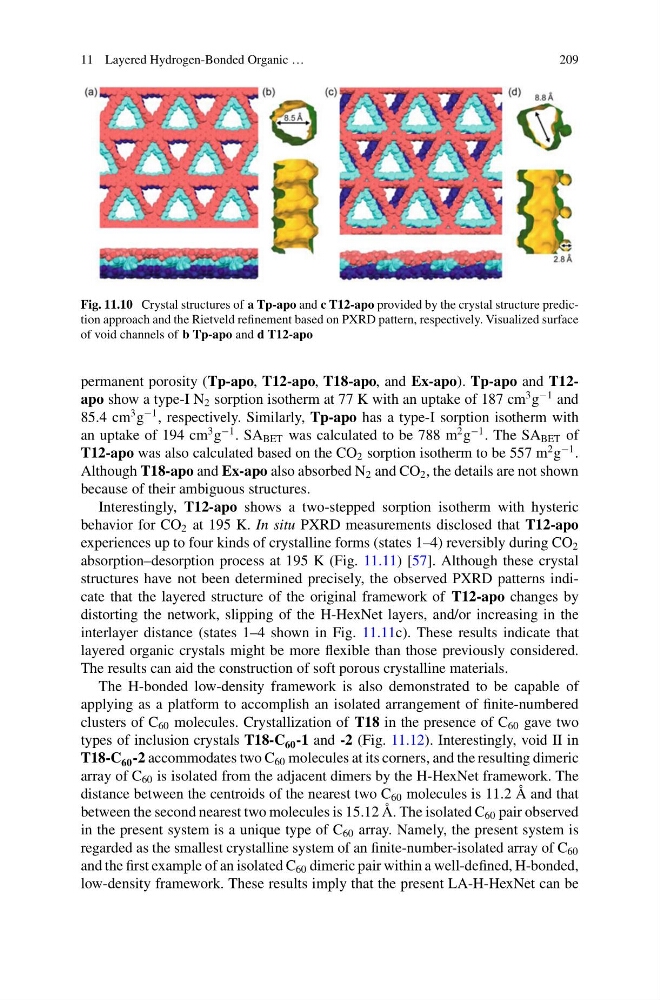
Fig. 11.10 Crystal structures of a Tp-apo and c T12-apo provided by the crystal structure prediction approach and the Rietveld refinement based on PXRD pattern, respectively. Visualized surface
of void channels of b Tp-apo and d T12-apo
permanent porosity (Tp-apo, T12-apo, T18-apo, and Ex-apo). Tp-apo and T12apo show a type-I N 2 sorption isotherm at 77 K with an uptake of 187 cm
3 g
−1 and
85.4 cm
3 g
−1 , respectively. Similarly, Tp-apo has a type-I sorption isotherm with
an uptake of 194 cm
3 g
−1 . SA BET was calculated to be 788 m
2 g
−1 . The SA BET of
T12-apo was also calculated based on the CO 2 sorption isotherm to be 557 m
2 g
−1 .
Although T18-apo and Ex-apo also absorbed N 2 and CO 2 , the details are not shown
because of their ambiguous structures.
Interestingly, T12-apo shows a two-stepped sorption isotherm with hysteric
behavior for CO 2 at 195 K. In situ PXRD measurements disclosed that T12-apo
experiences up to four kinds of crystalline forms (states 1–4) reversibly during CO 2
absorption–desorption process at 195 K (Fig. 11.11) [57]. Although these crystal
structures have not been determined precisely, the observed PXRD patterns indicate that the layered structure of the original framework of T12-apo changes by
distorting the network, slipping of the H-HexNet layers, and/or increasing in the
interlayer distance (states 1–4 shown in Fig. 11.11c). These results indicate that
layered organic crystals might be more flexible than those previously considered.
The results can aid the construction of soft porous crystalline materials.
The H-bonded low-density framework is also demonstrated to be capable of
applying as a platform to accomplish an isolated arrangement of finite-numbered
clusters of C 60 molecules. Crystallization of T18 in the presence of C 60 gave two
types of inclusion crystals T18-C 60 -1 and -2 (Fig. 11.12). Interestingly, void II in
T18-C 60 -2 accommodates two C 60 molecules at its corners, and the resulting dimeric
array of C 60 is isolated from the adjacent dimers by the H-HexNet framework. The
distance between the centroids of the nearest two C 60 molecules is 11.2 Å and that
between the second nearest two molecules is 15.12 Å. The isolated C 60 pair observed
in the present system is a unique type of C 60 array. Namely, the present system is
regarded as the smallest crystalline system of an finite-number-isolated array of C 60
and the first example of an isolated C 60 dimeric pair within a well-defined, H-bonded,
low-density framework. These results imply that the present LA-H-HexNet can be
209
Fig. 11.10 Crystal structures of a Tp-apo and c T12-apo provided by the crystal structure prediction approach and the Rietveld refinement based on PXRD pattern, respectively. Visualized surface
of void channels of b Tp-apo and d T12-apo
permanent porosity (Tp-apo, T12-apo, T18-apo, and Ex-apo). Tp-apo and T12apo show a type-I N 2 sorption isotherm at 77 K with an uptake of 187 cm
3 g
−1 and
85.4 cm
3 g
−1 , respectively. Similarly, Tp-apo has a type-I sorption isotherm with
an uptake of 194 cm
3 g
−1 . SA BET was calculated to be 788 m
2 g
−1 . The SA BET of
T12-apo was also calculated based on the CO 2 sorption isotherm to be 557 m
2 g
−1 .
Although T18-apo and Ex-apo also absorbed N 2 and CO 2 , the details are not shown
because of their ambiguous structures.
Interestingly, T12-apo shows a two-stepped sorption isotherm with hysteric
behavior for CO 2 at 195 K. In situ PXRD measurements disclosed that T12-apo
experiences up to four kinds of crystalline forms (states 1–4) reversibly during CO 2
absorption–desorption process at 195 K (Fig. 11.11) [57]. Although these crystal
structures have not been determined precisely, the observed PXRD patterns indicate that the layered structure of the original framework of T12-apo changes by
distorting the network, slipping of the H-HexNet layers, and/or increasing in the
interlayer distance (states 1–4 shown in Fig. 11.11c). These results indicate that
layered organic crystals might be more flexible than those previously considered.
The results can aid the construction of soft porous crystalline materials.
The H-bonded low-density framework is also demonstrated to be capable of
applying as a platform to accomplish an isolated arrangement of finite-numbered
clusters of C 60 molecules. Crystallization of T18 in the presence of C 60 gave two
types of inclusion crystals T18-C 60 -1 and -2 (Fig. 11.12). Interestingly, void II in
T18-C 60 -2 accommodates two C 60 molecules at its corners, and the resulting dimeric
array of C 60 is isolated from the adjacent dimers by the H-HexNet framework. The
distance between the centroids of the nearest two C 60 molecules is 11.2 Å and that
between the second nearest two molecules is 15.12 Å. The isolated C 60 pair observed
in the present system is a unique type of C 60 array. Namely, the present system is
regarded as the smallest crystalline system of an finite-number-isolated array of C 60
and the first example of an isolated C 60 dimeric pair within a well-defined, H-bonded,
low-density framework. These results imply that the present LA-H-HexNet can be